Career Changers: 3-6 Job Ad Skills to Build an ATS Ready Skills Based Resume

If you're switching careers, just graduated or explaining a gap in employment, a skills-based CV is the format that gives you the fairest hearing. The immediate task is straightforward: pick a few competencies from the job advert, back each with evidence, then let a short chronological history sit underneath for reassurance. What follows is the exact method, a copy-ready template and two role-specific examples.
TL;DR:
- Skills-based CVs are ideal for career changers, graduates, and those with employment gaps, as they prioritize competencies over chronological work history.
- The hybrid format, combining skills with a brief chronological list, generally works better for ATS software and recruiters, offering a balanced view of reliability and relevance.
- Extract 8 to 10 relevant skills directly from the job advert, using exact phrasing, and prove each with one to four quantifiable, outcome-focused bullets.
- Keep the CV concise within one to two pages, structured with clear sections: profile, skills, employment history, and education, using standard formatting for ATS-friendliness.
- Avoid vague claims, hidden timelines, excessive skills headings, and non-standard formatting that can break data parsing or reduce application credibility.
Table of Contents
- What is a skills-based CV?
- When should you use a skills-based CV?
- How do you choose your core competencies from a job advert?
- How do you write evidence bullets for each skill?
- Where does the rest of the CV go?
- How do you keep a skills-based CV ATS-friendly?
- Copy-ready skills-based CV template and two examples
- What mistakes should you avoid before sending it?
- Why the skills-first method works, and where it still needs help
- Sources
- FAQ
What is a skills-based CV?
A skills-based CV, sometimes called a functional CV, groups your capabilities under competency headings instead of listing jobs in date order. It suits career changers, recent graduates and applicants with employment gaps, because it lets you lead with what you can do rather than where you've done it. The format has two main variants, and the difference matters more than most guides admit.
A pure functional CV drops the timeline almost entirely, grouping everything under skill headings with no dates attached. A hybrid CV keeps the skills section up front but adds a compact chronological employment history underneath. In practice, hybrid formats tend to work better because recruiters and applicant tracking systems both expect to see some sense of career progression.
That expectation shapes how you should think about the format:
- ATS software scans for structured sections and dates. A CV with no timeline at all can look incomplete to the parser, not just to a human reader.
- Recruiters read fast. A skills section tells them you're relevant; a short employment line tells them you're credible.
- Career changers benefit most, because the skills section reframes unrelated job titles around transferable ability rather than sector experience.
Treat "skills-based" and "functional" as the same idea. The safer version, in nearly every case, is the hybrid.
When should you use a skills-based CV?
The format isn't universal, and knowing when to switch away from it matters as much as knowing how to build it.
- Career change: your most relevant experience sits in transferable skills rather than a matching job title, so a skills section lets you lead with ability instead of a confusing employment history.
- Recent graduate: you have limited paid work experience but plenty of evidence from placements, projects, societies or coursework that a skills format can showcase without exposing thin employment dates.
- Employment gap: a skills-first layout reduces how prominent the gap looks, though you should still list dates and be ready to explain the gap at interview.
- Stable, linear career progression: here, chronological usually wins. If your last three job titles show a clean upward path in the same field, a timeline sells that story better than a skills list ever could.
- Mixed situation: most readers fall somewhere between these extremes, which is exactly why a hybrid format, skills first, then a brief timeline, is the sensible default rather than a compromise you settle for.
How do you choose your core competencies from a job advert?
Start with the job description itself, not a generic skills list from memory. Read it twice: once for overall shape, once with a highlighter (digital or literal) for repeated terms.
Look specifically for:
- Words or phrases that appear more than once, which usually signal what the employer cares about most.
- The difference between "essential" and "desirable" requirements, often split into two separate lists in the advert.
- Section headings like "responsibilities" versus "requirements", since responsibilities hint at day-to-day skills and requirements hint at qualifying criteria.
- A mix of hard skills (technical, measurable, e.g. "financial modelling", "Python") and soft skills (behavioural, e.g. "stakeholder management", "problem solving").
Once you've extracted 8 to 10 candidate skills, cut them down. Career-service guidance consistently recommends a few competency headings, each strong enough to carry its own evidence. Order them by relevance to the advert, not by your personal preference, and put the skill mentioned earliest or most often in the job description first.
Pro Tip: Mirror the advert's exact phrasing where it's natural. If the posting says "project coordination" rather than "project management", use their term. This is semantic matching in practice, not keyword stuffing, and it helps both ATS software and a skimming recruiter see the fit immediately.
How do you write evidence bullets for each skill?
A competency heading with no proof underneath is just a claim, and claims don't survive scrutiny. The fix is the STAR method: Situation, Task, Action, Result. A brief example: "Managed a five-person volunteer team (Situation) tasked with reorganising a food bank's stock system (Task).
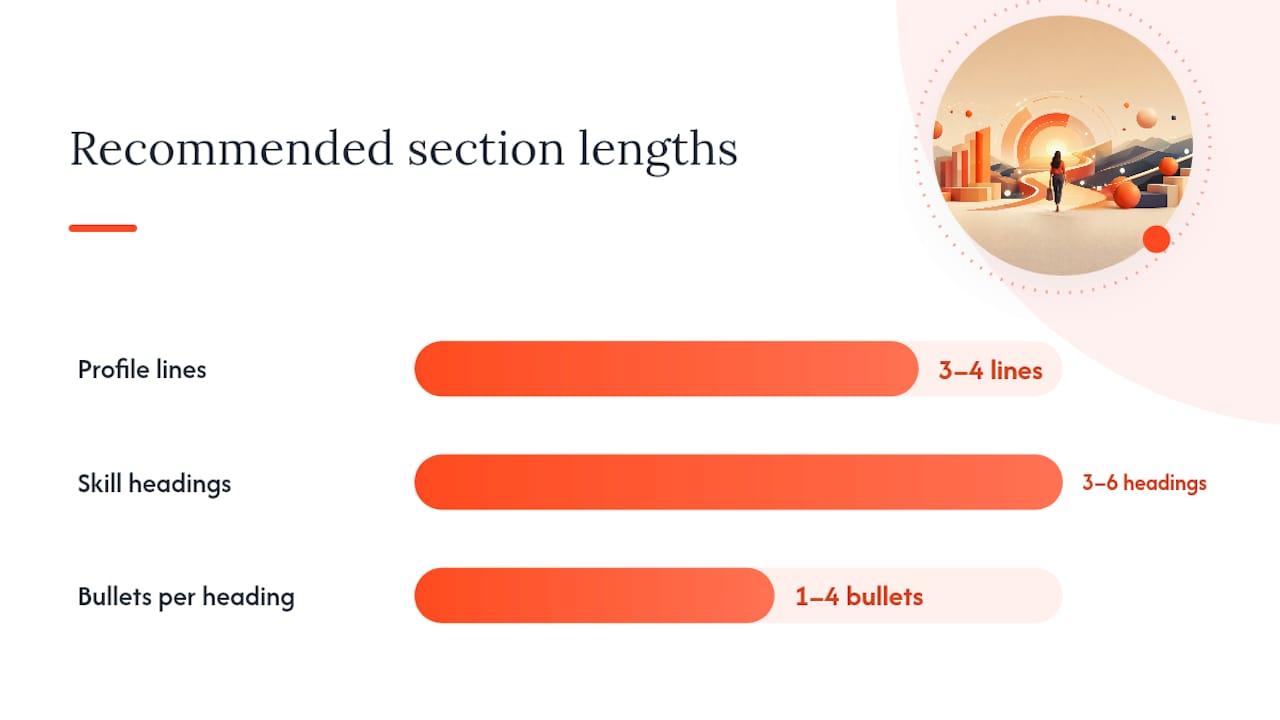
Each competency should carry one to four bullets, pulled from wherever the evidence actually lives, paid work, volunteering, side projects, coursework or placements.
- Start with a strong verb. "Led", "built", "reduced", "negotiated" all do more work than "responsible for".
- Add just enough context so the achievement makes sense without a full backstory.
- Quantify wherever you can. Numbers, percentages, timeframes and team sizes all make a claim verifiable rather than aspirational.
- Keep it to one or two lines. If a bullet needs three sentences, it's probably two bullets.
This matters more for soft skills than hard ones. Recruiter guidance is consistent on this point: soft skills need pairing with concrete outcomes to be believed at all. "Excellent communicator" on its own is filler. "Presented quarterly results to a 40-person department, simplifying technical data for a non-specialist audience" is evidence.
Keep the language ATS-aware as you write. If the advert used "customer service", don't switch to "client relations" purely for variety, since a parser matches literal terms far more reliably than a human reader infers synonyms.
Where does the rest of the CV go?
Your skills section is the centrepiece, but it needs the right scaffolding around it to read as a complete, credible document.
- Profile or personal statement: three to four lines at the very top, summarising your target role and your strongest one or two competencies. Keep it specific to the job, not generic.
- Skills section: follows immediately after the profile, since this is what you want read first.
- Employment history: a short, dated list beneath the skills section. List employer, job title and dates only, no fresh bullet points here, since the evidence has already been given above.
- Education and extras: qualifications, relevant training, languages and any certifications sit last, unless a specific certification is essential to the role, in which case pull it higher.
On format: keep the whole document to one page if you have under five years of experience, two at most otherwise. Use a standard, readable font (Arial, Calibri or similar) and save as a PDF unless the application system specifically requests a Word document. Name the file clearly, "FirstName_LastName_CV.pdf" is safer than "CV_final_v3.pdf" for a recruiter opening dozens of attachments.
How do you keep a skills-based CV ATS-friendly?
A skills-first layout is only useful if a parser can actually read it, and this is where well-intentioned formatting choices quietly sabotage applications. Applicant tracking systems scan for structure and specific text, not visual design.
- Use conventional section headings: "Skills", "Employment History", "Education", not creative alternatives that a parser won't recognise.
- Repeat the advert's own keywords naturally, both within your skills bullets and inside your short employment entries, so the same terms appear in more than one place.
- Avoid text boxes, tables for layout, columns, graphics or icons standing in for headings. These frequently break parsing entirely, turning a strong CV into a blank submission.
- Stick to standard bullet points and a single-column layout rather than a two-column design, however tidy it looks on screen.
Pro Tip: Save your CV as a PDF for human readers, but if a job portal specifically requests a Word document, use that instead. Some older ATS platforms parse .docx more reliably than PDF.
Appliqu's guide to ATS-friendly CVs goes further into formatting choices that trip up specific parser types, worth a look once your draft is otherwise finished.
Copy-ready skills-based CV template and two examples
Here's a one-page structure you can populate directly, followed by two short samples showing how it looks in practice.
Template order:
- Name, contact details, location
- Profile (3 to 4 lines, role-specific)
- Skills section (3 to 6 headings, 1 to 4 bullets each)
- Employment history (employer, title, dates only)
- Education and extras
| Element | Recent graduate example | Career changer example |
|---|---|---|
| Target role | Digital marketing assistant | Project coordinator |
| Skill heading 1 | Social media management | Cross-team coordination |
| Evidence bullet | Grew a university society's Instagram following significantly over one term through a weekly content calendar | Coordinated a volunteer rota across multiple departments for a six-month community project |
| Skill heading 2 | Data analysis | Budget tracking |
| Evidence bullet | Analysed campaign engagement data in Excel to identify the best-performing post formats | Managed an event budget, staying under target |
| Employment history | Retail assistant, part-time (dates only) | Retail manager, 4 years (dates only) |
Adapt either sample by swapping in the competencies your own target advert actually names. The structure stays identical, only the evidence changes.
What mistakes should you avoid before sending it?
A handful of errors show up repeatedly in skills-based CVs, and most are easy to fix once you know to look for them.
- Vague skill claims with no evidence. "Strong communicator" alone convinces nobody, pair every skill with a specific, quantified example.
- Hiding the timeline completely. Dropping dates entirely raises more suspicion than a visible gap does. Career-service guidance is clear that gaps should stay visible, not concealed.
- Too many competency headings. Beyond six, the document loses focus and recruiters skim past the weaker entries.
- Generic, non-tailored language. Reusing the same CV for every application ignores the specific terms each advert uses.
Pro Tip: Prepare a two-sentence, honest explanation for any gap before the interview, not during it. A calm, brief answer reads as confidence; a rehearsed-sounding excuse reads as evasion.
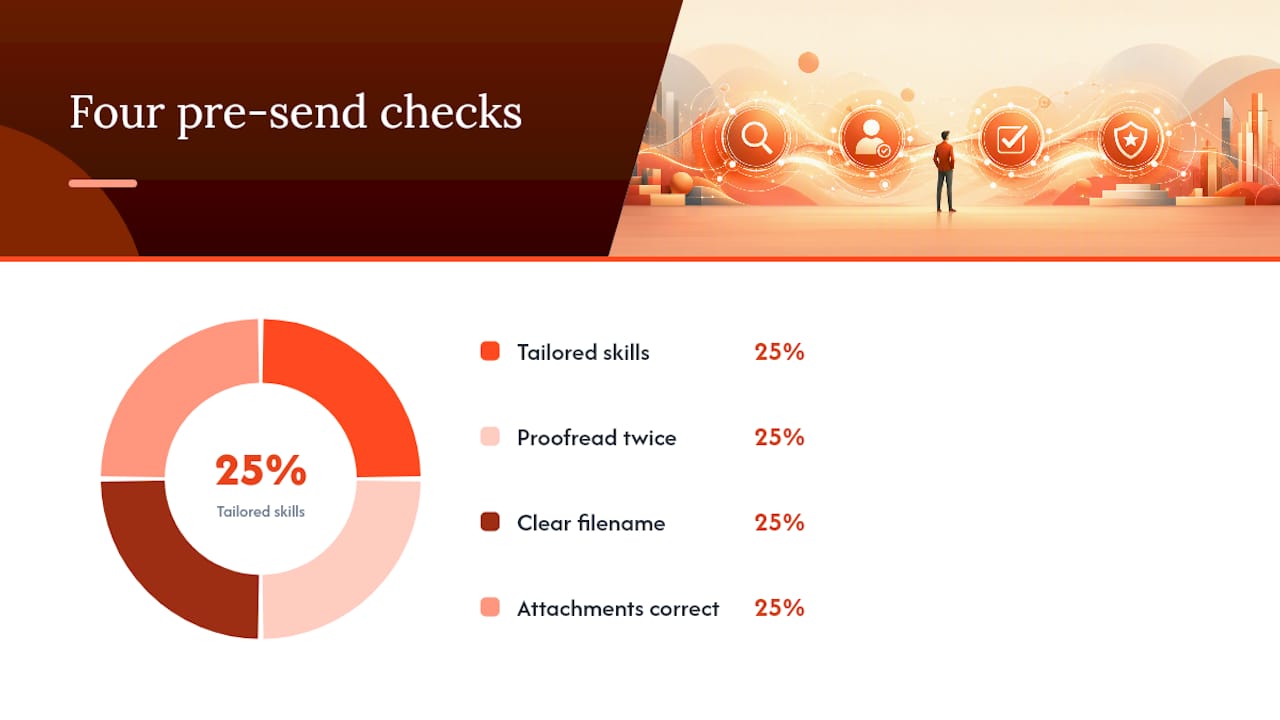
Before sending, run through this: tailored skills section, proofread twice, clear file name, correct attachments included.
Why the skills-first method works, and where it still needs help
Most guidance on skills-based CVs stops at "list your skills", which misses the actual problem: recruiters distrust unsupported claims, and ATS software ignores anything it can't structurally parse. The method that works is narrower than most people expect, pull competencies directly from the advert's own language, then prove each one with a number. Career changers, in particular, underuse this. They write the CV as an apology for their pivot, when the whole point of a skills-first format is to stop apologising and start demonstrating transferable ability directly.
Where this gets genuinely time-consuming is doing it fresh for every application. Appliqu's approach to AI CV tailoring reads the full job posting rather than matching isolated keywords, which is the same semantic logic behind picking your 3 to 6 competencies by hand, but automated at scale for readers applying to multiple roles.
Alex
Sources
For structure and wording, Indeed UK's skills-based CV guide, Jobs.ac.uk's skills CV template and Prospects' skills-based CV example all cover the format from slightly different angles worth cross-checking.
- How to write a skills-based CV | Indeed UK
- Skills CV template | Jobs.ac.uk
- Skills-based CV example | Prospects
- How to prove your soft skills | Reed / Diversity Dashboard
Use these to sense-check your own draft against your target sector's specific conventions.
FAQ
What is a skills-based CV?
A skills-based CV, also called a functional CV, organises your experience under competency headings instead of a chronological job list. It's designed for career changers, graduates and people with employment gaps who want to lead with capability rather than job titles.
What are good skills to put on a CV?
Strong choices vary by role, but commonly valued examples include communication, project coordination, data analysis, problem solving and stakeholder management. The right five depend entirely on what the specific job advert repeats and prioritises, so scan the posting before choosing.
What are the top skills recruiters look for?
Recruiters generally weigh a mix of technical ability specific to the role alongside soft skills such as teamwork, adaptability and communication. What matters most is pairing each claimed skill with a concrete, measurable example rather than listing the skill alone.
How many skills should I include on my CV?
Aim for a few competency headings, each backed by one to four evidence bullets. Beyond six headings, the document tends to lose focus and recruiters skim past the weaker entries.
Should a skills-based CV still include an employment history?
Yes. A short, dated employment history underneath the skills section reassures recruiters and satisfies ATS expectations, since hybrid formats that combine skills with a visible timeline tend to perform better than a pure functional layout with no dates at all.