Fix Your Career Change Resume With One Tweak, Tailor in 30-60 Minutes

The single most effective change you can make is this: replace your job title headline with your target role, and follow it with a tight professional profile that names your previous field, your transferable skills, and where you are headed. Pair that with a hybrid CV format that puts a skills section near the top, above your full employment history. Everything else in your career change resume follows from that one structural decision.
TL;DR:
- A clear target-role headline and a concise professional profile are essential to quickly convey your career change intent and relevant transferable skills.
- Using a hybrid CV format that highlights skills early helps demonstrate capability before full employment history, which is crucial in shifting fields.
- Quantifying achievements and translating responsibilities into the language of the target industry significantly improve relevance and credibility.
- Ensuring your CV is ATS-friendly with standard formatting, clear headings, and keyword matching increases the chances of passing initial screening filters.
- Tailoring your CV for each role in about 30 to 60 minutes greatly enhances your application quality without sacrificing essential details.
Table of Contents
- What a career change CV looks like
- How do I write a professional profile for a career change?
- How do you identify and translate transferable skills?
- How do I rewrite my work history for a career change?
- What education, certifications and projects should you include?
- Formatting and ATS optimisation: what actually gets your CV read
- Worked examples: before and after bullets you can adapt
- How do you tailor your CV in under an hour per application?
- Common mistakes and a one-page checklist
- How Appliqu fits into a career-change job search
- The translation-first approach to career-change resumes
- Let Appliqu handle the volume while you keep the craft
- Sources
- FAQ
What a career change CV looks like
A career change resume works differently from a standard CV because it has to do two jobs at once: prove you can do the new role and explain why you are qualified despite lacking a matching job title. The hybrid, or combination, format solves this by leading with evidence before chronology.
The recommended order runs like this:
- Target-role headline (your intended job title, not your last one)
- Professional profile (three sentences: origin, transferable skills, target role)
- Core skills section (five to eight skills with one-line evidence each)
- Selected relevant experience (the achievements that map most directly to the new field)
- Full employment history (dated, for ATS and recruiter trust)
- Education, certifications and projects
This order works because it front-loads intent and keywords before a recruiter has decided whether to keep reading. Prospects and career-specific guides recommend a short professional statement precisely because it answers the first, unspoken question in a hiring manager's mind: "why is this person applying?" A skills-led or hybrid format also gives you space to show relevant strengths before a recruiter reaches a job title from another industry and mentally files you as "not a fit."
One thing changes with the stakes here too: your cover letter carries more weight than usual, because it is the only place you can explain motivation and context that a CV format cannot fully capture.
How do I write a professional profile for a career change?
Start with the headline, not the paragraph. Pull the exact job title language used in the adverts you are targeting and place it at the top of your CV, above your name if your template allows it, or directly beneath it. If three of the five roles you want to call the position "Operations Coordinator," that is your headline, not "Former Retail Manager."
The profile itself follows a three-part formula:
- Origin: one clause naming your current or most recent field
- Transferable skills: two or three skills that map directly onto the new role's core demands
- Target role plus evidence: the role you want, backed by one concrete line of proof
This structure matches what Prospects recommends: state the move explicitly rather than hoping a recruiter infers it from your skills list.
Here are three profile examples at different seniority levels:
Senior: "Operations manager with 12 years leading retail teams of 40+, now moving into supply chain planning.
Mid-career: "Secondary school teacher transitioning into learning and development. Strong background in curriculum design, stakeholder communication and performance assessment, having built training materials used by 200+ students annually."
Early-career: "Hospitality graduate moving into customer success, bringing two years of client-facing problem-solving and a track record of resolving service issues under pressure in high-volume environments."
Pro Tip: Write the profile last, after you have drafted your skills section and rewritten bullets. It is far easier to summarise strong evidence than to write a summary and then hunt for proof that matches it.
How do you identify and translate transferable skills?
Most career changers underestimate how much of their experience maps onto the new field. The problem is rarely a lack of relevant skill. It is a lack of translation.
Follow this three-step framework:
- Audit: List every recurring responsibility from your current or most recent roles, no matter how field-specific it sounds.
- Map: Open five to ten job adverts in your target field and highlight the skills, verbs and phrases that repeat across them. This is your evidence bank for what the new field actually values.
- Translate: Rewrite each audited responsibility using the target field's own vocabulary, keeping the underlying skill intact.
This audit, map, translate method mirrors what Prospects recommends for anyone changing fields: compare your existing responsibilities against real adverts rather than guessing what "transferable" means in the abstract.
Include five to eight skills in your core skills section, each backed by a short evidence line rather than a bare keyword. A skill with no proof reads as a claim; a skill with a number or outcome reads as fact.
Two translation examples show how this works in practice. A classroom teacher moving into learning and development reframes "managed classroom behaviour and engagement" as "designed and delivered structured learning sessions for groups of 30, adapting content to varied skill levels." A retail manager moving into operations reframes "oversaw daily store operations" as "managed end-to-end operational workflows, including inventory control, staff scheduling and vendor coordination across a £2m annual turnover site."
Pro Tip: Keep a running list of the exact phrases that repeat across your target adverts. When five different postings use "stakeholder management" instead of "client relations," that is the phrase your CV should use.
How do I rewrite my work history for a career change?
This is where most career change resumes fail. Writers either keep old-field jargon untouched, which reads as irrelevant to a recruiter skimming for new-field signals, or they strip out so much detail the bullets become vague and unconvincing.
Use this template for every bullet: action verb + task + measurable outcome. Quantify wherever you can. A number does more work than an adjective, because it gives a recruiter something concrete to compare against other applicants. Career guidance on rewriting a CV for a career change consistently points to this pattern: translate old-field jargon into target-field language, and lead with the outcome rather than the task.
Here is the shift in practice:
- Before (retail, generic): "Responsible for team performance and customer satisfaction."
- After (targeting operations): "Improved team productivity by 22% through revised scheduling and performance tracking, directly supporting a customer satisfaction score increase across the site."
- Before (teaching, generic): "Taught lessons and managed student progress."
- After (targeting L&D): "Designed and delivered training content for 150+ learners annually, with measurable improvement in assessment outcomes across three cohorts."
When deciding what to keep and what to cut, keep anything that demonstrates a transferable competency (leadership, budget ownership, process improvement, client management) and cut sector-specific detail that only makes sense inside your old field, such as niche software names or internal job codes with no external meaning.
On chronology: detail your most recent 10 to 15 years fully, and compress anything older into a single line with job title, employer and dates. If a senior role from 20 years ago still carries a genuinely transferable achievement, keep the achievement and drop the granular detail around it.
Never switch to a dateless, functional CV to obscure the transition. Applicant tracking systems and recruiters read a dateless format as evasive rather than strategic, and it tends to raise more suspicion than it resolves. Keep dates. Curate content instead.
What education, certifications and projects should you include?
Anything that demonstrates active movement toward the new field deserves prominence, even if it is unfinished. A part-completed certification with an expected completion date signals genuine intent in a way that a completed but unrelated degree from a decade ago does not.
Structure this section to work double duty as both proof and keyword source:
- List in-progress qualifications with an "expected completion" date rather than omitting them until finished
- Include micro-credentials from recognised providers if they map to skills in your target adverts
- Add volunteering, freelance work or capstone projects as evidence, described with the same action-verb-plus-outcome structure used in your employment history
- Be honest about incomplete qualifications; list the course name, provider and current status rather than implying completion
A volunteer role coordinating a community fundraising drive can carry real weight for a project management transition if you describe the deliverable: "Coordinated a 40-volunteer fundraising campaign, managing a £15,000 budget and delivering the event two weeks ahead of schedule." Freelance work should be listed with the same specificity you would give paid employment, including client scope and outcome, not treated as a footnote.
Formatting and ATS optimisation: what actually gets your CV read
Most rejected career-change CVs are never seen by a human. They fail at the parsing stage, before a recruiter ever opens the file.
Follow these formatting rules:
- File type: submit as a Word document or a text-based PDF, never a scanned image or a design-heavy PDF with embedded graphics.
- Length: two pages is standard for mid-career applicants; one page is acceptable early-career, and three only for senior roles with extensive relevant history.
- Layout: use standard section headings ("Work Experience," "Education," not creative alternatives), avoid tables and text boxes, and skip photos, icons and graphics that many parsers cannot read correctly.
- Keyword mapping: extract five to ten high-value terms from your target adverts and mirror that exact phrasing in your profile, skills section and top bullets, without repeating any single term unnaturally often.
National Careers Service guidance is explicit on this point: conventional section headings, clear dates and simple layouts perform far more reliably with applicant tracking systems than creative formatting choices. A functional, skills-only CV with no dates is particularly likely to be penalised by parsers built to expect chronological structure.
Pro Tip: Run your CV through an ATS checker before you send it. A tool that flags parsing errors before a human ever sees the file catches problems you cannot see by eye.
Worked examples: before and after bullets you can adapt
Three common transitions illustrate how the translation works in practice.
Teaching to learning and development: "Delivered lessons to Year 10 students" becomes "Designed and facilitated structured learning content for groups of 30, achieving measurable gains in assessed outcomes across two academic years."
Hospitality to customer success: "Handled guest complaints and requests" becomes "Resolved an average of 25 client issues weekly under time pressure, maintaining service quality scores above target across a high-volume front-of-house operation."
For a template personal statement structure, adapt the three seniority examples above: a senior version leads with years of experience and a headline metric, a mid-career version balances background and ambition, and an early-career version leans on transferable soft skills backed by one concrete example. Whichever you adapt, replace the placeholder metrics with your own real numbers. Even an estimate, clearly framed as an estimate, works better than a vague adjective like "significant" or "extensive."
How do you tailor your CV in under an hour per application?
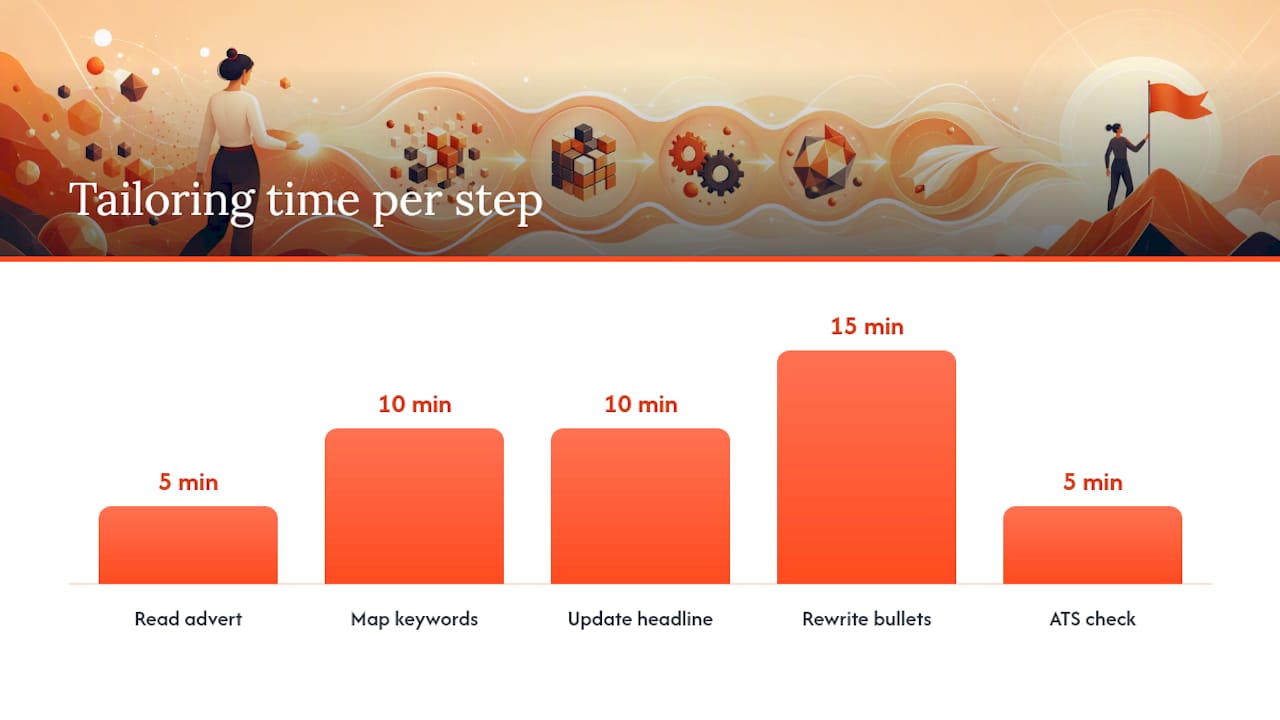
A master CV only earns its keep if you actually adapt it for each role rather than sending the same document everywhere. This workflow takes 30 to 60 minutes and covers the fields that matter most.
- Read the advert closely (5 minutes): note the exact job title and repeated skill terms.
- Map keywords against your master CV (10 minutes): identify which of your existing bullets already match, and which need new phrasing.
- Update your headline and profile (10 minutes): swap the target role wording and tweak the evidence line to match this specific advert.
- Rewrite your top one or two bullets (15 minutes): adjust the strongest, most relevant achievement to mirror this employer's language.
- Run a final ATS check (5 minutes): confirm headings, dates and file format are intact before sending.
Five fields change on every tailored application: the title line, the profile, the top three to five skills, one or two rewritten bullets, and the cover letter opening line. Career-adaptation routines like this consistently improve application speed and consistency compared with sending an identical CV to every posting.
If you are applying to a high volume of roles, batching this process across similar job types saves real time, and automation can help with the repetitive tailoring and submission steps once your core profile and top bullets are locked. The judgement calls, particularly what to emphasise and how to phrase your strongest evidence, still benefit from your own review before anything goes out.
Common mistakes and a one-page checklist
The most frequent failure is burying the career-change signal on page two instead of stating it in the headline and profile. Close behind: leaving old-field jargon untranslated, using a dateless functional format that reads as evasive, offering claims with no measurable evidence, and treating the cover letter as an afterthought rather than the place where motivation gets explained.
| Fix | Where it goes |
|---|---|
| Target-role headline | Top of CV, above the profile |
| Three-sentence profile | Directly below headline |
| Five to eight skills with evidence | Near the top, before full history |
| Two rewritten, quantified bullets | Most recent or most relevant role |
| ATS format check | Before every submission |
Once your career change resume passes the CV stage, the interview shifts the burden of proof onto you to explain the same transition verbally, with the same origin, skills, target-role logic you used on paper.
How Appliqu fits into a career-change job search
Appliqu reads the full text of a job posting rather than scanning for isolated keywords, matching roles to your profile through semantic comparison rather than simple keyword overlap. That matters for career changers specifically, because your strongest matches often will not share your previous job title at all.
Appliqu writes sample applications on its free Explorer tier, tailoring your CV and cover letter to postings it finds across job boards. The Amara case study shows how sustained, tailored applications supported a move into a new field entirely, and it is worth reading for a concrete sense of how the process plays out over time.
The practical approach is to keep your professional profile and top bullets under your own manual control, since those are the parts of the career change resume that most need judgement, then let batch tailoring handle volume once that foundation is solid.
The translation-first approach to career-change resumes
Most advice on career change resumes treats the CV as a marketing document, something to dress up until the gaps disappear. That framing causes more harm than it fixes. A CV that disguises a transition instead of naming it reads as evasive to both software and people, and it forces the reader to do the work of figuring out your story instead of you doing it for them.
The stronger approach treats the CV as a translation exercise. Your experience did not change when you decided to switch fields. Its description needs to change, honestly and specifically, into vocabulary your target field recognises. That means naming the move directly in your profile, backing every skill claim with a number where you can find one, and resisting the temptation to hide behind a dateless functional format that only invites suspicion.
Quantify. Translate. Never disguise. Those three instincts do more for a career-change CV than any template alone.
Alex
Let Appliqu handle the volume while you keep the craft
Once your master CV is built, the real challenge for most career changers is not writing one strong application. It is writing dozens of them without losing quality on any single one. Appliqu is built for exactly that gap: it scans over 100 job boards continuously, matches roles to your profile using the full context of each posting, and tailors your CV and cover letter for each application it submits.
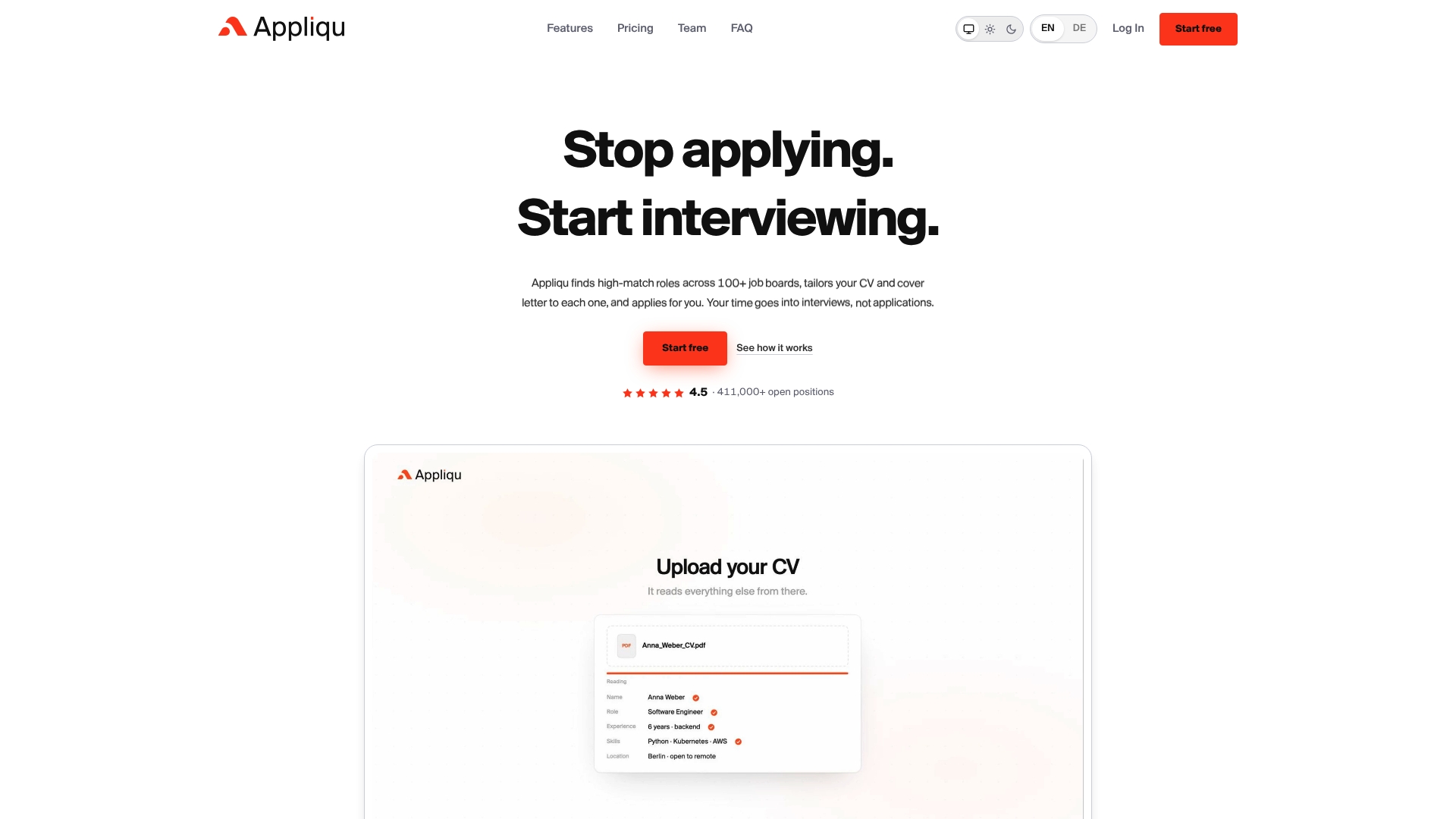
Explorer, the permanent free tier, lets Appliqu write five sample applications so you can see how the tailoring works against your own profile before committing to anything. Sending applications starts with Core at €29.90 per month for 100 applications, VAT included. Pro, at €69.90 per month, covers 300 applications and adds access to the Appliqu Job Board. Concierge, at €199 per month, includes unlimited applications plus a session with a senior consultant, VAT included throughout. You choose between two modes: on approval, where you review each application before it sends, or Autopilot, where Appliqu submits without a manual check at each step.
The sensible setup for a career change is to keep your profile and top bullets exactly as you have written them here, then let Appliqu apply that same evidence across a high volume of matched roles. Start with Explorer or read how the approach played out in the Amara case study before deciding whether to scale up.
Sources
- Career change CV: How to switch industries without starting from scratch (UK guide 2026) | SpeedCV
- How to change careers | Prospects
- How to write a CV | National Careers Service
FAQ
How do I mention a career change in my resume?
State it directly in your professional profile using the origin, transferable skills, target role formula rather than leaving a recruiter to infer it from your job history.
What is the 30-30-30 rule for career change?
Definitions of this rule vary across career guidance sources, so treat any specific breakdown with caution rather than as a fixed standard.
How do I write a resume summary for a career change?
Write three sentences: your previous field, two or three transferable skills relevant to the new role, and the target role itself backed by one measurable achievement.
What is the 7 second rule in resume?
It refers to the idea that recruiters form an initial impression within seconds of scanning a CV, which is why your target-role headline and profile need to sit at the very top, not buried after your job history.
Should I use Appliqu to help with a career-change CV?
Appliqu can batch-tailor and submit applications once your profile and top bullets are set, matching your CV against full job descriptions across more than 100 boards rather than isolated keywords.