Decide in 30-90 seconds whether to apply without a cover letter

Yes, you can skip the cover letter for most high-volume online applications, agency submissions, and roles where the advert marks it optional and the form focuses on structured questions or a portfolio link. No, you should not skip it for public sector, academic, legal, charity, or speculative applications, where it is often scored or the only place to explain your fit. Check the advert wording first, then use the checklist below.
TL;DR:
- Skipping the cover letter is acceptable for high-volume applications, portfolio-driven roles, and structured screening questions, but not for academic, legal, or public sector jobs.
- Most employer screening relies heavily on keywords from the CV and answers to structured questions, with fewer than half of UK managers reading cover letters before shortlisting.
- For roles prioritizing scoring criteria or where the letter explains motivation, a tailored cover letter remains essential, especially for senior or speculative applications.
- Using a prepared, adaptable base letter can save time, but it must be carefully reviewed to ensure company and role-specific details match the job advert.
- When skipping the letter, focus on optimizing your CV, tailoring application answers, and leveraging networking or follow-up emails to increase your chances.
Table of Contents
- When applying without a cover letter is acceptable
- When you should always include a cover letter
- A fast decision checklist: decide in 30 to 90 seconds
- What to do instead if you choose to skip the cover letter
- How automation makes tailored letters less painful
- Why I stopped writing a letter for every application
- A practical option when you must tailor many applications
- Sources
- FAQ
When applying without a cover letter is acceptable
Most online job applications no longer depend on a letter at all. High-volume employers, tech companies with portfolio-led hiring, and recruitment agencies routinely process candidates through a CV and a set of screening questions, with the cover letter treated as an afterthought rather than a gate.
The evidence backs this up. Fewer than half of UK hiring managers read the cover letter before shortlisting, which means your CV and your answers to any screening questions usually decide whether you get through the first cut. Applicant tracking systems reinforce this: they parse CVs for keywords and qualifications long before a human ever opens a cover letter file, if one was even requested.
Statistic Callout: With under half of hiring managers reading cover letters before shortlisting, the CV carries most of the weight in the initial screening stage for the majority of roles.
Agency submissions deserve a special mention. Many recruitment agencies strip cover letters entirely before forwarding your application to their client, so energy is better spent polishing your CV and preparing for the recruiter's phone call than drafting a letter nobody downstream will see.
Spotting a low-value-letter situation takes seconds once you know what to look for:
- One-click apply buttons (LinkedIn Easy Apply, Indeed Quick Apply) rarely route the letter anywhere useful.
- Structured screening questions replacing free text usually mean the employer wants standardised answers, not prose.
- A portfolio, GitHub, or Behance link requested instead of a letter field signals the work itself is the evidence.
- Agency job boards with no named hiring manager typically process CVs first and letters never.
- "Optional" wording paired with a bare CV upload field and no further prompts often means the field is a formality.
Structured application forms and anonymised screening, both recommended in inclusive recruitment guidance, exist precisely to standardise assessment and reduce the influence of a free-text letter. If an employer has built their process this way, a missing letter genuinely will not disadvantage you against everyone else answering the same structured questions.
When you should always include a cover letter
Some sectors have not moved on from the letter, and pretending otherwise costs you interviews. Public sector roles, academic posts, charity work, and legal positions frequently treat the cover letter, or its cousin the "supporting statement," as a scored document with its own marking criteria separate from the CV.
Speculative applications sit in the same category for a different reason. If nobody has advertised the role, the letter is the only thing explaining why you are contacting this employer at all. Small employers and senior positions follow the same logic: with no large HR team to interpret a bare CV, the letter often becomes the deciding piece of context on cultural fit, career motivation, and why you left your last role.
This is also where a bad letter does more damage than no letter. A generic, unedited template pasted across twenty applications reads as carelessness, and Harvard Business Review argues that even in roles where the letter is not required, a strong one still reveals role-specific thinking that matters to the person reading it. A weak one reveals the opposite.
A scored supporting statement usually needs to demonstrate three things in miniature: how your experience maps directly onto the person specification, one concrete example of a relevant achievement with a measurable outcome, and a closing line that connects your motivation to that specific organisation, not "the sector" in general. Public sector panels in particular often mark each criterion separately, so vague coverage across all of them scores worse than sharp coverage of the two or three that matter most.
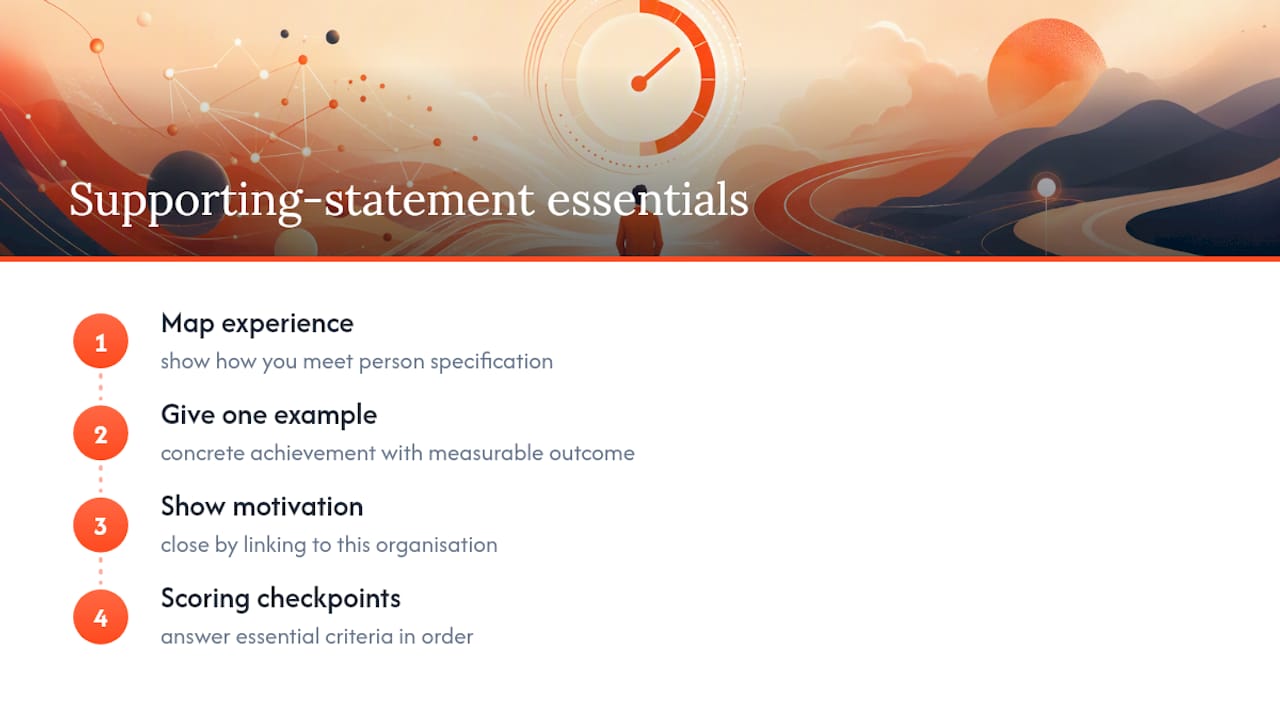
Pro Tip: If a public sector advert lists "essential criteria," structure your supporting statement to answer each one in its own short paragraph, in the same order they appear in the job description. Panels marking against a scoring grid reward this far more than a flowing narrative.
A fast decision checklist: decide in 30 to 90 seconds
Run through this before opening the application form. It takes less time than reading the job advert twice.
- Read the exact wording. Does the advert say "required," "optional," or say nothing about a cover letter at all?
- Check the sector. Public sector, academia, law, and charity default to "always write one" regardless of wording.
- Check the application route. Agency job board or direct employer portal? Agencies usually strip letters; direct applications to smaller employers rarely do.
- Check the seniority of the role. Senior and leadership roles almost always benefit from a short letter, even when not requested.
- Check whether a portfolio or work sample is requested instead. If so, that link is doing the job a letter would otherwise do.
Score it simply: if two or more of these point toward "write one," write one. If two or more point toward "skip it," skip it and move your effort into the CV and application fields instead.
Pro Tip: Draft one strong base letter with four short parts: an opening line naming the role and why you want it, two matching achievements as proof, a sentence linking your values to the employer's, and a closing line on availability. Editing only the specifics per job cuts the time per letter to roughly 20 minutes, which makes "write one anyway" a much less costly default when you are unsure.
This base-letter approach also protects you from the generic-letter trap mentioned earlier. You are not writing from scratch each time, so there is no excuse for leaving the company name wrong or the job title mismatched, mistakes that are more common in rushed original letters than in a carefully edited template.
What to do instead if you choose to skip the cover letter
Skipping the letter is not the same as skipping effort. The time you save needs to go somewhere, and the smartest places to put it are the parts of the application that are actually being read.
- Optimise your CV first. Match the keywords and phrasing from the job description directly into your CV's skills and experience sections, since this is what most ATS software and human screeners scan before anything else.
- Fill every application field properly. Tailored answers in "why do you want this role" or "relevant experience" text boxes carry much of the weight a cover letter would otherwise carry, and Prospects notes that employers who ask for detailed form answers are often using them as a direct substitute.
- Update your LinkedIn profile and portfolio link so anything the recruiter clicks through to reinforces what your CV claims, rather than contradicting it with stale information.
- Send a short follow-up note by email a week after applying, restating your interest in one or two sentences, if you have a named contact to send it to.
- Contact a recruiter or network contact directly when one exists, since a five-minute phone conversation about your fit for the role often does more work than a letter would have done anyway.
None of this requires more time than writing a mediocre letter would have taken. It just redirects that time toward the parts of the process someone is actually going to look at.
How automation makes tailored letters less painful
The three-paragraph base letter mentioned earlier works well precisely because it is built to be repurposed, not rewritten. Automation tools built for this task can hold that structure steady while swapping in the specifics: the company name, the two achievements that best match this particular advert, and the closing line on availability.
Used properly, this is not about generating filler. It is about removing the repetitive fifteen minutes of formatting and re-checking company names across your tenth application of the day, so the ten minutes you do spend goes into the one sentence that actually needs to be right: why this employer, specifically.
Cover letters still reveal role-specific thinking even when they are not strictly required, which is exactly the piece that generic automation tends to strip out if you let it run unchecked.
A few practical habits keep automated drafts safe to send:
- Always read the final letter before submitting, checking the company name, job title, and any specific achievement claims match the actual advert.
- Treat automated output as a first draft, not a finished letter, especially for the sectors covered earlier where the letter is scored.
- Keep one manually written "gold standard" letter on file to compare automated drafts against, so you notice quickly if quality slips.
If you want to see what a properly tailored letter looks like against the job advert it responds to, these worked examples show the structure in practice. For a longer look at where automation helps and where it should not replace your own judgement, this comparison of AI letter generators against fuller application automation is worth reading before you commit to either approach.
Why I stopped writing a letter for every application
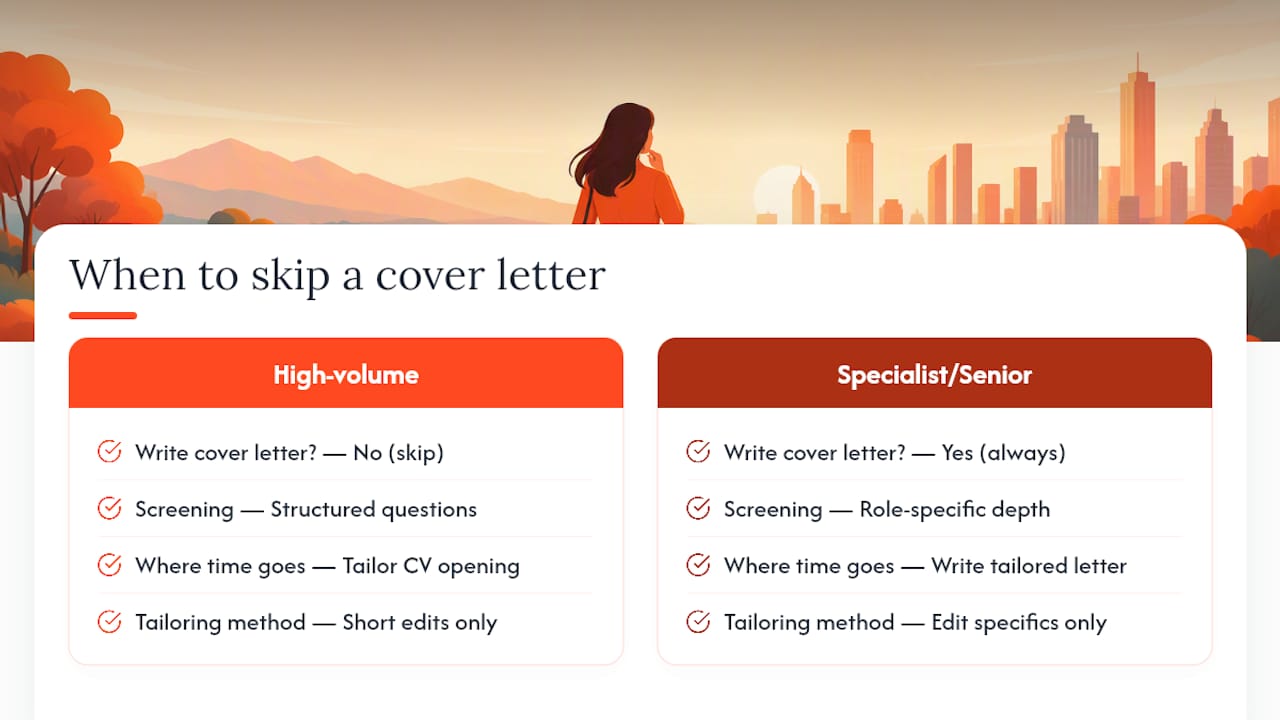
I apply the checklist above without exception now. For high-volume roles with structured screening questions, I skip the letter and put that time into tailoring my CV's opening summary instead. For specialist or senior roles, I always write one, using the base-letter structure and editing only the specifics.
The rule I follow is simple: if writing a genuinely tailored letter takes longer than about 20 minutes, something in my base template needs fixing, not the process itself.
Alex
A practical option when you must tailor many applications
If you are applying to dozens of roles a month and trying to decide, letter by letter, which ones deserve the full treatment, that decision fatigue is the real cost, not the writing itself. Appliqu exists for exactly that volume problem: it reads the full job posting, not just keywords, and tailors both CV and application content to match.

Appliqu's Explorer tier is free permanently and writes 5 applications so you can see the tailoring quality before committing to anything. Sending starts with the Core plan at €29.90 a month (100 applications, VAT included), with Pro at €69.90 a month (300 applications, plus access to the Appliqu Job Board) and Concierge at €199 a month for unlimited applications plus a senior consultant session. You choose between two modes: "on approval," where you review every application before it goes out, or Autopilot, where Appliqu sends on your behalf once you have set your preferences.
This suits frequent applicants and career changers testing multiple directions at once far more than someone applying to three or four carefully chosen roles. If that is your situation, the Appliqu plans are worth a look, and the CV tailoring approach behind them is explained in more detail in how AI-powered tailoring works in practice.
Sources
- Do You Still Need a Cover Letter in 2026? What UK Recruiters Actually Say - DEV Community
- Are optional cover letters really optional? | Glassdoor
- Cover letters still matter-even if they're not required | Harvard Business Review
FAQ
Is it okay to apply without a cover letter?
Yes, for most high-volume, agency, and portfolio-led applications where the advert marks the letter optional or omits it entirely. It is not okay for public sector, academic, legal, charity, or speculative applications, where the letter is often scored or the only source of context on your fit.
Is it okay not to include a cover letter when one is optional?
It depends on how you use that flexibility. An optional cover letter can act as a test of motivation: a tailored one can differentiate you from other candidates, while a generic one can actively work against you, so the safest choice is usually a short, specific letter rather than none at all.
What should I do if I don't have a cover letter ready?
Prioritise tailoring your CV to the job description's keywords first, since that is what most screening decisions rely on. If you have time left, draft a short letter using a base structure covering your motivation, two matching achievements, and your availability, editing only the specifics for this role.
Is a cover letter really necessary?
Not for every application, but it remains necessary wherever it is explicitly required, scored, or the only document explaining your motivation, such as speculative approaches or senior roles. Even where it is optional, a well-targeted letter can still reveal role-specific thinking that a CV alone cannot show.
Does Appliqu write cover letters as well as CVs?
Appliqu writes tailored applications, including cover letters where the role calls for one, as part of the same process that customises your CV to each job posting. The Explorer tier writes 5 applications for free, with sending unlocking from the Core plan at €29.90 a month.