10-20 Minute Tailored Cover Letter: Quick Workflow and Ready Lines

A tailored cover letter mirrors two or three requirements pulled straight from the job advert and proves each one with a concrete example or result. It runs a few hundred words, fits one side of A4, and takes roughly 10 to 20 minutes to adapt properly. Skip the tailoring and even a well-written letter reads as generic; do it well, and a short, specific letter beats a long, vague one every time.
TL;DR:
- Tailoring a cover letter involves focusing on two or three key requirements from the advert and backing each with specific examples or results.
- Research about the employer should be limited to one relevant detail to create a personalized sentence that demonstrates genuine interest.
- Using a structured approach, you write one evidence sentence per requirement, ensuring the letter remains concise, about 200 words, and formatted professionally.
- Avoid common mistakes such as generic templates, spelling errors, or copying your CV, which can easily cost you an interview.
- AI can help generate first drafts, but successful tailoring depends on replacing vague phrases with personal details and proofreading thoroughly before submission.
Table of Contents
- What structure makes a cover letter tailored, not generic?
- How do you tailor a cover letter to a specific job and employer?
- Cover letter templates and lines you can adapt today
- What cover letter mistakes cost you an interview?
- Can AI write a genuinely tailored cover letter for you?
- When is a fully tailored letter worth the time?
- Scaling tailored applications without losing your voice
- Where to read more on cover letter best practice
- Sources
- FAQ
What structure makes a cover letter tailored, not generic?
A tailored cover letter follows a predictable shape. What changes each time is the evidence inside it, not the skeleton.
The opening states the role you want and gives one sharp reason you're applying, ideally naming something specific about the employer rather than a stock phrase like "I am writing to apply for". The middle, usually one or two paragraphs, does the real work: each paragraph should tie directly to a requirement from the advert and prove it with a short story or a number, using something like the STAR method (Situation, Task, Action, Result) to keep it concrete. The closing should be brief: a clear statement of interest, a nod to next steps, and a formal sign-off matched to how you opened the letter.
Presentation matters as much as content. Career services consistently recommend keeping the letter to one side of A4, roughly a few hundred words, because a cover letter's job is to add context the CV can't, not repeat it.
A few formatting rules worth locking in:
- Use a standard, readable font (Arial or Calibri, 11 or 12 point) with sensible margins, not a cramped block of text.
- Address a named contact wherever the advert or company website gives you one; "Dear Hiring Manager" is a fallback, not a first choice.
- If you're applying by email, the message body can serve as the letter itself rather than duplicating a separate attachment.
- Match your sign-off to your greeting: "Dear Ms Keller" pairs with "Yours sincerely"; "Dear Sir or Madam" pairs with "Yours faithfully".
How do you tailor a cover letter to a specific job and employer?
Tailoring isn't a vague instinct, it's a repeatable sequence. Run through these steps for every application that matters.
- Pull two or three must-have requirements from the advert. Ignore the nice-to-haves. Look for the skills or experience repeated more than once, or listed under "essential".
- Research the employer for one usable detail. Ten minutes on the company website, its LinkedIn page, or a recent news mention is usually enough. You're not writing an essay on their history, just finding one sentence-worthy fact that shows you looked.
- Turn that research into a single employer-specific sentence. Something like "Your recent expansion into renewable logistics is exactly the kind of challenge I want to work on" does more than "I've always admired your company".
- Write one evidence sentence per chosen requirement. Use STAR or a quantified outcome: "Managed a portfolio of 40 client accounts, increasing renewal rates by identifying at-risk contracts early" reads far better than "I have strong client management skills".
- Adjust your tone to match the advert's formality and the company's public voice. A scale-up's careers page often reads casually; a public sector advert rarely does. Senior roles call for language around strategy and outcomes; junior roles can lean more on eagerness and transferable skills.
- Run a final check before sending: correct name and job title, no leftover placeholder text, one strong evidence sentence per paragraph, and formatting intact.
University career services frame the tailored letter as one that shows why you fit the specific job, using the advert's own language to mirror what the employer is actually asking for.
Pro Tip: Keep a running document of three or four evidence sentences you're proud of, each tied to a different skill. Tailoring then becomes picking and lightly rewording, not starting from a blank page every time.
Cover letter templates and lines you can adapt today
A workable skeleton, with placeholders swapped in:
Dear [Name], I'm writing to apply for the [Job Title] role at [Company], particularly drawn to [specific detail about the company]. In my current position at [Employer], I [evidence sentence tied to requirement one]. I also [evidence sentence tied to requirement two]. I'd welcome the chance to discuss how this experience applies to [Company]'s [specific goal or project]. Yours sincerely, [Name]
Opening lines for three common scenarios:
- Advertised role: "Your listing for a Data Analyst caught my attention because of the emphasis on turning customer data into pricing decisions, which is exactly what I've spent the last two years doing."
- Speculative application: "I'm reaching out directly because your recent move into subscription retail matches the operations background I'd like to bring to a growing team."
- Internal application: "Having spent eighteen months in the Customer Success team, I'm applying for the Team Lead role to build on the retention improvements I helped drive this year."
Two evidence sentences worth stealing the structure of:
- STAR style: "When our support queue doubled overnight, I restructured the ticket triage process, cutting average response time from six hours to under two."
- Metric style: "Grew organic newsletter sign-ups from 200 to 1,400 a month by rewriting the landing page copy around reader intent."
Full worked examples, built around real job adverts, sit in Appliqu's cover letter examples.
What cover letter mistakes cost you an interview?
The same handful of mistakes appear across most rejected applications, and most take under two minutes to fix.
- Sending an obviously generic letter with no reference to the role or employer.
- Leaving in a copy-paste error, wrong company name, wrong job title, or a placeholder from a template.
- Repeating the CV line by line instead of adding new context or a story.
- Opening with a flat, low-energy line like "I am writing to apply for..."
- Skipping proofreading and submitting a letter with typos or awkward phrasing.
Recruiters flag generic, copy-pasted letters as one of the fastest ways to get an application dismissed, and the fix doesn't take long: personalise three elements (company detail, job title, one concrete example) and run a two-minute check before sending.
Three checks worth doing every single time: confirm the name and job title are correct, scan for two or three phrases lifted directly from the job description, and make sure at least one evidence sentence is specific rather than generic. If you used an AI draft, read it aloud. Unedited AI text tends to sound smooth but empty, full of phrases like "proven track record" with nothing concrete behind them.
Can AI write a genuinely tailored cover letter for you?
AI is a strong starting point for a first draft, not a finished product. The useful version reads the whole job description, not just a scan for keywords, then proposes phrasing you personalise until it sounds like you rather than a template. Career guides now recommend exactly this approach: let AI handle structure and a first pass, then edit heavily before it goes anywhere near a submit button.
Semantic matching, reading the full posting rather than pattern-matching a handful of keywords, produces noticeably better first drafts than keyword-stuffed templates, because it picks up on context an advert implies rather than states outright. That distinction is central to how Appliqu approaches CV tailoring as well: matching the whole job posting rather than isolated terms.
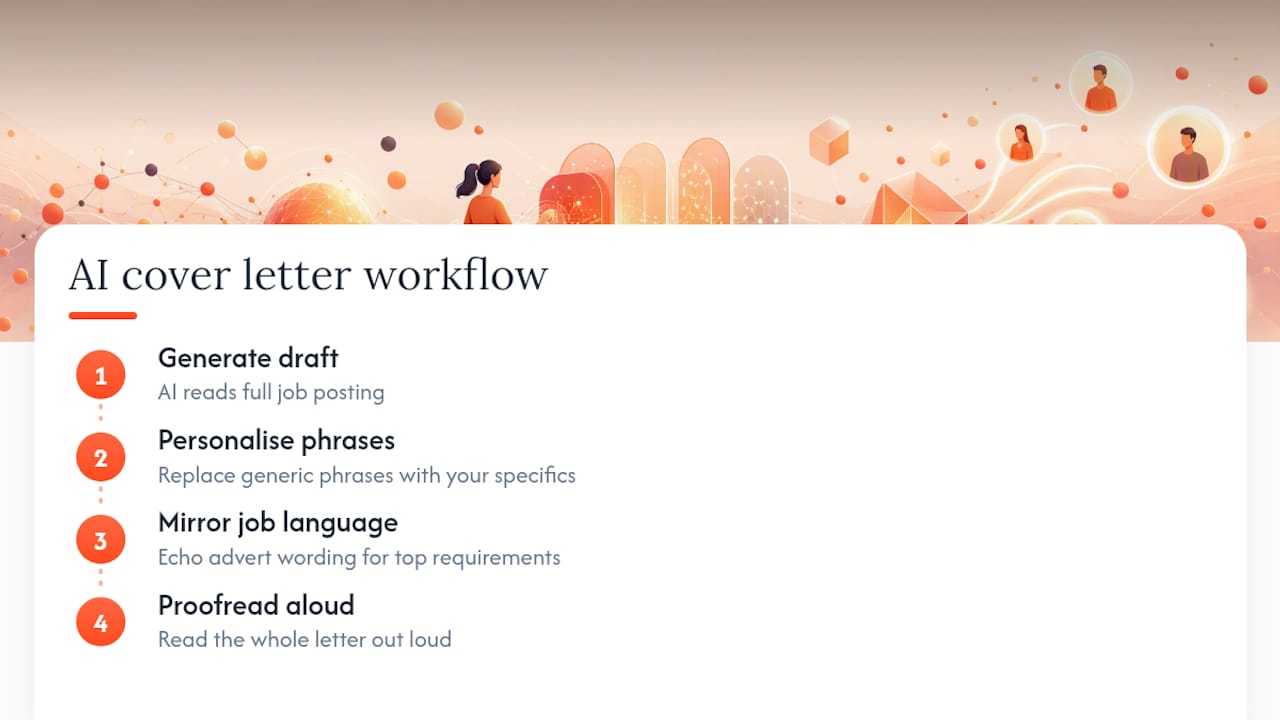
The AI draft is the starting line, not the finish. Replace generic phrases with a real detail from your own experience, mirror the exact language the advert uses for its top requirements, then proofread the whole thing out loud before it goes anywhere.
A workable workflow: generate a draft, replace every generic phrase with something specific to you, mirror a few phrases from the job description itself, then proofread properly. Skip any one of those four steps and the letter reads exactly like what it is.
When is a fully tailored letter worth the time?
Reserve full tailoring for roles that matter: competitive postings, senior positions, and employers you'd genuinely turn down other offers for. For high-volume applications, a short, lightly personalised email covering the same two or three points does the job without the full write-up.
A realistic target is a handful of fully tailored applications a week alongside a larger batch of lighter, quicker ones. Spending a significant amount of time on every single application, including long shots, can burn out most job seekers within a short period.
Alex
Scaling tailored applications without losing your voice
Writing one excellent tailored letter takes twenty minutes. Writing thirty of them, each properly matched to a different job description, is where most job seekers give up and start pasting the same paragraph everywhere. An AI-driven service exists to fill that gap.
Appliqu reads the full job posts on each of the roles it finds across more than 100 job boards, not just the listed keywords, and uses that to generate a tailored CV and cover letter for every application it submits. A permanently free Explorer plan lets you see drafts of five applications so you can judge the quality yourself. You can choose between an approval mode, reviewing each letter before it goes out, or an automated mode, but a quick personal check before submission is still worth doing, particularly for roles you care most about.
Have a look at the Explorer plan and see what a tailored draft actually looks like before deciding how much of the process to automate.
Where to read more on cover letter best practice
For deeper reading beyond this guide, the National Careers Service covers structure and length benchmarks, the University of Nottingham explains tailoring and employer research, and MIT's Career Advising and Professional Development office offers worked sample letters worth studying paragraph by paragraph.
Sources
- How to write a cover letter | National Careers Service
- Covering letters - The University of Nottingham
- Learnist
- How to write a cover letter for the UK market in 2026 - Robert Walters
FAQ
What is a tailored cover letter?
It's a cover letter that mirrors two or three specific requirements from a job advert and backs each one with a concrete example, rather than reusing the same generic text for every application.
How do you write a tailored cover letter?
Pull the key requirements from the job advert, research one specific detail about the employer, then write a short opening, one or two evidence paragraphs matched to those requirements, and a brief closing, keeping the whole letter to a few hundred words.
What is the seven second rule for a CV?
It refers to the idea that recruiters skim a CV for only a few seconds before deciding whether to read further, which is why clear formatting and the most relevant achievements need to be immediately visible near the top.
Are cover letters outdated in 2026?
No. Career services and recruitment guides still treat them as standard practice for most applications, since a tailored letter adds context and motivation a CV alone can't show, though a short, lightly personalised email can substitute for high-volume applications.
How long should a tailored cover letter be?
Around a few hundred words, fitting comfortably on one side of A4, is the benchmark most university career services and national guidance recommend.