Cover Letter Writing Service: What You Get and Costs

A cover letter writing service gives you a letter written for you, either by a human writer who interviews you and drafts it, or by software that generates it from your CV and the job advert. A human writer suits a single high-stakes application or a career change. Appliqu suits the other case: many applications that each need an individual letter. This guide explains what each route delivers, what to supply, how to spot poor providers and how to decide.
TL;DR
- A good service produces a letter aimed at one specific job, built from evidence in your CV, not a template with the company name swapped in.
- Human writers are strongest where judgement matters: positioning a career change, a senior move, a single dream role.
- For volume, a letter per application becomes the bottleneck. Appliqu writes a tailored letter for each role and applies for you.
- Check what a provider promises, what it needs from you, how long it takes and what it costs before you pay anything.
- Be wary of anyone who asks for money upfront in return for a job placement.
Table of Contents
- What a cover letter writing service actually provides
- What personalised actually means
- What to give a provider, and what to expect back
- What affects the price
- How to judge quality and spot red flags
- When paying a human writer is worth it
- When another approach is more suitable
- Our perspective
- How Appliqu handles cover letters for you
- A practical way to decide
- Frequently asked questions
- Sources
What a cover letter writing service actually provides
A cover letter introduces you and your CV. According to the NC State Poole College of Management style guide, it focuses on skills, experience and key accomplishments, and an effective one is targeted to a specific job opening. That definition is the standard any service should be held to.
In practice, services fall into three types:
- Human writers. A freelancer or agency writer reviews your CV and target roles, often asks questions, and drafts a letter. You usually receive an editable document and a limited number of amendments.
- AI cover letter generators. You paste in a CV and a job description and receive a draft in seconds. Quality depends on how well the draft reflects your real experience, and you still have to send it.
- Application services that write and submit. The letter is one step inside a wider process of searching, matching, tailoring and applying. Appliqu belongs here.
What you receive differs by type, so compare like with like. A one-off letter from a writer is a finished document. A generator gives you a draft to edit. A full application service gives you letters already attached to submitted applications.
What personalised actually means
Many providers advertise a personalised letter. The test is simple: does the letter choose evidence that matters to this employer?
The University of Cambridge Careers Service explains that tailoring signals suitability through the order of sections, the language used and the evidence selected. Inserting the company name in the first line does none of this.
A genuinely personalised letter does the following:
- Picks two or three achievements from your history that match the priorities in the advert.
- Uses the employer's own terms for the role, where they are accurate for your experience.
- Explains why you want this role at this organisation, in a sentence or two that could not be pasted into another letter.
- Stays consistent with your CV, so that the two documents support each other.
If you want to see what this looks like, our cover letter examples show three full letters next to the job advert they answer.
What to give a provider, and what to expect back
Whatever route you choose, the quality of the output follows the quality of the input. Prepare the following before you order or generate anything.
What you supply
- Your current CV, even if it is out of date. Say which parts are weak or missing.
- The job advert, or a list of the roles you are targeting. A letter for a specific advert is stronger than a general one.
- Two or three achievements you want mentioned, with real figures only where you can stand behind them.
- Your reason for applying, in your own words, especially if you are changing sector or returning after a break.
- Practical constraints, such as notice period, location, visa status or salary expectations, if the employer asks for them.
What you should receive
- A letter in an editable format that you can adjust and reuse.
- Content that fits on one page. CareerOneStop describes good letters as 200 to 400 words in three or four short paragraphs, with a heading, a brief introduction, highlights and a closing.
- A clear statement of turnaround time and of how many revisions are included.
- Wording you recognise as yourself. If you would not say it in an interview, change it.
The GOV.UK service manual sets out a useful standard for any service, public or private: it should make clear what it is for, what information you must provide, how long it takes, how much it costs and when you can expect a result. A provider that cannot answer those five points on its own page has not thought about you as a customer.
What affects the price
Prices for human-written letters vary widely between providers. The main factors are:
- Seniority of the writer. Many agencies offer tiers, with a more experienced consultant charging more for the same document.
- Your career level. Executive and specialist letters take longer to research and write.
- Turnaround. Express delivery is commonly sold as an extra.
- Bundling. A letter ordered with a CV rewrite is often cheaper than a standalone letter.
- Number of letters. Per-letter pricing makes ten applications ten times the cost, which is why volume applicants look elsewhere.
Read each provider's own pricing page rather than a comparison site, because prices and inclusions change. Check whether amendments, a second letter and file formats are included.
Our own pricing is published on the Appliqu pricing page. Core is 29.90 EUR per month for 100 applications. Pro is 69.90 EUR per month for 300 applications. Concierge is 199 EUR per month for unlimited applications, with a senior consultant session. Prices include VAT where applicable.

How to judge quality and spot red flags
Before paying, run through this checklist.
- Ask for a sample. A sample for your sector or level shows how the writer handles evidence. Generic samples that could suit any job are a warning.
- Check the process. A reputable writer asks you questions. A provider that asks for nothing but your CV and a payment will produce a template.
- Search the provider's name. The Federal Trade Commission advises searching a firm's name online alongside words such as scam, complaint or reviews.
- Distinguish writing from placement. Writing a document is a legitimate paid service. Promising to place you in a job is a different claim. The FTC says that legitimate job placement firms typically collect fees from the hiring company, not the job seeker, and that paying upfront for job placement is often a sign of a scam. These are United States sources, but the logic applies anywhere.
- Be sceptical of guarantees. No writer controls an employer's decision. Any promise of interviews or a job should end your interest.
- Read the revision terms. Know how many changes are included and how long you have to request them.
When paying a human writer is worth it
A human writer earns the fee when the letter must carry an argument that your CV cannot make alone. Typical cases:
- A career change, where you need to connect transferable skills to a new field.
- A senior or specialist role, where one letter shapes how a small panel reads you.
- A gap or an unusual path that needs framing honestly.
- Writing in a second language for a role where fluency in written English will be judged.
- A single application you care about more than any other.
One freelancer versus automation comparison makes the same distinction: people are worth paying for judgement, such as positioning a career change or targeting roles, while automation suits repetitive administrative work. It is one writer's view, not a measured study, but it matches how the decision tends to fall.
A human writer is a poorer fit when you are sending dozens of applications. Per-letter fees, turnaround of days and the effort of briefing a writer on every advert do not scale.
When another approach is more suitable
Paying per letter is not the only option.
- Write it yourself with a clear structure. Our tailored cover letter workflow shows how to produce a role-specific letter in 10 to 20 minutes.
- Use a general AI program and edit it. CareerOneStop says that job seekers can use programs such as ChatGPT or Microsoft Copilot provided they edit the output so that it reflects their own voice, skills, experience and interest in the position. The editing is the part that matters.
- Use a university or sector careers service. Many universities offer feedback to students and alumni. Sector bodies exist too: Cinfo, for example, provides application review and interview preparation for international cooperation roles, with services graded by the level of feedback.
- Skip the letter where the employer does not read one. Some applications do not need one, and our guide on how to decide in 30 to 90 seconds whether to apply without a cover letter covers the judgement.
If you are comparing generators with services that carry out the whole process, our comparison of AI cover letter generators and job agents sets out the differences.
Our perspective
We see the cover letter as one step in a larger task, and it is the step most often done badly under time pressure. People write one good letter, then reuse it for the next fifteen roles because the search, the form-filling and the tracking take the rest of their evening.
That is why Appliqu does not treat the letter in isolation. Appliqu searches more than 1.5 million jobs from over 500 sources, including company career pages, and scores every role against your profile with semantic matching. For each role it writes an individual cover letter, tailors your CV and applies in the employer's own application form, just as you would yourself. There are no mass emails.

We also think control matters more than speed. In "on approval" mode, you read and approve every application before it goes. On Autopilot, Appliqu applies on its own. You choose, and you can edit your CV together with Appliqu at any point.
We do not claim a software draft replaces a human writer in every case. For a delicate career change or a single senior application, a skilled human adviser is a sensible investment. For a search that involves many roles, a letter per application written for you is the practical answer.
Niclas Fischell
How Appliqu handles cover letters for you
Appliqu applies for you. For each job it finds and scores, Appliqu reads the full job posting, writes a letter for that role, adapts your CV and submits in the employer's own form. It then connects to your inbox, detects replies and interview invitations and keeps all your applications in one place.
The plans work as follows:
- Explorer is free forever. Appliqu writes 5 applications there, so you can judge the letters on your own roles before paying.
- Core (29.90 EUR per month) starts the sending of applications, with 100 applications.
- Pro (69.90 EUR per month) gives 300 applications and the Appliqu Job Board.
- Concierge (199 EUR per month) gives unlimited applications and a senior consultant session.
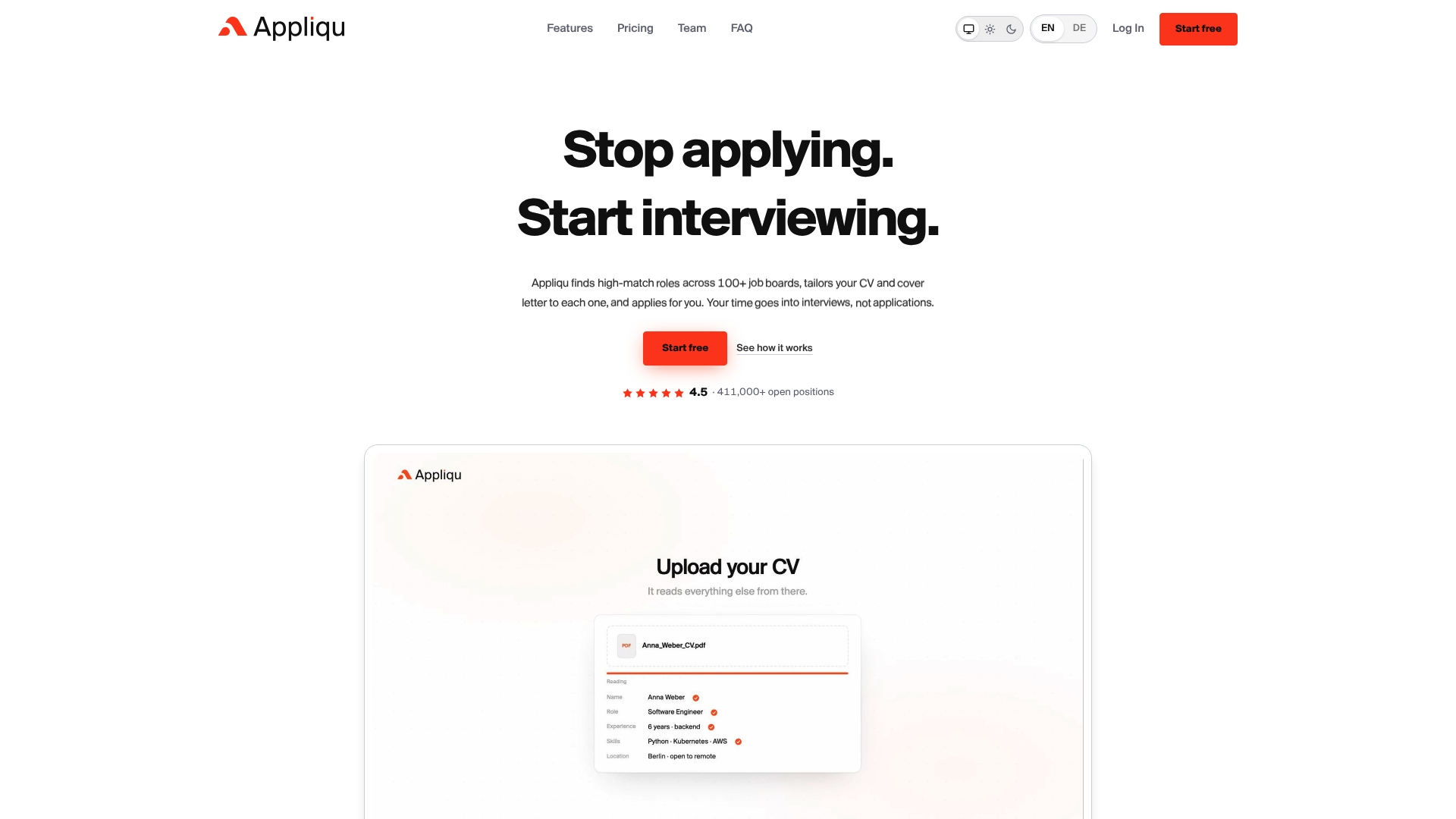
Start with the free Explorer plan on the Appliqu pricing page and read the five letters it writes against your own CV.
A practical way to decide
Use this short test.
| Your situation | Best route |
|---|---|
| One important application, unusual background | Human writer, or a careers adviser |
| A few applications, you enjoy writing | Write it yourself using a structure |
| Many applications across several roles | Appliqu, writing a letter per role |
| Many applications and a need for senior input | Appliqu Concierge, with a senior consultant session |
| Employer does not read letters | Skip the letter, focus on the CV |
If you are automating, keep the quality of each application high. Our five-stage workflow for automating job applications without losing tailoring describes how to do it, and our guide to avoiding auto-apply mistakes covers what goes wrong when it is done carelessly. If your CV needs adapting for each role too, read whether AI can tailor your CV for every application.
Frequently asked questions
Is a cover letter writing service worth paying for?
It is worth it when the letter has to make an argument your CV cannot, for example in a career change or a senior application. It is less worthwhile for high-volume searching, where per-letter fees add up quickly. Ask for a sample and check the revision terms before you commit.
What is the difference between a personalised letter and a template?
A template changes the company name and job title. A personalised letter selects the evidence from your history that matches this employer's priorities and explains why you want this particular role. If a letter could be sent to another employer unchanged, it is a template.
Can I use AI to write my cover letter?
Yes, provided you edit the result. CareerOneStop advises that the output should reflect your own voice, skills, experience and interest in the role. Check every claim against your CV, and remove anything you could not discuss at interview.
Does Appliqu write a cover letter for every application?
Yes. Appliqu writes an individual letter for each role, tailors your CV and applies in the employer's own application form. In "on approval" mode you approve every application first. On Autopilot, Appliqu applies on its own.
How do I avoid scams when hiring a writer?
Search the provider's name with words like scam or complaint, and read independent reviews. Treat any request for upfront payment in return for a job, or any guarantee of interviews, as a warning. Paying for a document you receive is different from paying for a promised placement.
Sources
- NC State Poole College of Management: Resume and Cover Letter Style Guide
- University of Cambridge Careers Service: CVs and Applications
- CareerOneStop: How do I write a cover letter?
- GOV.UK: Designing good government services
- FTC consumer advice: Job seekers, avoid executive placement scams
- FTC: Halts fake job opportunity and resume repair operation
- Cinfo: Job application support in international cooperation
- Velo Apply: Freelancer vs AI tool