Stop Auto Apply Mistakes: AI Job Search for Candidates With 5 Free Drafts

AI can genuinely speed up job hunting: it scans listings faster than you can, scores fit against your profile, and drafts tailored CVs and cover letters in seconds rather than hours. It cannot yet judge nuance, verify its own claims, or read a room in an interview. The safe rule is simple: let AI draft and shortlist, and you review before anything gets sent. Coursera's Accelerate Your Job Search with AI course and Atlas Job's practical guide both teach this exact discipline, and Appliqu builds it into the product itself.
TL;DR:
- AI tools excel at discovering new job listings quickly and continuously across multiple boards, often within hours of posting.
- Semantic matching improves accuracy by evaluating responsibilities rather than just keywords, enabling better alignment in roles like career changers or senior positions.
- A cautious workflow involves setting clear criteria, reviewing drafts for fabricated claims, and applying each application with human oversight to avoid risks like dishonesty or account flags.
- Using AI for job applications works best alongside personal networking and industry contacts, especially for high-level or niche roles, where direct outreach still dominates.
- Employers still prefer human-reviewed cover letters and interviews, so AI drafts should be used as first passes, with final editing and truth-checking before submission.
Table of Contents
- What does AI job search actually do?
- How to run an efficient, safe AI-assisted job search
- Prompts, templates and the weekly improvement loop
- Risks, etiquette and the guardrails that protect your candidacy
- How Appliqu builds the safe workflow into the product
- Where AI fits alongside traditional job hunting
- Customising AI to different industries and roles
- Data privacy and security in AI job search tools
- What actually matters, in Alex's view
- Getting started with Appliqu's approach
- Sources
- FAQ
What does AI job search actually do?
Four functions do the real work: discovery, scoring, tailoring and tracking. Atlas Job's breakdown of AI job search functions treats these as the four pillars worth understanding before you trust any output.
Discovery means continuous scanning across dozens or hundreds of job boards rather than you refreshing five tabs each morning. A properly built aggregator checks new postings around the clock, catching listings within hours of going live rather than days.
Scoring is where semantic matching earns its keep. Keyword matching flags a CV because it contains the word "Python"; semantic matching reads the whole job description and your whole profile, then judges whether the underlying responsibilities actually line up. This distinction matters more than most jobseekers realise. A role titled "Growth Marketing Manager" might genuinely suit a candidate whose CV says "Demand Generation Lead" if the semantic engine reads the duties, not just the title.
Tailoring takes your base CV and adjusts emphasis, phrasing and bullet order to mirror the language of a specific advert, without inventing experience you don't have. Good tailoring highlights real achievements in the words the employer used. Bad tailoring invents a certification or inflates a job title, which is fabrication, not optimisation.
Tracking replaces the spreadsheet you were never going to keep updated. A proper pipeline view shows what's been sent, when, and what follow-up is due.
Red flags to watch for in any AI-assisted output:
- A tailored CV bullet that claims a skill or result not present anywhere in your original material
- A cover letter that reads generically despite claiming to be "tailored"
- A match score with no explanation of which criteria drove it
- No visible date stamp or status on tracked applications
If you want a deeper look at how tailoring should work in practice, Appliqu's guide to CV tailoring covers the mechanics in more detail.
How to run an efficient, safe AI-assisted job search
Follow this sequence and you get the speed benefit of automation without the reputational risk of sending sloppy or dishonest applications.
- Set precise criteria first. Define role, location, salary floor and two or three genuine must-haves. Vague criteria produce a flood of low-relevance matches that waste your review time later.
- Let AI score and shortlist, then apply judgement. A high match score is a starting point, not a verdict. Discard anything below your threshold and skim the rest for obvious mismatches the algorithm missed.
- Tailor with AI, then edit in your own voice. Run the draft, then read it aloud. If a sentence doesn't sound like you, rewrite it. This step alone catches most fabrication risks.
- Run every claim through a truth check. Does every skill, date and achievement in the draft trace back to something in your real CV or portfolio? If not, cut it.
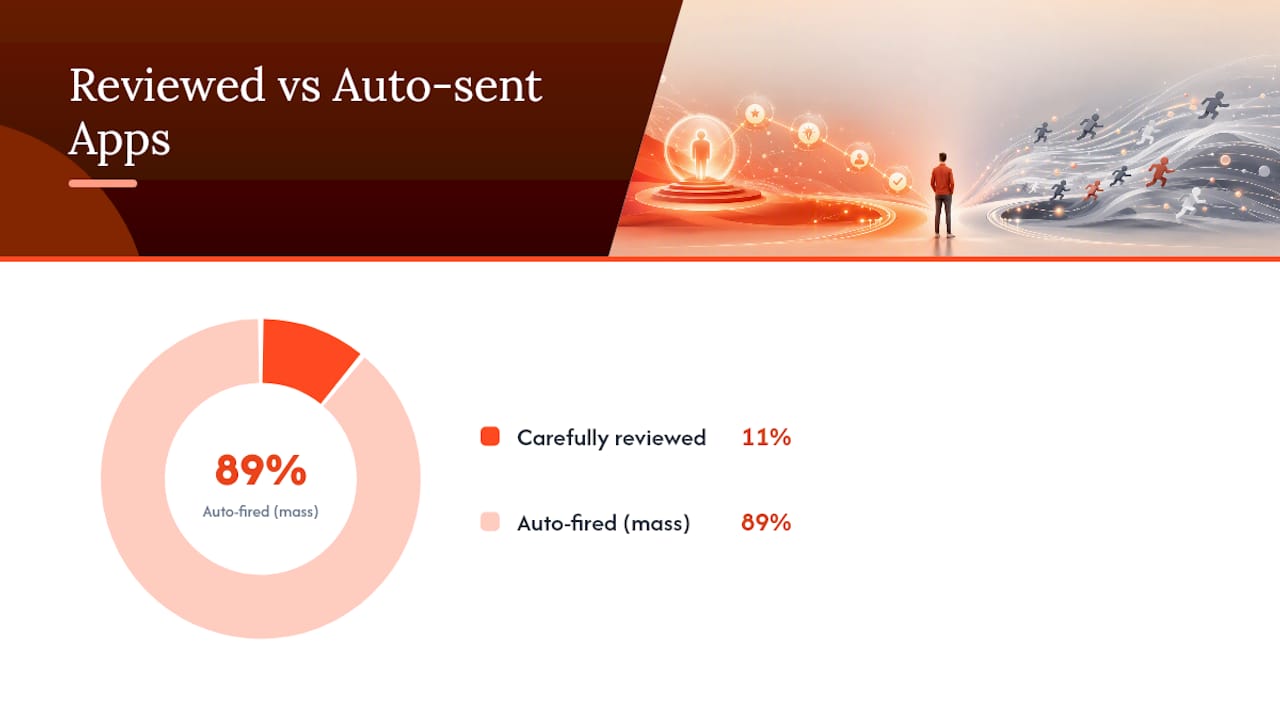
- Cap your daily sends and keep a final approval step. Ten carefully reviewed applications beat eighty auto-fired ones. Atlas Job's safe workflow guide makes the same point: unsupervised mass auto-applying tends to backfire, both on response quality and on your own attention.
- Track every submission and schedule follow-ups. A week with no reply usually warrants a short, polite nudge, not silence.
Pro Tip: Keep a "skills evidence" note, three or four bullet points listing your provable, quantifiable achievements. Paste it into every AI prompt as a constraint so the tool can't drift into invented claims.
This sequence is also where Appliqu's cover letter comparison is useful reading, since it shows how generator tools differ from a workflow that keeps a human checkpoint before sending.
Prompts, templates and the weekly improvement loop
A good AI prompt works like a brief: context, constraints, format and quality criteria. Tell the tool who you are, what you won't claim, how long the output should be, and what "good" looks like. Find My Lane's guide on prompts that actually help treats prompting as a skill in its own right, not an afterthought.
Before tailoring anything, build a quick skill map: pull the eight to twelve job adverts you're most interested in, list the recurring phrases and requirements, then use that map to decide which of your real achievements to foreground in each CV version.
A repeatable three-step loop keeps quality climbing:
- Draft. Generate the first version with your brief.
- Critique. Ask the tool (or a trusted person) what's weak, generic, or unsupported.
- Rewrite. Fix the specific issues, don't just regenerate from scratch.
Track two numbers weekly: applications sent versus replies received, and interviews per ten applications. If replies stall, the problem is usually the tailoring, not the volume.
Sample prompt skeleton for a CV bullet: "Using only the achievements listed below, rewrite this bullet to emphasise [skill from the advert], in under 20 words, without adding any skill not listed." For interview prep, a STAR-format prompt built around Appliqu's common interview questions turns vague nervousness into structured answers you can actually rehearse.
Risks, etiquette and the guardrails that protect your candidacy
Fabrication is the single biggest risk. An AI draft that invents a certification, inflates a job title, or claims a result you didn't achieve isn't a shortcut, it's a lie with your name attached. Map every claim in a draft back to real evidence before it leaves your outbox.

Mass auto-apply is the second risk, and it's more common than most jobseekers admit. JobSprout's sector data shows AI use in job applications has grown quickly, and the same research notes that employers often give candidates no guidance at all on whether AI use is acceptable. That silence cuts both ways: it means you won't be automatically penalised for using AI, but it also means you carry full responsibility for what you send.
Practical guardrails worth adopting:
- Cap daily sends rather than firing every match the moment it appears
- Prefer a workflow that pre-fills a form and waits for your approval over one that submits without checkpoint
- Be ready to answer honestly if asked whether you used AI, transparency reads better than denial
- Never let an automated tool answer application questions that request personal reflection or specific project detail you haven't verified
Many UK jobseekers already use AI in applications, yet most still say they trust human-led hiring decisions more than fully automated ones. That gap is exactly why the human review step isn't optional.
Portal bot detection is a real, practical concern too. Systems that auto-submit at scale risk account flags. A pre-fill-then-approve model avoids that entirely, since a human still clicks "send". Appliqu's piece on whether recruiters can tell is worth reading if you want the fuller picture on detection and disclosure.
How Appliqu builds the safe workflow into the product
Appliqu reads the full text of each job posting, not just its keywords, and matches it against your profile across more than 100 job boards. That semantic approach is what lets it surface roles a keyword search would miss, then draft a tailored CV and cover letter for each one.
The plans map directly onto how much of the workflow you want automated:
- Explorer is a permanent free tier. Appliqu writes 5 applications so you can see the drafting quality before committing to anything.
- Core costs €29.90 a month and unlocks sending, with 100 applications included.
- Pro costs €69.90 a month for 300 applications, plus access to the Appliqu Job Board.
- Concierge costs €199 a month for unlimited applications and a session with a senior consultant.
All prices include 19% VAT. Two sending modes exist throughout: on approval, where Appliqu prepares each application and waits for your sign-off, and Autopilot, where sending runs without a per-application check. Given the fabrication and volume risks covered above, on approval is the sensible default for anyone still calibrating their criteria.
In practice, this saves the most time on the repetitive parts, drafting variations, pre-filling forms, and keeping a live pipeline view, while leaving judgement calls with you. For CV mechanics specifically, Appliqu's CV builder guide covers ATS formatting in more depth.
Where AI fits alongside traditional job hunting
AI job search tools work best as an addition to your existing network, not a replacement for it. Referrals, industry contacts and direct outreach still open doors that no aggregator can see, particularly for senior or niche roles that never get publicly posted. The sensible split: let automated discovery handle the high-volume, publicly listed roles, and keep your own relationship-building for the roles that move through word of mouth.
Recruiters and hiring managers still expect a human voice in cover letters and interview answers, so treat AI drafts as a first pass, not a final product. A CV tailored by AI should still get read aloud by you before it goes anywhere, and a cover letter should reference something specific about the company that a generic tool couldn't have guessed.
There's also a timing argument for blending methods. Traditional networking moves slowly, weeks or months to build a useful contact, while automated discovery can surface and apply to a fresh listing within hours of it going live. Running both in parallel means you're never solely dependent on one channel's pace.
The practical version of this looks like: two or three hours a week on networking and informational conversations, and the rest of your search time on automated discovery, scoring and tailored applications, reviewed before sending. Neither channel alone gives you full market coverage, but together they cover the roles that are advertised and the roles that never are.
Customising AI to different industries and roles
A matching algorithm tuned for graduate schemes behaves differently to one tuned for senior technical hires, and the difference matters more than most jobseekers assume. Entry-level roles tend to weight transferable skills and potential heavily, since candidates rarely have deep track records yet. Senior and specialist roles weight specific, provable experience, named tools, certifications, years in a narrow function, far more heavily.
This is why semantic matching outperforms simple keyword filters for career changers in particular. Someone moving from teaching into corporate training doesn't share many keywords with a "Learning and Development Manager" posting, but the underlying skills, curriculum design, stakeholder communication, assessment, overlap heavily. A matching system that reads full context rather than isolated terms catches that overlap; one that doesn't will filter the candidate out before a human ever sees the application.
Freelancers and contractors need a different customisation again: matching against project-based briefs and day-rate expectations rather than fixed salary bands and permanent job titles. Regulated professions, healthcare, law, finance, add another layer, since a tailored CV still has to respect licensing language and can't soften or omit legally relevant qualifications.
The practical takeaway is to check, whenever you're using an AI job search tool, whether it lets you set role-specific criteria rather than applying one generic scoring model to every application. If it doesn't, you'll see a flood of technically-keyword-matched but practically irrelevant results.
Data privacy and security in AI job search tools
Your CV contains some of the most sensitive personal data you'll hand to any online service: full work history, salary expectations, sometimes health-related career gaps, and enough detail to build a fairly complete profile of you. Before connecting any AI job search tool to your accounts or uploading a CV, check what happens to that data after the application is sent.
Three questions are worth asking of any platform: does it store your CV and cover letter drafts indefinitely or only for the duration of an active search, does it share your data with third parties beyond the job boards you're actually applying to, and can you delete your data on request. Under data protection law across the EU, including Germany, Austria and Switzerland's own equivalent framework, you have a right to know what's held and to request deletion, and a legitimate provider should make that process straightforward rather than buried in support tickets.
Auto-fill features carry their own risk if implemented carelessly, since a tool that stores your login credentials for multiple job boards is holding a meaningful amount of access. Look for providers that use secure, encrypted storage for anything of that nature, and be cautious of any tool that asks for more account access than the task actually requires. Reading the privacy policy before you connect your accounts takes five minutes and tells you more than any marketing page will.
What actually matters, in Alex's view
The debate around AI job search usually gets framed as automation versus authenticity, as if the two are opposites. They aren't. The tools that work best are the ones that speed up drafting while leaving a human checkpoint before anything sends, which is exactly the workflow Atlas Job and Coursera's own course both teach. Test it, track your reply rate honestly, and adjust weekly rather than assuming the first version of your prompts is the best one.
Alex
Getting started with Appliqu's approach
Appliqu is the practical way to run the exact workflow this article describes, without the manual grind of retyping the same CV details into forty different application forms. Explorer, the free tier, lets Appliqu write 5 applications so you can judge the drafting quality for yourself before spending anything. Core, at €29.90 a month, unlocks sending for 100 applications; Pro, at €69.90 a month, extends that to 300 applications plus the Appliqu Job Board; Concierge, at €199 a month, gives unlimited applications and a session with a senior consultant. All prices include 19% VAT.
Getting started takes three steps: build your profile with your real, provable achievements, run your first search with precise criteria rather than broad ones, and review Appliqu's first application drafts closely before deciding whether "on approval" or Autopilot suits how much oversight you want. If you want to see the full plan breakdown and start with your first free drafts, visit Appliqu's homepage to set up your profile.
Sources
- Accelerate Your Job Search with AI
- AI and the UK job search: 2026 statistics, trends and data | JobSprout
- UK jobseekers use AI in applications, but trust humans
FAQ
Can I use AI to find a job?
Yes. AI tools can scan job boards continuously, score how well a listing matches your profile, and draft tailored CVs and cover letters, but you should still review every draft before it's sent.
What's the best AI for job search?
There's no single "best" tool for every case; the stronger question is whether a tool uses semantic matching across many boards and keeps a human review step, which is how Appliqu and the workflow described by Atlas Job both operate.
How do you search for jobs using AI?
Set precise criteria (role, location, salary floor, must-haves), let an AI tool scan and score listings against your profile, tailor your CV and cover letter for the strongest matches, then review and send manually or via an "on approval" step.
Which jobs are least likely to be replaced by AI?
Roles requiring deep human judgement, physical dexterity, or high-stakes interpersonal trust, such as skilled trades, senior clinical care, and complex negotiation-heavy roles, tend to be cited as more resistant to automation, though no role is entirely immune to change over time.