Career Coaching for Job Seekers: What It Covers and How to Choose

Career coaching for job seekers is structured, one-to-one guidance through a job search: clarifying what you want, choosing target roles, sharpening applications, preparing for interviews and weighing offers. A coach advises and challenges you, but you still do the work. The most useful way to approach it is to separate the thinking work (direction, positioning, confidence), where a human coach adds the most, from the execution work (searching, writing, submitting, tracking), which can be handled by Appliqu.
This guide explains what a coach actually does, what a typical engagement looks like, how transition coaching works, how to assess a coach before you commit, and how to combine coaching with automation without paying twice for the same task.
TL;DR
- A career coach helps you set direction, build a target list, refine applications, prepare for interviews and negotiate. You carry out the plan yourself.
- Research on job-search interventions is encouraging, but it describes groups of people and promises no individual outcome.
- Before hiring a coach, check credentials, ask for a preliminary conversation and confirm the coach's approach fits your situation.
- Coaching is strongest on direction and confidence. Appliqu covers the repetitive execution: it searches, scores, writes, tailors and applies for you.
- Career changers, graduates, employed professionals and international applicants each need a different emphasis from a coach.
Table of Contents
- What a career coach does for a job seeker
- What a coaching engagement looks like
- Career transition coaching: moving into a different field
- What the evidence says about coaching and job-search support
- Career coach, job search coach or career consultant
- How to assess a coach before you commit
- Where AI fits next to a human coach
- Our perspective
- Putting coaching and Appliqu together
- Adapting coaching to your situation
- Appliqu plans for the execution side
- FAQ
- Sources
What a career coach does for a job seeker
A career coach works with you on the decisions that sit before and around an application. According to Kellogg School of Management's account of its career coaching (November 2025), a coach can help you clarify goals and motivations, identify suitable companies, build a target list, refine applications, prepare for interviews and negotiate offers. Coaches can also help you identify the competencies a role requires and point you to resources for building the ones you lack.
The same source describes the core method: converting self-knowledge about your values, motivations and goals into an actionable search plan, while the job seeker keeps ownership of the journey. That last point matters. A coach is not a recruiter and does not place you in a job.
In practice the work falls into five areas:
- Direction. Which roles, sectors and employers fit your skills and priorities.
- Positioning. How your CV, LinkedIn profile and cover letters present that direction.
- Search strategy. Where to look, whom to contact, and how many applications deserve real effort.
- Interviews. Preparing your answers, practising, and reviewing what happened afterwards.
- Offers. Comparing options against your own priorities and negotiating terms.
What a coaching engagement looks like
Engagements differ by coach, but they tend to follow a similar order. One session-by-session description of a full career coaching engagement moves from intake and assessment through role research, CV and LinkedIn materials, job search and interview preparation, and finally offer negotiation. The search itself runs on a weekly rhythm, so each session reviews what you did since the last one and sets the next tasks.
Deloitte's coaching roadmap for transition assistance gives a similarly detailed picture. Job-search coaching can begin with a CV review, an emotional check-in and a search strategy. It then continues through assessments, personal branding, CVs, social profiles, cover letters, networking and online search tools. Later stages include preparation for interview methods, mock interviews, feedback on past interviews, and evaluation of offers. Deloitte notes that a coach can help you assess what worked in an interview and what should improve before the next opportunity, and can discuss offer choices against your priorities.
A realistic first session therefore looks like this:
- You describe your situation: current role or gap, what prompted the search, constraints such as location, salary or visa.
- The coach asks about achievements, preferences and past applications.
- You agree what the next four to six weeks should produce, for example a target list of 20 employers and a revised CV.
- You leave with tasks, not just advice.
Career transition coaching: moving into a different field
If you are changing field, the work is different. The question is no longer "how do I present myself for this job" but "which jobs should I be aiming at, and what is the route there".
According to the same session-by-session guide, transition coaches may use interest, values and strengths assessments to narrow down directions. You then research and choose a target role, and map the change, including any retraining and the order of the steps.
A useful transition coaching process usually produces:
- A transferable skills inventory. Skills written in the language of the target field, not your old one. A project manager in construction and one in software share planning, budgeting and stakeholder work, but describe it differently.
- A shortlist of two or three target roles. Not ten. Each one has a clear gap analysis: what you already have and what is missing.
- A bridging plan. A course, a certification, a side project or a lateral move that makes the change credible.
- A narrative. A short, honest explanation of why you are changing and why now, which you can use in cover letters and interviews.
The narrative is where cover letters often fail for career changers. A generic letter cannot carry a story about a change. Each letter needs to connect your background to that specific role, which is why many career changers pair coaching with a tailored application for each posting. Our cover letter examples show three full letters with the job ad alongside, so you can see how a letter ties experience to a posting.
What the evidence says about coaching and job-search support
No study can promise that coaching will work for you, and we make no such promise. What the research does show is that structured support tends to help in aggregate.
- A meta-analysis of coaching effects on individuals in organisations found a significant positive effect of coaching on work and career attitudes, with an effect size of 0.54.
- A summary published by the Career Development Association of Australia reports a meta-analysis of 47 independent studies involving 9,575 people. The odds of getting a job were 2.67 times higher for people who took part in a job-search intervention than for those who did not.
- For students, a 2016 meta-analysis of nine studies on career interventions for university and graduate students found a large weighted effect size of 0.80. Interventions based on socio-constructivist models showed higher effectiveness than those based on social cognition theory or person-environment fit models.
Two cautions apply when reading these figures. First, a job-search intervention is broader than one-to-one coaching: it includes workshops and group programmes. Second, an average across studies describes a group, not you. Use the findings as a reason to take structured support seriously, not as a forecast.
Career coach, job search coach or career consultant
The three labels overlap, and there is no single legal definition in the UK, so judge a person by what they offer rather than by the title.
| Label | Typical focus | What to ask |
|---|---|---|
| Career coach | Direction, goals, transitions, long-term planning | How do you work with assessments and goal setting? |
| Job search coach | The search itself: CV, applications, networking, interviews | What will I have produced by the end of each session? |
| Career consultant | Often a more advisory and expert-led role, sometimes with a specific sector focus | Which sectors and levels do you know well? |
One point holds across all of them. As Indeed's guide to job search coaches puts it, a job search coach mentors you through the search, but you must follow through on the advice, because the coach cannot do all the work for you. That gap between advice and execution is exactly where most job seekers lose time.
How to assess a coach before you commit
UCSF's career office suggests using the NCDA comparison chart to understand professionals' education, credentials and practice focus. It also recommends a preliminary consultation in which you ask about qualifications, approach, expertise and process, and judge whether you feel comfortable with the person.
Turn that into a checklist:
- Credentials. Coaching is not a regulated profession in the UK, so look for accreditation from a professional body. The International Coaching Federation publishes a credentialed coach finder for the UK where you can filter by job and career change.
- Relevant experience. Has the coach worked with people in your sector, at your level, or in your kind of transition?
- Method. Ask what a typical session looks like and what you will do between sessions.
- Scope. Is it coaching only, or does it include CV writing, LinkedIn work and interview practice? Know what you are buying.
- Terms. Ask about the length of an engagement, the price per session or package, and the cancellation terms before you agree.
- Fit. After the first conversation, ask yourself whether you would be comfortable discussing a bad interview with this person.
Many coaches offer an introductory conversation, so use it with two or three candidates before choosing.
Where AI fits next to a human coach
Searches such as "AI career coaching" reflect a real question: which parts of the work can be automated, and which need a person?
Research from The Conference Board, reported in 2025, indicates that AI can manage up to 90% of day-to-day coaching functions, such as guiding goal-focused conversations, role-play, feedback, matching and onboarding, and supporting clients between sessions. Human expertise remains necessary for emotionally charged, political or values-based discussions. A 2025 study by Stellenbosch Business School of an AI chatbot coach with graduate employees found that it improved goal clarity and structured thinking, while users missed the sense of personal connection they get from a human.
The JFF field guide on generative AI in career coaching (2025) describes coaches as providing nuanced interpretation of goals, recognition of potential and empathetic support through transitions, while AI tools process market data. The Globe and Mail quotes a University of Waterloo researcher who argues that AI should augment rather than replace a job seeker's own critical thinking.
The practical conclusion is a division of labour:
- Use a human coach for the questions about who you want to be professionally, what to say about a career break, how to handle a difficult conversation and how to weigh an offer.
- Use Appliqu for the repetitive volume of the search: Appliqu searches more than 1.5 million jobs from over 500 sources, including company career pages, and scores every role against your profile with semantic matching. Appliqu writes a tailored cover letter for each role, adapts your CV and applies in the employer's own application form.
Our perspective
Most job seekers we talk to do not lack advice. They lack hours. A coach can tell you which roles fit, but someone still has to read each posting in full, adapt the CV, write a letter that refers to that role and complete the employer's form. That is where weeks disappear.
We built Appliqu to take over that whole chain instead of one step of it. Appliqu searches, scores each role against your profile, writes the cover letter, tailors the CV, applies in the employer's own form and detects replies and interview invitations in your inbox. Every application is individual, with no mass emails.
You decide how much control you keep. In approval mode you approve every application yourself. On Autopilot, Appliqu applies on its own. Either way you edit your CV together with Appliqu, so the documents stay yours.
Our view is that coaching and Appliqu answer different questions. Coaching answers "what should I go for?" and Appliqu answers "how do I apply to all of it properly without losing my evenings?" If you agree a target list with a coach, Appliqu can carry out the applications against it.
Niclas Fischell
Putting coaching and Appliqu together
If you want a structure that works, use this sequence:
- Define direction. With a coach, or alone using the transferable skills approach above, decide on two or three target roles.
- Set the profile. Enter your experience, preferences and target roles in Appliqu so that scoring reflects your priorities.
- Choose your mode. Start with approval mode if you want to read every letter before it is sent. Move to Autopilot once you trust the output.
- Review weekly. Use your coaching sessions, or a weekly self-review, to look at which applications and replies came in and adjust the targets.
- Prepare for interviews. When Appliqu detects an invitation in your inbox, move your effort to preparation and practice.
Our guides on focused, market-driven applications and on scaling targeted applications without losing quality explain why a short, well-scored list beats volume for its own sake. If you want to know how tailoring works, see how AI can tailor your CV for every application.
Adapting coaching to your situation
Employed professionals searching quietly
Your constraint is time and discretion. Ask a coach to focus on positioning and on how to approach a search without alerting your employer. Keep the execution light: applications that arrive while you work, and replies collected in one place, matter more than extra hours at night.
Career changers
Spend most of the coaching budget on the transition plan described earlier: skills inventory, two or three target roles, a bridging step and a narrative. Then write each application so the narrative is visible in the letter.
Graduates and students
The 2016 meta-analysis cited above points to benefits from career interventions for students, so use your university careers service first, as it is usually included in your studies. Early-career coaching should focus on choosing a direction, a first CV and interview practice. For internships and first jobs, volume matters more than for senior roles, but each application still needs to refer to the role.

International job seekers
If you apply across borders, the coaching questions are about geography, language and sector. HEC Paris describes MBA coaching that includes sector-specific coaching and weighing sector, geography and language priorities when planning a career change. Apply the same logic to your own search: decide the country and sector first, then search. Appliqu works for English-language applications in any country.
Appliqu plans for the execution side
The Explorer plan is free permanently, and Appliqu writes 5 applications there. Sending applications starts with Core.
| Plan | Price per month | What it covers |
|---|---|---|
| Explorer | €0 | 5 written applications, permanently free |
| Core | €29.90 | 100 applications |
| Pro | €69.90 | 300 applications, plus the Appliqu Job Board |
| Concierge | €199 | Unlimited applications, plus a senior consultant session |
Prices include VAT where applicable.
If you want one human conversation as part of the package, Concierge includes a session with a senior consultant alongside unlimited applications. You can compare all plans on the Appliqu plans page.
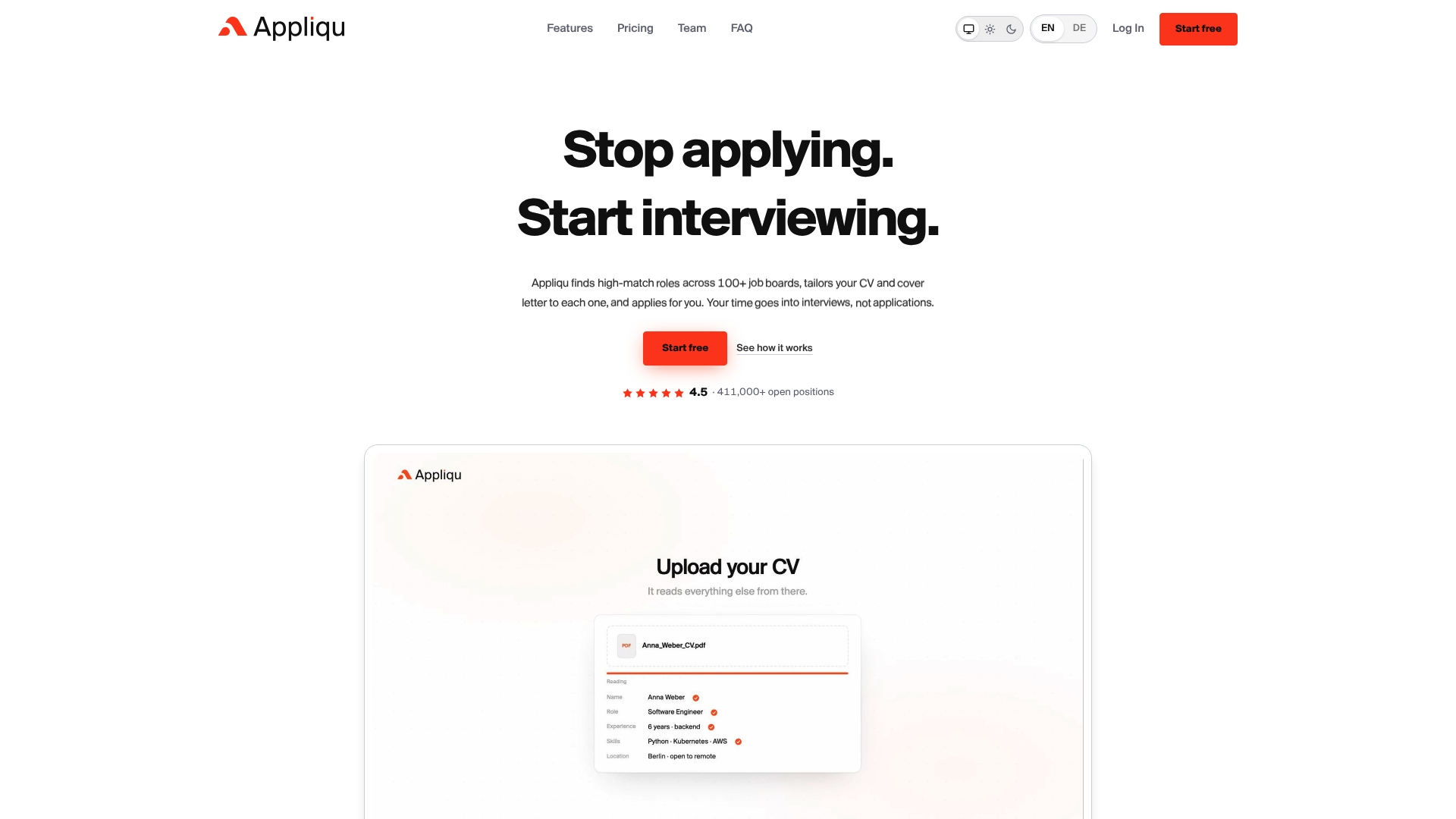
Start on Explorer to see what Appliqu writes for a real posting from your target list, then move to the plan that matches how many applications your search needs.
FAQ
Is career coaching worth it for a job search?
It can be, particularly if your difficulty is direction, confidence or interviews rather than a lack of openings. Research on job-search interventions is positive on average, as shown above, but it cannot predict your result. Define what you want from the coach before the first session so you can judge progress.
How is a career coach different from a recruiter?
A recruiter is usually paid by an employer to fill a vacancy. A career coach works for you, helps you decide what to aim for and prepares you to apply. A coach does not place you in a job, and, as Indeed's guide notes, the coach cannot do the work for you.
Can AI replace a career coach?
It can take over a large share of structured, repetitive tasks. The Conference Board's research indicates AI can manage up to 90% of day-to-day coaching functions, but human expertise remains necessary for emotionally charged or values-based conversations. Many job seekers use both: a person for the big decisions and Appliqu for searching, writing and applying.
How do I find a qualified career coach in the UK?
Start with a professional body directory such as the ICF credentialed coach finder, then book a preliminary conversation with two or three coaches. Ask about qualifications, approach, relevant experience and terms, and choose the one you feel comfortable working with.
What should I prepare for my first coaching session?
Bring your current CV, a list of roles you have considered, and a short account of what is and is not working in your search. Also note your constraints, such as location, salary range, notice period or visa status. This lets the coach move straight to a plan.
Sources
- Kellogg School of Management: How Kellogg career coaches help you
- Meta-analysis on the effects of coaching on individual level outcomes in an organizational context
- CDAA: Career Development Works
- What Does a Career Coach Do? The Work, Session by Session
- Deloitte: Transition Assistance Coaching Roadmap
- ECPS Journal: What Do University or Graduate Students Need to Make the Transition
- Indeed: What Is a Job Search Coach?
- UCSF: Choosing a Career Development Professional
- ICF UK: Find a Coach
- The Conference Board research on AI and career coaching
- Stellenbosch Business School: AI coaching for graduate employees
- JFF: Career Coaching and Generative AI Field Guide
- The Globe and Mail: Can AI be an effective career coach?
- MBA Pathfinders: Career Support at HEC Paris