Confidential Job Search: How to Look for a New Job Discreetly

A confidential job search stays private because you control three things: the devices and accounts you use, the hours you spend, and the places where your name and intentions become visible. The less manual work the search needs during your working week, the fewer signals you create. Appliqu searches more than 1.5 million jobs from over 500 sources, including company career pages, writes a tailored cover letter for each role and applies for you in the employer's own application form, so the daily routine that usually gives people away is largely removed.
TL;DR
- A discreet search fails mostly through signals you create yourself: work devices, public profile changes, calendar entries and a trusted colleague who talks.
- Decide your confidentiality level first (employer unaware, a few people aware, or open), then set your CV, LinkedIn and email accordingly.
- Keep every part of the search on personal devices, personal email and your own time, and schedule interviews outside core hours.
- Appliqu applies for you in approval mode or on Autopilot, and connects to your inbox to detect replies and interview invitations in one place.
- Career changers and first-time applicants can use the same approach, with the CV adapted to each role.
Table of Contents
- What a confidential job search actually means
- Where a confidential search usually leaks
- Set up your search before you apply
- Take the daily routine out of your working week
- Recruiters and networking without exposure
- Handling replies and interview invitations discreetly
- Confidential searches for career changers
- What to check in any search service
- Plans and prices
- Start a discreet search with Appliqu
- Our perspective
- FAQ
- Sources
What a confidential job search actually means
The terms "confidential", "discreet", "stealth" and "passive" overlap, but they are not the same thing.
A passive job search means you are employed, open to a better offer and not actively applying. Recruiters approach you, and you respond selectively. A confidential or stealth search is an active search that you keep private from your current employer and colleagues. You may apply to dozens of roles while looking entirely settled at work.
The level of secrecy you need varies. A recruiter writing for Winslow Search describes three levels: external only (your employer knows, outsiders do not), most colleagues unaware (your manager and a few peers know), and full confidentiality, where nobody at your company knows until you resign. Dream Executive uses a similar split: fully confidential, selectively open and open. Decide which one applies to you before you change anything, because it determines your CV wording, your LinkedIn settings and who you tell.

Most employed professionals need the full version. Job-Hunt.org points out that searches can take months, and looking while still employed protects both your job and your income during that time.
Where a confidential search usually leaks
The Winslow Search guide makes a useful observation: candidates who fail at full confidentiality rarely do so because someone is watching them. They fail because they create signals their company can read, sometimes by accident and sometimes by trusting the wrong colleague. The usual signals are these:
- Work devices and networks. Company laptops, phones, email and Wi-Fi can be monitored. A local government guide on looking for a new job while employed says to use personal phones and your own time, never company resources.
- Calls and interviews at the office. Taking a recruiter's call in a meeting room risks being overheard. Step outside or take the call on a walk.
- Calendar entries. Block interview slots as "personal" or "busy", never as "interview".
- Public profile changes. A sudden LinkedIn rewrite, a new headline or a green "Open to Work" banner is visible to colleagues.
- Conversations. Telling a colleague you trust is the most common way the news reaches a manager.
- Reference requests and contact from new employers. A recruiter who phones your current employer too early ends your confidentiality.
Each of these is a habit you can change, which is why a confidential search is more a matter of routine than of secrecy tricks.
Set up your search before you apply
Spend an evening on setup, on a personal device, before you send anything.
1. Create a separate email address
Use a personal address that you do not share with your employer, ideally one that does not show your full name if you apply to roles blind. Never use your work address for any part of the search, including newsletter sign-ups and job alerts.
2. Prepare a CV that does not expose your employer
If you list your current employer on a CV that a recruiter or a job board may circulate, a colleague searching for your company name could find it. A common approach is to describe the employer generically (for example, "a European logistics company, 4,000 employees") until a serious conversation begins. Do not be creative with dates and job titles: recruiters verify them, and vague or changed facts cost you credibility.
Appliqu adapts your CV for each role together with you, so you can keep one master version with the level of detail you are comfortable sharing and let each application emphasise what that employer asks for.
3. Adjust LinkedIn quietly
Turn off the setting that shares profile changes with your network. Use the option that signals to recruiters only, rather than the public banner. Note that LinkedIn itself says it cannot guarantee complete privacy for that setting, and it works by hiding your status from recruiter accounts at the company you list as current. Treat it as a reduction in visibility, not a guarantee. Avoid posting content that reads like a job pitch, and avoid anything that reveals proprietary information about your current company.
4. Decide when interviews can happen
The Loudoun County guidance suggests scheduling interviews before or after work, at weekends, or on annual leave or personal days. When you reply to an invitation, say that you are employed and the search is confidential, and ask that nobody contacts your current employer before you have agreed to it. Video interviews at the start or end of the day are common, so offering them is rarely a problem.
5. Choose who knows
Tell nobody at work. Choose references who have already left the company where possible. Resign only once you have a signed offer and any background checks are complete.
Take the daily routine out of your working week
Setup protects your identity. The harder problem is time. A serious search means reading hundreds of postings, tailoring a cover letter for each, retyping the same details into employer forms and following up. Doing that around a full-time job pushes people to search at lunch, on the work laptop or in the toilet cubicle, which is exactly how searches leak.
This is where Appliqu removes the burden instead of adding another thing to manage. Appliqu takes over the application process:
- Search. Appliqu searches more than 1.5 million jobs from over 500 sources, including company career pages, so roles that are never posted on the large job boards still appear. Our guide to hidden job opportunities explains where those roles sit.
- Match. Appliqu scores every role against your profile with semantic matching, which compares the meaning of your experience with the meaning of the posting rather than counting identical keywords.
- Write. Appliqu writes a tailored cover letter for each role. Every application is individual, with no mass emails.
- Apply. Appliqu applies directly in the employer's own application form, just as you would yourself.
- Track. Appliqu connects to your inbox, detects replies and interview invitations and keeps all your applications in one place.
Because the work runs without you sitting at a screen during office hours, there is nothing to do at your desk. You check results in the evening, on your own device.
Choose how much control you keep
Confidentiality often goes together with a wish to control exactly what is sent. Appliqu gives you two modes:
- On approval: you approve every application yourself before it is sent. This suits people who want to review each cover letter and check that the right version of the CV goes to each employer.
- Autopilot: Appliqu applies on its own, which suits people with a clear profile who want the search to continue steadily without daily decisions.
A sensible pattern is to start on approval for the first few applications, confirm that the tone and the CV content match what you would send, and move to Autopilot once you are comfortable. For more on reviewing drafts before they go out, read our guide to job automation privacy, and for how the continuous approach works alongside a full-time job, see passive job search automation.
Recruiters and networking without exposure
Recruiters are one of the safest routes for a discreet search, provided you set the terms. Build relationships with a small number of specialists in your field before you need them. Share your CV only after you have reviewed a specific opportunity and have agreed that the recruiter may present you. In your first message, say that you are employed and that the search is confidential. Ask that nobody approaches your employer without your consent.
Executive search firms often go further. Aquis Search, for instance, describes a process in which candidates sign a non-disclosure agreement before the hiring company's name is revealed. That is typical of senior roles. For most professional roles, a polite request for confidentiality is the realistic standard.
Networking works best in small, personal conversations rather than public posts. A private message to a former colleague now at a company you admire reveals far less than a public update. If you are curious how much of the market never appears in public listings, the hidden-opportunities guide above covers it.

Handling replies and interview invitations discreetly
When a reply arrives, the risk moves from applying to responding. Check your personal inbox outside working hours, reply promptly and propose slots that do not clash with your working day. Appliqu detects replies and interview invitations in your connected inbox and keeps them alongside the application they belong to, so you do not need to search through messages to know which employer wrote and what they asked. Our guides on handling interview invitations and interview preparation cover the reply, the confirmation and the preparation in order.
If you plan your search in numbers, our article on interview pipeline forecasting shows how to estimate how many applications you need to keep your calendar manageable. A very full interview calendar is hard to hide, so planning matters in a confidential search.
Confidential searches for career changers
Career changers often search discreetly for good reason: they are not yet sure the move will work and prefer not to unsettle their current team. The approach is the same, with two additions.
Translate your experience. List what you do in your current role as skills, not job titles: managing budgets, handling difficult clients, analysing data, coordinating projects, training colleagues. Then compare that list with the requirements in postings for the new field. Skills that appear in both are your transferable skills, and they belong at the top of your CV and cover letter.
Let the match reflect meaning, not titles. A title filter will hide roles that fit you but are named differently. Because Appliqu scores each role against your profile with semantic matching, a role in a new field can score well when your experience genuinely corresponds to what the employer describes. Appliqu then writes the cover letter around that correspondence for each role, which is the part career changers find hardest to do repeatedly.
Graduates and students searching for internships or a first job can use the same setup. Confidentiality matters if you are working part-time or on a placement and do not want that employer to hear about it. A personal email address, a tailored cover letter for each application and a single place to see every reply are the basics.
What to check in any search service
Whatever service you use, confirm these points before you give it access to your inbox, your CV or your accounts:
- Control: can you approve each application, or let it run on its own, and change your mind later? Appliqu offers both on approval and Autopilot.
- Quality of each application: is every cover letter written for the specific role, or is the same text sent everywhere? Appliqu writes an individual letter for each role.
- Where applications are submitted: in the employer's own form, or by mass email? Appliqu applies in the employer's own application form.
- Data protection: what personal data is shared and with whom. If you are in the UK or EU, our guide to GDPR for job applications explains your rights and what to share.
- Price and volume: what you pay each month and how many applications that covers.
Plans and prices
Appliqu has four plans, and the prices include VAT where applicable:
| Plan | Price per month | Applications | Also included |
|---|---|---|---|
| Explorer | €0 | Appliqu writes 5 applications | Free forever |
| Core | €29.90 | 100 | Sending applications starts here |
| Pro | €69.90 | 300 | The Appliqu Job Board |
| Concierge | €199.00 | Unlimited | A senior consultant session |
Explorer is a permanent free plan: you see how Appliqu searches, scores and writes for your profile. Sending starts with Core.
Start a discreet search with Appliqu
If you want a search that continues quietly in the background while you do your job, Appliqu applies for you and keeps every reply in one place. Begin with Explorer, where Appliqu writes 5 applications for your profile, and move to Core when you want applications sent. You can compare all plans on the Appliqu plans page.
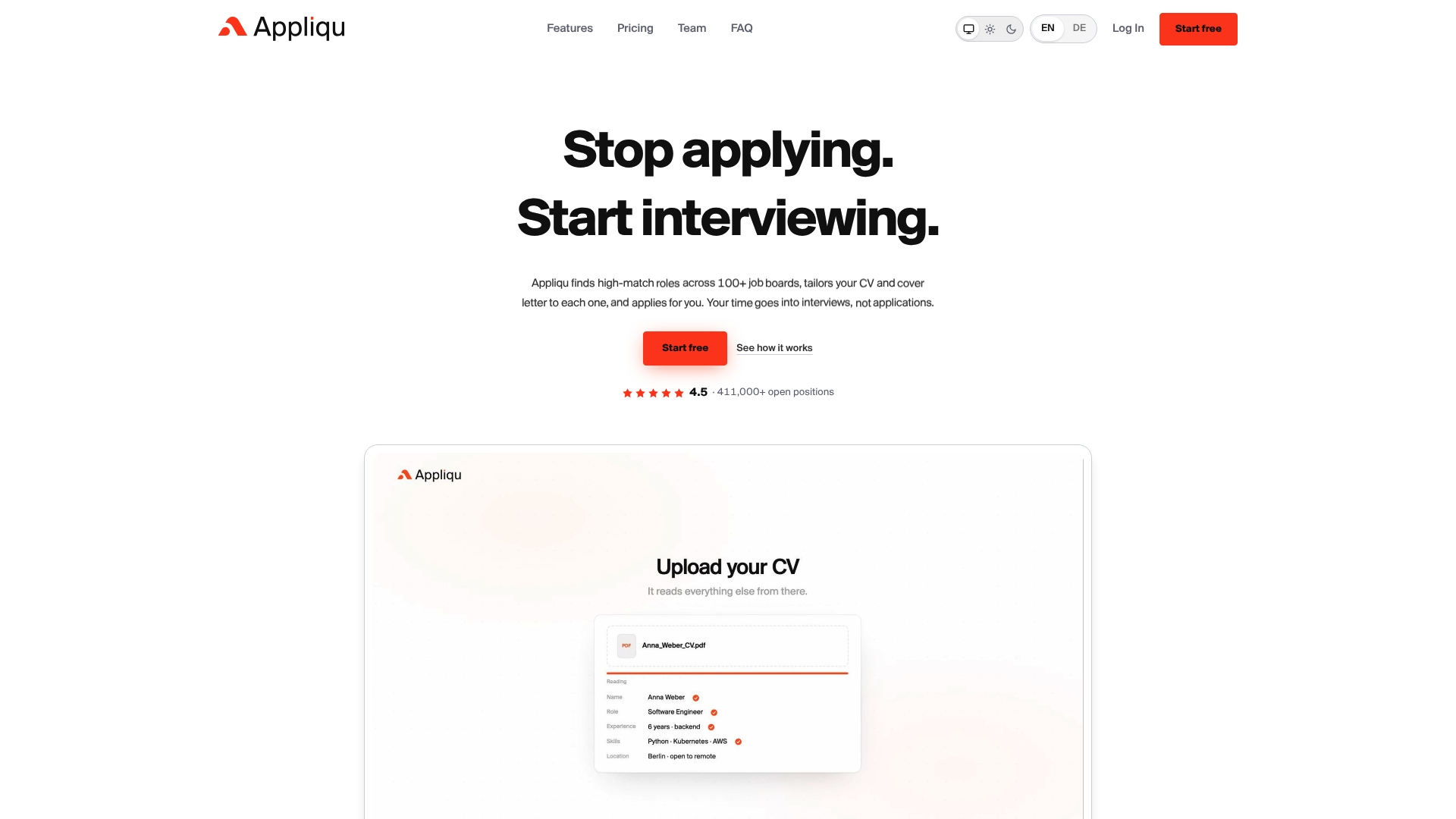
The Pro plan adds the Appliqu Job Board, and Concierge adds a senior consultant session for people who want to talk through a larger move, such as a change of field.
Our perspective
A confidential search is not about hiding. It is about not leaving a trail while you do the ordinary work of finding a better role.
The trail usually comes from the effort of the search itself: the lunchtime applications, the half-finished forms on the wrong laptop, the calendar gaps that nobody can explain. We built Appliqu around the idea that the whole application process, from search to the reply in your inbox, can be taken off your plate, so the search stops competing with your job for your attention.
You decide how much control you want. In approval mode you read and approve each application. On Autopilot, Appliqu applies on its own. In both cases every application is individual, written for that role and submitted in the employer's own form, which is how a considered candidate would apply anyway.
Our advice is simple. Decide your confidentiality level, keep the search on personal devices and let Appliqu handle the repetitive work, so your energy goes to the conversations that matter.
Niclas Fischell
FAQ
Is it legal to look for a new job while employed?
Yes, in general. Looking for another job is not unlawful, but your contract may contain terms on confidentiality, notice periods or working for competitors. Read your contract, and do not use company time or equipment for the search. If you are unsure about a specific clause, an employment adviser or solicitor can tell you where you stand.
Should I mark my current employer as confidential on my CV?
If your CV is circulating beyond a single application, describing your employer generically is a common approach, because a colleague searching the company name will not find you. Keep your job titles and dates accurate. Recruiters check them, and unclear facts damage trust. Once you are in a serious conversation, you can name the employer.
Does LinkedIn's recruiter-only setting hide my search?
It reduces visibility to recruiters at the company you list as current, but LinkedIn states it cannot guarantee complete privacy. Use it together with other precautions: switch off profile-change sharing, avoid public announcements and keep your messages private.
Can Appliqu apply for me without my having to approve each application?
Yes. On Autopilot, Appliqu applies on its own. In approval mode you approve every application yourself before it is sent. Sending applications starts with the Core plan, and Explorer is a free plan where Appliqu writes 5 applications.
How many applications do I need for a discreet search?
It depends on your field and seniority, so plan against your own numbers. Core covers 100 applications a month, Pro 300 and Concierge is unlimited. Our article on interview pipeline forecasting shows how to estimate the volume you need.
Sources
- Tips for looking for a new job while employed (Loudoun County)
- How to conduct a confidential executive search (Winslow Search)
- The confidential executive search (Dream Executive)
- Confidential job search: finding a job while employed (Job-Hunt.org)
- Look for a recruitment job without your boss knowing (MGP)
- Mastering confidential search (Aquis Search)
Recommended
The all-in-one career platform.
Appliqu finds matching jobs, rewrites your CV & cover letter for every single one and applies for you.
- Appliqu writes every application to an exceptional standard.
- You approve. Appliqu sends.
- Everything at a glance. Stay relaxed.
No credit card needed.
4.5 on Trustpilot · Cancel anytime


