Internship Search Tips: Find and Win the Right Placement

The most reliable way to find an internship is to start early, define what you want, search employers' own career pages as well as job boards, tailor every application and keep a log of everything you send. Universities recommend applying two to three months before the start date, and competitive schemes recruit even earlier. This guide covers each step in order, from planning to follow-up, and finishes with the checks international applicants need to make.
TL;DR
- Start early: competitive summer internships often begin recruiting in November, and a search can take three to nine months depending on the industry.
- Define your criteria first (role, skills, location, work mode, timeline), then build a target list of employers.
- Search beyond job boards: go to company career pages, ask your university careers service and use your network.
- Tailor your CV and cover letter to each posting, and keep a log so that you apply with quality rather than volume.
- International applicants should confirm work rights and placement rules before applying.
Table of Contents
- Start with a plan, not a job board
- When to start applying
- Where to look for internships
- Find internships that match your skills
- Tailor each application
- Track every application
- Speed up the search without lowering quality
- International applicants: check these first
- Perspective: why we think the whole process matters
- How Appliqu fits an internship search
- FAQ
- Sources
Start with a plan, not a job board
Most searches stall because they begin with scrolling. A short planning phase saves weeks later.
Columbia's careers service recommends beginning with reflection on your interests, strengths, values and skills, then researching recruitment timelines, building a target list of organisations and drafting a timeline. Its checklist suggests a list of around 20 organisations and notes that a search can take anywhere from three to nine months, depending on the industry.
Boston University adds a practical layer: define your search criteria, including preferred locations, salary or benefits, remote, in-person or hybrid work and your personal timeline. Seattle Pacific University frames the same idea as needs (timeline, finances, family obligations) and wants (type of work, location, company, role), see its job and internship guidance.
Write your answers on one page:
- Role and field: two or three job titles you would accept.
- Skills: the five skills you most want to use or build.
- Location and mode: cities, countries, remote or hybrid.
- Dates: when you can start and for how long you can commit.
- Money: whether you need a paid placement, and the minimum you can accept.
This page becomes the filter for every posting you read. It also makes it easier to say no to roles that look attractive but do not fit.
When to start applying

Timing matters more than most students expect. Boston University advises applying about two to three months before you want to start. Its guide says competitive summer internships often begin recruiting as early as November, with many applications posted between December and March. For spring or autumn placements, postings tend to appear about three months ahead, with a bulk arriving roughly a month before the semester begins.
These figures come from a US university, so check the cycle in your own country and sector. The pattern holds widely: large employers with structured schemes recruit early, and smaller organisations hire closer to the start date. Use this as a working calendar:
| Stage | What to do |
|---|---|
| 6 to 9 months before | Reflect, set criteria, build the target list, update your CV and online profiles |
| 4 to 6 months before | Apply to structured schemes at large employers, attend careers events |
| 2 to 3 months before | Apply widely, follow up, contact smaller organisations directly |
| 1 month before | Check for late postings, ask your network about unadvertised roles |
Before you apply, make sure you can complete the full placement. Check dates, location costs and any university requirements first, so you never have to withdraw after an offer.
Where to look for internships
Job boards are one channel among several. Use at least three of the following.
Employers' own career pages
The University of Washington suggests going directly to organisations' careers pages and searching for "internships" or "early talent programmes". If nothing is listed, it recommends contacting the organisation by email or LinkedIn with a tailored message. It also suggests proposing a customised internship to organisations you want to work for.
This is where many roles appear first, and sometimes only. Appliqu searches more than 1.5 million jobs from over 500 sources, including company career pages, so you do not need to visit each page by hand.
University careers services and dedicated sites
In the UK, Prospects lists several routes: searching its internship listings, reading employer profiles, speaking to your university careers service, following employers on social media and contacting companies speculatively. It also names programmes aimed at specific groups, such as the Change 100 programme for students and graduates with disabilities and the 10000 Interns Foundation for Black and Black heritage students.
The University of Minnesota's College of Liberal Arts suggests job boards, professional associations and community groups that focus on specific identities or interests. If your university uses Handshake, its filters can narrow results by area and position type.
Your network
Seattle Pacific University advises telling your network that you are looking in a particular field and reaching out to alumni, faculty, neighbours, classmates and former colleagues. Duke recommends informational interviews with alumni as a way to learn about a field and keep conversations going.
A short message works best. Name the person you are writing to, say how you found them, ask one specific question and keep it under 100 words.
Speculative applications
If a company you like lists no internship, write to the relevant team with a CV and a short note on what you could contribute. It works best for small and mid-sized organisations, where nobody has had time to publish a scheme.
Find internships that match your skills
Searching by job title alone returns noise. Boston University recommends using your criteria and self-knowledge to identify positions that fit your skills and interests. Two habits help.
Search by skills and outcomes, not only titles. One company's "marketing assistant" is another's "growth intern" or "content trainee". Try three to five title variants plus the tools you know, such as SQL, Figma or Excel.
Read the whole posting before you decide. Responsibilities show what you would actually do. Requirements show which skills the employer will test for.
Semantic matching can speed this up. Appliqu scores every role against your profile, so the roles that fit your skills and goals rise to the top of the list, rather than the ones with the closest keyword. You still decide what to pursue.
Tailor each application
Quality beats volume. Duke's internship guide emphasises quality of application over quantity and advises tailoring your CV accordingly.
The CV
UW-Madison SuccessWorks advises adjusting your CV for each opportunity, removing irrelevant information and reordering bullet points so the most relevant items come first. Babson recommends comparing the internship description with your CV and adding relevant keywords where they honestly apply. Boston University suggests saving a copy of the description and identifying the skills the employer wants, then showing you have experience in those areas.
A quick method:
- Highlight the five repeated requirements in the posting.
- Match each one to a real example from study, volunteering, part-time work or projects.
- Move those examples to the top of your CV and rewrite them with verbs and numbers where you have them.
- Remove anything that does not support the role.
Our guide on how to analyse job descriptions and tailor your CV with one edit walks through this in more detail.
The cover letter
UW-Madison says a cover letter should show that you understand the employer's needs and how your skills can help, and should be proofread thoroughly. Boston University adds that your CV and cover letter should tell the same general story, so tailoring never turns into inconsistency.
Keep it to one page: an opening that names the role and why this organisation, one or two paragraphs connecting your experience to their needs, and a short close inviting contact.
Track every application
Duke advises keeping a log with the employer name, date of application, date of follow-up and notes. Columbia suggests a spreadsheet for contacts, positions and target organisations. Use these columns:
| Column | Purpose |
|---|---|
| Employer and role | Avoid duplicate applications |
| Source and link | Return to the posting if it is removed |
| Date applied | Plan follow-up |
| Version of CV and letter | Know exactly what they received |
| Contact and notes | Prepare for interviews |
| Status and next step | See what needs action this week |
Set a weekly slot to review the log and follow up. Reply to emails and voicemails promptly, as Duke advises, and use a professional email address.
Speed up the search without lowering quality
Most of the time goes into repetitive work: finding postings, reading them, adapting documents, and filling in forms. You can reduce this in three ways.
- Batch your work. Spend one session finding and shortlisting, another writing, another submitting.
- Reuse your structure, not your text. Keep a master CV and a bank of strong examples, and tailor from them.
- Apply a daily cap. Five well-matched applications are worth more than twenty generic ones.
Appliqu takes over the repetitive steps. It searches, scores roles against your profile, writes a tailored cover letter for each role, adapts your CV and applies in the employer's own application form, just as you would yourself. Every application is individual. Our article on targeted applications without losing quality explains the approach, and the one on internship application automation for students shows how to begin in approval mode.
International applicants: check these first
Eligibility rules differ by country and by visa, so check before you invest time in an application.
As one UK example, Imperial College London explains that a student on a Student visa for a full-time programme may work part-time, up to 20 hours a week during term. Full-time work is permitted only for a placement that is part of the programme, or outside term-time, and the rules for one-year Master's courses differ over the summer. Other countries have their own limits.
Before applying, check:
- whether the employer can accept your work permission and for how many hours;
- whether the placement must be credit-bearing or approved by your university;
- whether the internship is paid, and what the law in that country requires;
- start and end dates against your visa and course dates.
Your university's international student advice team is the right contact for your own situation. Ask them in writing and keep the answer with your application log.
Perspective: why we think the whole process matters
Most advice on internship searches treats finding, writing and applying as separate tasks. In our experience they are one process, and the weak point is rarely motivation. It is the sheer amount of repeated work between finding a role and sending a proper application.
That is why Appliqu takes over the whole process instead of single steps: job search, matching, cover letter, CV tailoring, submitting in the employer's own form and detecting interview invitations. Appliqu searches more than 1.5 million jobs from over 500 sources, including company career pages, so internships that never reach the big boards are part of the search.
We also believe you should decide how much control you keep. In approval mode you approve every application yourself. On Autopilot, Appliqu applies on its own. Either way, each application is individual, never a mass email, and you edit your CV together with Appliqu.
Niclas Fischell
How Appliqu fits an internship search
If you want to spend your evenings on interview preparation and networking rather than forms, Appliqu applies for you. It connects to your inbox, detects replies and interview invitations and keeps all your applications in one place.
The Explorer plan is free forever, and Appliqu writes 5 applications there. Sending applications starts with the Core plan at €29.90 per month for 100 applications. Pro is €69.90 per month for 300 applications plus the Appliqu Job Board. Concierge is €199 per month for unlimited applications plus a senior consultant session. Prices include VAT where applicable.
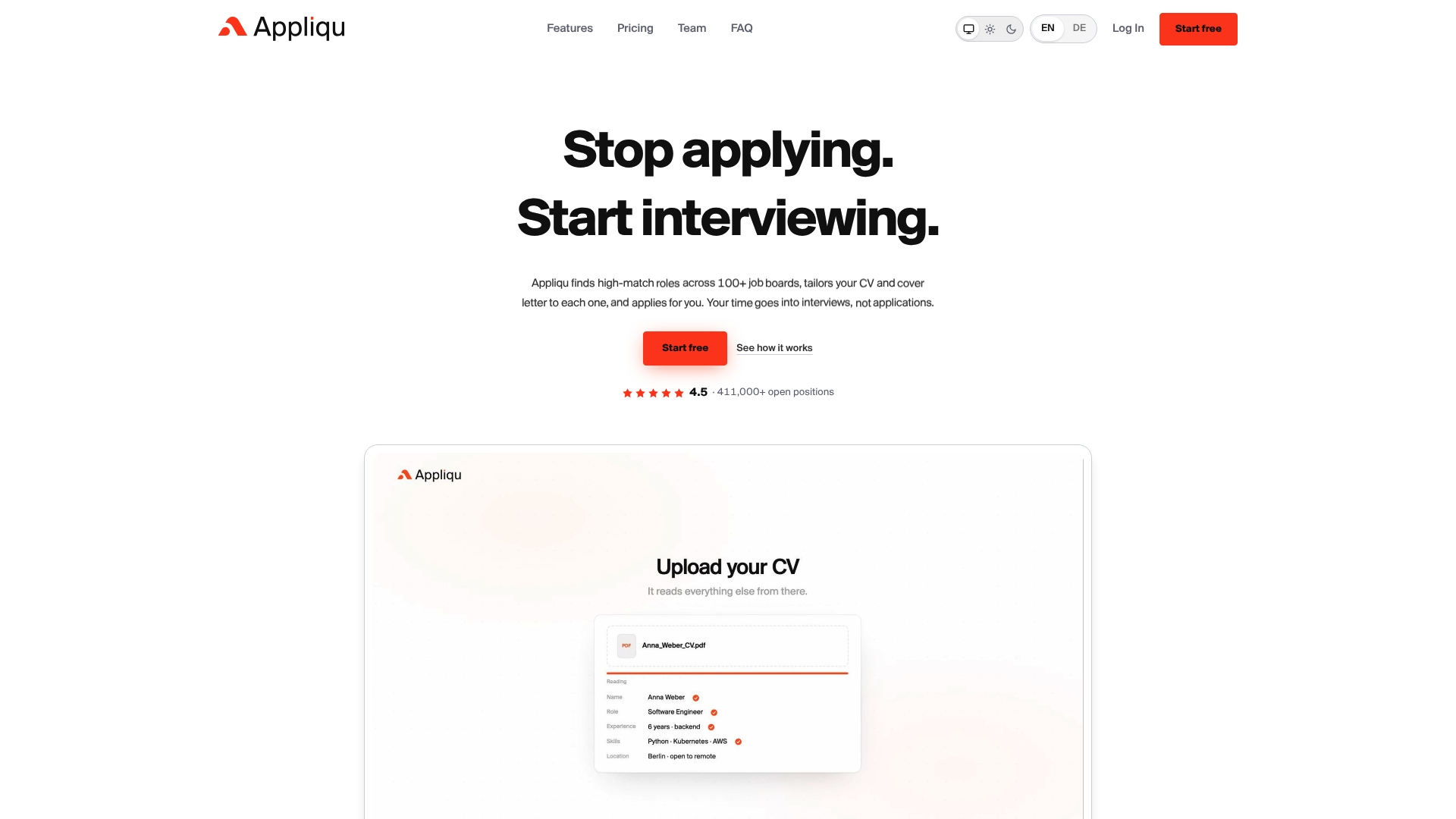
You can compare the plans and start with Explorer on the Appliqu plans page.
FAQ
How early should I start looking for an internship?
Start three to nine months before you want to begin, depending on the industry. Boston University advises applying two to three months ahead at the latest, and competitive summer schemes can open in November. Check each employer's recruitment timeline.
Where is the best place to find internships?
Use several channels together: employers' own careers pages, your university careers service, dedicated sites such as Prospects in the UK, and your network. Roles on company pages are often not advertised elsewhere. Appliqu searches company career pages alongside other sources.
Do I need a different CV for every internship?
You need a tailored version for each role. Keep a master CV, then reorder bullet points and use the posting's relevant keywords where they honestly describe your experience. Your CV and cover letter should still tell the same overall story.
Can international students apply for internships?
Often yes, but work rights depend on your visa and the country. Confirm permitted hours, whether the placement must be part of your course and the dates before applying. Your university's international student advice team can confirm this.
Sources
- Your Job or Internship Search Checklist, Columbia Career Education
- Finding Jobs and Internships, Boston University (Fall 2026)
- How to Search for an Internship, Boston University Center for Career Development
- Find a job or internship, Seattle Pacific University
- Finding Internships, University of Washington Career and Internship Center
- Internships, Prospects
- Internship and Job Search, University of Minnesota College of Liberal Arts
- Internship Guide, Duke Career Hub
- Resume and Cover Letters, UW-Madison SuccessWorks
- Search for a Job or Internship, Babson
- Work rules during your studies, Imperial College London
Recommended
The all-in-one career platform.
Appliqu finds matching jobs, rewrites your CV & cover letter for every single one and applies for you.
- Appliqu writes every application to an exceptional standard.
- You approve. Appliqu sends.
- Everything at a glance. Stay relaxed.
No credit card needed.
4.5 on Trustpilot · Cancel anytime


