How to Find a Job With No Experience: A Practical Plan

You find a job with no experience by targeting roles that are built for beginners, showing the skills you already have in the language of each job advert, and sending a tailored application to enough employers to get interviews. The first part is research, the second is writing, the third is volume. Appliqu takes over the third part and most of the second: it searches more than 1.5 million jobs from over 500 sources, including company career pages, scores every role against your profile, writes a tailored cover letter for each one, adapts your CV and applies in the employer's own application form.
This guide is for graduates, students, career changers and anyone applying in English for a first role in their field. It covers where to look, what counts as experience, how to write the application and how to keep the search manageable.
TL;DR
- "No experience" rarely means nothing to show: projects, volunteering, part-time work and group assignments count when you describe them as responsibility and results.
- Aim at entry-level jobs, internships, traineeships, support roles and adjacent roles, not only at the job title you would ideally like.
- Every application needs a tailored CV and cover letter. Volume without tailoring does not work for a beginner.
- Part of the vacancies never reach the big job boards, so direct approaches to employers belong in the plan.
- Appliqu searches, scores, writes and applies for you. You choose between approving each application yourself ("on approval") and Autopilot.
Table of Contents
- What employers mean by "no experience"
- Step 1: Choose a target before you search
- Step 2: Build an inventory of your experience
- Step 3: Match your inventory to real job adverts
- Step 4: Know which kinds of role to apply for
- Step 5: Write a CV and cover letter that fit each role
- Step 6: Apply in volume without losing quality
- Step 7: Reach employers who have not advertised
- Step 8: Prepare for interviews with little to draw on
- Who should do what: a quick plan for each reader
- Where Appliqu fits
- Our view on starting without experience
- FAQ
- Sources
What employers mean by "no experience"
Most employers who advertise a beginner role do not expect a work history in that field. They expect evidence that you can learn quickly and behave professionally. That evidence comes from more places than paid jobs.
Prospects, the UK graduate careers service, says formal employment is not the only source of relevant experience: academic projects, extracurricular activities, internships, hobbies and volunteering can all show transferable skills. It lists communication, digital proficiency, problem-solving, critical thinking, time management, organisation, teamwork and leadership as the skills to make visible in an application.
The US HR body SHRM makes the same point from the employer's side. Its advice is that employers may count academic projects, group work, campus leadership, volunteering, freelance assignments and service jobs as experience when they demonstrate responsibility and workplace skills.
So the first task is not to find a job. It is to change how you describe what you have already done.
Step 1: Choose a target before you search
Searching "jobs for people with no experience" returns thousands of listings in every sector, most of them unrelated to each other. A beginner who applies to all of them writes thin, generic applications. Narrow the field first.
The Times Higher Education student guide advises graduates to define their search criteria in advance: industry, location, employer size and the skills they want to develop. Write down:
- Two or three job titles you would accept as a first role (for example, junior marketing assistant, customer success associate, research assistant).
- Location and working pattern: city, commutable area, hybrid or remote.
- Two or three skills you want to build in the first year.
- A minimum salary below which the role does not work for you.
If you are searching across borders, the Duke University Career Hub recommends focusing on no more than three countries at first and checking official in-demand occupation lists and visa pathways before applying abroad. International applicants should settle work eligibility before they send anything: RBC's guidance for new graduates in Canada cautions international students to investigate work permits early, and the same logic applies in any country.
A short demand check helps with the choice. Our guide to a 30 minute job demand analysis shows how to find three roles that are hiring now, so you aim at titles with real vacancies.
Step 2: Build an inventory of your experience
Take a sheet of paper and list everything you have done in the last five years that involved responsibility, a deadline, other people or a result. Include:
- Coursework and dissertations: a group project with a client brief, a data analysis, a presentation to an audience.
- Part-time and service jobs: retail, hospitality, tutoring, delivery. These show reliability, customer handling and working under pressure.
- Volunteering and student societies: running a budget, organising an event, leading a team.
- Personal projects and freelance work: a website, a blog, a small shop, a few paid gigs.
- Caregiving and family responsibilities: RBC's guide lists these among the sources of transferable skills alongside club leadership and group projects.
Then rewrite each item as an outcome, not a duty. SHRM advises emphasising outcomes over duties, explaining your contribution and quantifying results where you can. Compare:
| Duty (weak) | Outcome (stronger) |
|---|---|
| Helped run the society's social media | Posted three times a week for a year and grew the society's Instagram following from 200 to 650 |
| Worked on a group project | Led a team of four on a market-entry report and presented it to a panel of three lecturers |
| Worked in a café | Served around 150 customers per shift and trained two new colleagues on the till |
Use only figures that are true and that you can explain in an interview.
Step 3: Match your inventory to real job adverts
RBC recommends comparing job postings with the skills you already hold and using the postings to identify the skills to develop next. Harvard Summer School suggests using entry-level listings and LinkedIn to research roles, required skills, recruiters, hiring managers and alumni.
Do this with five to ten adverts for your target title. Highlight the skills and tools that appear in most of them. Those words are what a recruiter, or an applicant tracking system (the software many employers use to sort applications), will look for in your CV. Where you have a match, use the advert's own wording. Where you have a gap, note it as something to learn or to cover with a short course or project.
This is the step Appliqu does for every role. It reads the full job posting, scores it against your profile with semantic matching and shows you which roles fit, so you spend your time on roles with a real overlap instead of scanning titles.
Step 4: Know which kinds of role to apply for
The job title you want may not be open to a beginner. Several other routes lead to the same career, and you should apply to all of them.
Entry-level jobs and support roles
Prospects recommends considering temporary, part-time and entry-level work as stepping stones that provide practical experience, contacts and professional references. SHRM goes further: it suggests short-term contracts, project work, support positions and adjacent roles rather than waiting for an ideal first job. An administrative role in a company you want to work for is often the shortest path into a department.
Internships and traineeships
The EU's employment service EURES separates the two. Internships are generally for students or recent graduates and last weeks or months. Traineeships are longer and more structured, aimed at graduates or people with limited experience, and EURES describes them as paid training programmes with mentorship, goals and real responsibilities. It notes that financial benefits for internships may be limited, so check the terms before you accept.
The International Labour Organization's research on internships finds that paid, structured internships are associated with better labour-market outcomes, while noting the evidence does not prove that payment alone is the cause. In practice, give priority to placements with a clear programme, a named supervisor and a defined length.
Students will find more detail in our internship search tips and in the guide to internship application automation for students, which recommends starting with approval of each application.
Experience-building work
Prospects also recommends freelancing to build a portfolio, personal projects to show initiative and volunteering to gain experience. These do two jobs: they fill the gap on your CV and they give you something specific to discuss at interview. Choose one project that matches your target role and finish it, rather than starting several.
Step 5: Write a CV and cover letter that fit each role
A beginner's CV is short. One page is enough. Use this order:
- Contact details and a two-line profile naming the role you are applying for and your strongest relevant skills.
- Education, with relevant modules and your dissertation topic if it relates to the job.
- Experience, in the broad sense described above, each entry written as outcomes.
- Skills, using the exact terms from the advert where they are true.
- Projects, volunteering and interests that support the application.
The Times Higher Education guide recommends tailoring a concise CV and a personalised cover letter to each vacancy and tracking deadlines and follow-up actions. For someone with no experience, the cover letter does the most work: it is where you connect your inventory to this employer's needs in three short paragraphs. State why this company, name two or three matching skills with one proof each, and say what you want to learn.
Our page of cover letter examples shows three full letters next to the job advert they answer, so you can see how the matching works.
This is the stage that costs the most time. A tailored application can take an hour or more to write properly. Appliqu writes a tailored cover letter for each role, adapts your CV and applies directly in the employer's own application form, just as you would yourself. Every application is individual. There are no mass emails.
Step 6: Apply in volume without losing quality
A beginner has fewer qualifications to offer, so the number of applications matters. There is a trade-off, though: the more you send, the more likely each one is generic. Two approaches keep both.
The first is focus. Our article on a market driven job search argues for three focused applications over thirty scattershot ones when you are choosing between roles.
The second is to remove the repetitive work while keeping each application individual. With Appliqu you decide how much control you want:
- On approval: Appliqu prepares each application and you approve every one yourself before it is sent.
- Autopilot: Appliqu applies on its own.
If you are new to this, start on approval, read the first few letters and adjust your profile until they sound like you. Appliqu also connects to your inbox, detects replies and interview invitations and keeps all your applications in one place, so you do not need a spreadsheet to track what you have sent.
Step 7: Reach employers who have not advertised
Not every opening appears on a job board. The Australian Government's Job Jumpstart service recommends researching employers and approaching them directly. It says direct contact can demonstrate initiative, motivation and communication skills even when no vacancy is advertised.
That suits a beginner, because it replaces the experience line on your CV with visible effort. A short, specific message works best: who you are, one sentence on why this employer, and one skill you can offer. Our guide to hidden job opportunities explains where they are and how to reach them.
Networking works in the same way. Prospects suggests using alumni, professors, mentors, careers fairs and informational chats to learn about opportunities without asking for a job outright. A fifteen minute conversation about someone's career often leads to a referral later.
Applying through company career pages matters here as well. Appliqu searches company career pages along with job boards, so vacancies that never reach the large aggregators are part of the search. For a wider view of boards, see our overview of the best job boards in 2026.

Step 8: Prepare for interviews with little to draw on
Interviewers ask for examples. When you have no job history, the examples come from your inventory. Queen's University Career Services advises candidates to research the position and organisation, prepare examples from work, school or other life experiences, practise answers aloud and ask questions that clarify fit and expectations.
Prepare five stories, each with a situation, what you did and what happened. One should be about teamwork, one about solving a problem, one about a deadline, one about learning something new and one about a mistake and what you changed. Our job interview preparation plan runs from the invitation to the follow-up.
If you win an internship or traineeship, EURES recommends being proactive, volunteering for projects, building relationships with colleagues, requesting feedback and recording your tasks and learning for later interviews. That record becomes the experience your next application lacked.
Who should do what: a quick plan for each reader
| Your situation | Best first move |
|---|---|
| Student or recent graduate | Apply for internships, traineeships and graduate schemes; use university careers services and alumni |
| Career changer | Map your transferable skills to the new role's advert wording; apply to adjacent and support roles |
| Employed and looking quietly | Automate search and applications outside working hours; use approval mode so nothing is sent without you seeing it |
| International applicant | Confirm work eligibility and shortlist up to three countries before applying |
Where Appliqu fits
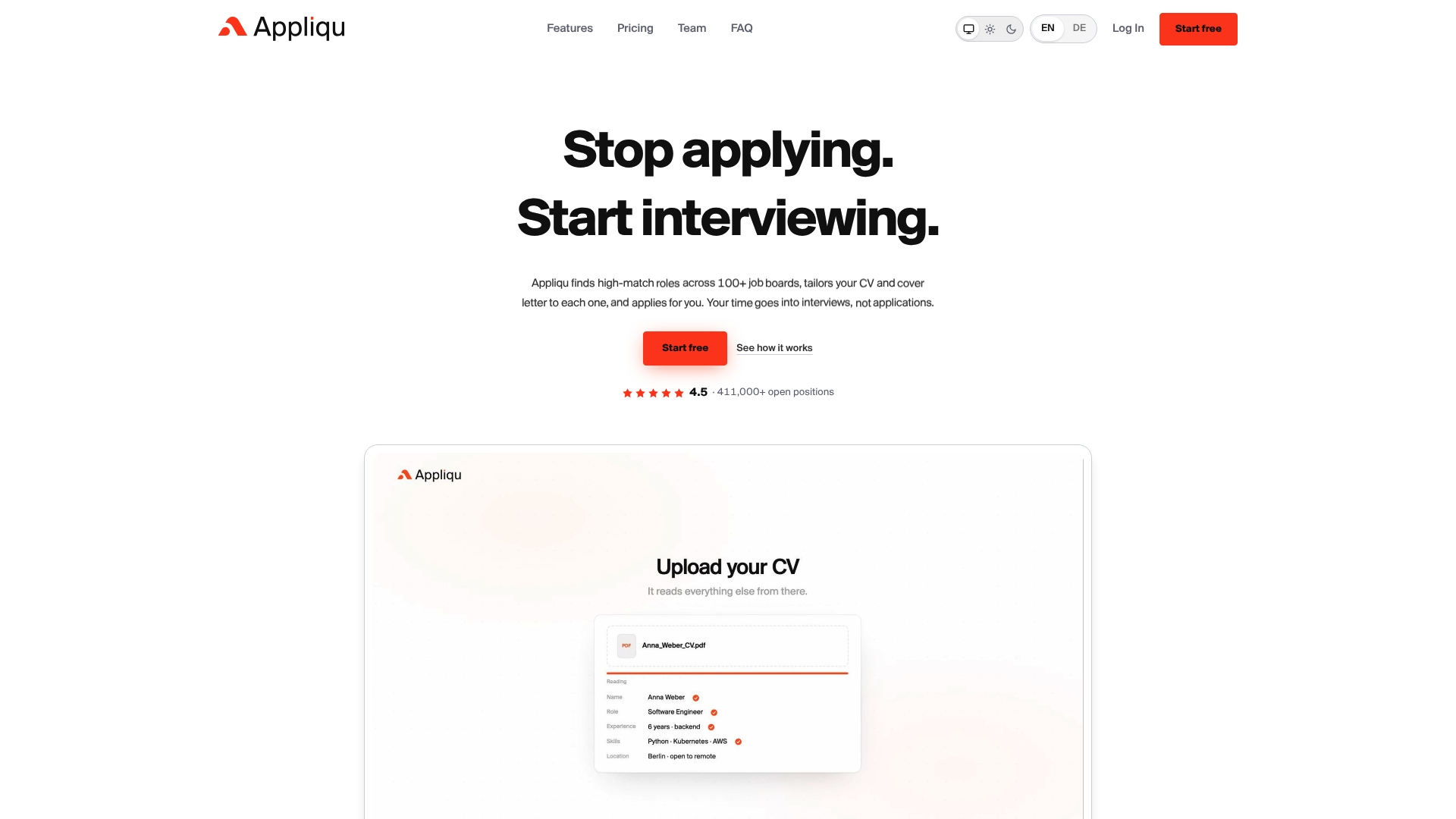
The slowest parts of a beginner's search are finding suitable roles, writing a separate letter for each and filling in each employer's form. Appliqu takes over that whole process: it searches, scores, writes, tailors and applies for you.
The Explorer plan is free forever, and Appliqu writes 5 applications there. Sending applications starts with Core at €29.90 per month for 100 applications. Pro is €69.90 per month for 300 applications plus the Appliqu Job Board. Concierge is €199 per month for unlimited applications plus a senior consultant session. Prices include VAT where applicable. You can see all four plans on the Appliqu plans page.
Our view on starting without experience
Beginners are told to "gain experience first", which is a circular instruction. What a beginner can control is the quality and the number of individual applications.
We built Appliqu to take over the whole application process, not single steps. Searching 1.5 million jobs from over 500 sources, scoring each role against your profile, writing the cover letter, adapting the CV and applying in the employer's own form are one job, and doing them together means each application is individual.
Control matters as much as speed. In approval mode you read and approve every application. On Autopilot Appliqu applies on its own. Either way you edit your CV together with Appliqu, so what employers read is your own account of your skills.
Our advice to anyone starting out: spend your hours on the inventory of what you have done and on the interview, and let Appliqu apply for you.
Niclas Fischell
FAQ
How can I find a job if I have no experience?
Choose two or three entry-level titles, list your projects, volunteering and part-time work as outcomes, and send tailored applications to many employers, including through company career pages. Add direct approaches to employers who have not advertised.
What jobs can I get with no experience?
Entry-level roles, support and administrative positions, temporary and part-time work, internships and traineeships are the usual starting points. Prospects and SHRM both recommend them as stepping stones that give practical experience, contacts and references.
How do I get a job after college or graduation?
Start searching before your final term. Apply for graduate schemes, traineeships and entry-level roles, use alumni and careers services, and tailor each CV and cover letter. International graduates should check work eligibility first.
Can I use Appliqu if I have no work history?
Yes. Appliqu scores roles against your profile, so education, projects and volunteering count. The Explorer plan is free forever and Appliqu writes 5 applications there. Sending applications starts with Core.
Should I let applications go out automatically?
You choose. In approval mode you approve every application yourself. On Autopilot Appliqu applies on its own. Most beginners start on approval and switch once the letters read the way they want.
Sources
- How to get a job with no experience, Prospects
- Ask Johnny: How do I get a job when I don't have any experience, SHRM
- The graduate guide to internships and work experience, Times Higher Education Student
- Global Career Search Strategy, Duke University Career Hub
- Your guide to finding an entry-level job as a new graduate, RBC Royal Bank
- How to land your first job, Harvard Summer School
- A guide to internships and traineeships in Europe, EURES
- Employment, International Labour Organization
- Three ways to find a job without work experience, Job Jumpstart
- Queen's Best, Queen's University Career Services
Recommended
The all-in-one career platform.
Appliqu finds matching jobs, rewrites your CV & cover letter for every single one and applies for you.
- Appliqu writes every application to an exceptional standard.
- You approve. Appliqu sends.
- Everything at a glance. Stay relaxed.
No credit card needed.
4.5 on Trustpilot · Cancel anytime


