Career Change at 30: A Practical Plan for Your Next Move

Changing careers at 30 is a sequence of small, checkable decisions rather than one leap: pick a direction, test it, price it, reframe your experience and then apply to roles one tailored application at a time. The last stage is where most career changers lose weeks, because every application needs a CV and cover letter that explain why your background fits a field you have not yet worked in. Appliqu searches more than 1.5 million jobs from over 500 sources, including company career pages, scores each role against your profile and applies for you with documents written for that role.
TL;DR
- Thirty is a course correction, not a restart: your first decade of work has built skills that most sectors use.
- Change one thing at a time (role, industry or location), not all three together.
- Save three to six months of living costs before you leap, and price any training before you commit.
- Rewrite your CV in the language of the job advert and write a custom cover letter for each role.
- Appliqu writes the cover letters, adapts your CV and applies in the employer's own form, so your time goes into networking and interviews.
Table of Contents
- Why 30 is a workable age to change
- Decide what kind of change you actually need
- A step-by-step plan for changing careers at 30
- What each application takes, and what Appliqu takes off your hands
- Choosing the right plan
- Common mistakes when changing careers at 30
- Our perspective
- FAQ
- Sources
Why 30 is a workable age to change
The fear behind this search is usually "I am too late". The evidence points the other way. UNSW describes the move as a course correction rather than starting over: a decade of work has trained you in leadership, stakeholder management, conflict resolution and resilience, and roughly 35 working years remain until 65.
You are also not unusual. Harvard Extension School cites a 2023 GoBankingRates survey in which 58% of workers said they planned a major job change in 2024. The labour market is moving too: the World Economic Forum's 2024 paper expects nearly a quarter of all jobs to change by 2027, with 69 million roles created and 83 million displaced. Changing field is increasingly a normal part of a working life.
In the UK, the National Careers Service states that it is never too late to make changes and suggests starting with the types of careers that suit your skills and lifestyle.
Decide what kind of change you actually need
Not every unhappy 30-year-old needs a new profession. There are three different moves, and each has a different cost:
- Same role, new employer. The cheapest change. Your CV barely changes.
- Same industry, new role (or the reverse). One variable changes, so your existing credibility carries over.
- New role and new industry. The full career change. It needs the most evidence on your CV and the most explanation in your applications.
Amanda C. Peters of Harvard Extension School advises switching one thing at a time rather than three, because trying to leave everything behind is often the hardest part. A marketing manager moving into product management inside the same sector is a smaller step than a marketing manager moving into data science at a hospital trust, and the first step can lead to the second.
If you are employed and looking quietly, this also protects you: a one-variable change can be searched for and applied to outside working hours without drawing attention.
A step-by-step plan for changing careers at 30
Step 1: Reflect on skills, values and constraints
EURES, the European employment network, advises reflecting on your skills, values, priorities and life aspirations: flexibility versus structure, working alone versus in a team. Write down what you want to keep from your current job as well as what you want to leave. Include fixed constraints such as a mortgage, childcare, location or visa status.
Step 2: Test the field before you commit
EURES suggests getting a taste of a target field through freelance work or volunteering. Harvard recommends "microsteps": a class, a conversation with someone in the field, a stretch assignment or a personal project. SUCCESS magazine observes that most career changers stall because they research endlessly without acting. Its answer is a 90-day sprint: informational interviews in the first month, courses and a rewritten LinkedIn profile in the second, and targeted applications in the third.

That 90-day shape is useful even if you do not follow it exactly. By the third month you should be applying, not still researching.
Step 3: Price the move
Money is the constraint that decides how fast you can go. EURES gives a rule of thumb of three to six months of living expenses saved before a career leap, and advises planning for a possible drop in income plus equipment or training costs.
For UK readers, the Learning & Work Institute's 2023 report "All Change" puts numbers on it. The average full-time sector switcher faces a pay penalty of £3,731 a year (14%), and the same report finds pay growth afterwards is 2.9 times faster for job changers than for stayers. It also estimates that a full-time one-year course could cost the average worker about £30,000 in lost wages, plus fees. The practical conclusion is to avoid a year out of work where you can.
Prices for retraining vary widely. Prospects says many changes need targeted learning rather than a full degree: online courses and microcredentials start from as little as £10 and some are free. Fields such as engineering, healthcare, IT and teaching can require conversion courses, often a master's degree or postgraduate diploma.

Step 4: Map your transferable skills to real job adverts
EURES lists critical thinking, adaptability, problem solving, organisation, creativity and negotiation as skills that apply in almost every sector. A list of skills is not enough, though. Columbia's Career Design Lab advises inventorying your skills against job requirements and learning the target industry's vocabulary: its examples are "fan engagement" in sports and "clients" and "investors" in finance.
A workable method:
- Collect five to ten adverts for the role you want.
- Highlight the skills and phrases that appear in most of them.
- Next to each, write one example from your own work that proves it, in that advert's wording.
- Fill the gaps with a short course, a project or volunteering.
OU Online makes the same point: map your skills using the job description's language. Our guide on building a skills-based CV for a career change shows how to pick the three to six skills from an advert that matter most.
Step 5: Rewrite your CV and write a cover letter for every role
Harvard advises updating your CV and LinkedIn with relevant projects, coursework or volunteer roles, rewriting past position summaries to show transferable skills, and writing a custom cover letter for every role that explains the change. For a career changer the cover letter does the work a job title normally does: it tells the reader why this move makes sense.
The common failure is a generic CV sent to dozens of roles, where the reader cannot see the link between your past and the new job. For the mechanics, see how to fix a career change CV with one tweak and how to write a tailored cover letter in 10 to 20 minutes.
Step 6: Use your network and apply in volume without losing quality
OU Online notes that your network is often strongest and most underused in your 30s. Tell former colleagues, managers and classmates exactly which role you are aiming for. Warm introductions matter most for the roles you want most.
For the rest, applications are a volume task. A changer typically needs more applications than someone staying in their field, and each must be individual. That is where the hours go.
What each application takes, and what Appliqu takes off your hands
A properly tailored application for a role outside your current field takes real time: reading the advert, matching your CV to it, writing a letter that explains the change, filling in the employer's form. Appliqu does each part:
| Stage | What it takes | What Appliqu does |
|---|---|---|
| Finding roles | Checking many boards and company career pages | Searches more than 1.5 million jobs from over 500 sources, including company career pages |
| Judging fit | Reading adverts against your skills | Scores every role against your profile with semantic matching |
| Cover letter | A fresh letter explaining the change each time | Writes a tailored cover letter for each role |
| CV | Reordering and rewording for each advert | Adapts your CV, and you edit it together with Appliqu |
| Submitting | Retyping details into each form | Applies directly in the employer's own application form, as you would yourself |
| Follow-up | Watching your inbox for replies | Connects to your inbox, detects replies and interview invitations and keeps all applications in one place |
You choose how much control you keep. In "on approval" mode you approve every application yourself. On Autopilot, Appliqu applies on its own. Every application is individual, with no mass emails.
This matters most for the quiet searcher. If you work full time, evenings are the only window, and spending them copying details into forms leaves nothing for the conversations and learning that move a career change forward. Our article on scaling targeted applications without losing quality covers the routine in more detail.
Choosing the right plan
Explorer is free forever, and Appliqu writes 5 applications there. It shows you how a tailored application reads for a role in your new field. Sending applications starts with Core.
| Plan | Price | What is included |
|---|---|---|
| Explorer | €0 per month | 5 applications written by Appliqu |
| Core | €29.90 per month | 100 applications |
| Pro | €69.90 per month | 300 applications, plus the Appliqu Job Board |
| Concierge | €199.00 per month | Unlimited applications, plus a senior consultant session |
Prices include VAT where applicable. A career changer who wants a steady flow of roles across two or three adjacent job titles fits Core or Pro. Concierge suits someone who wants a senior consultant session on the change itself alongside unlimited applications.
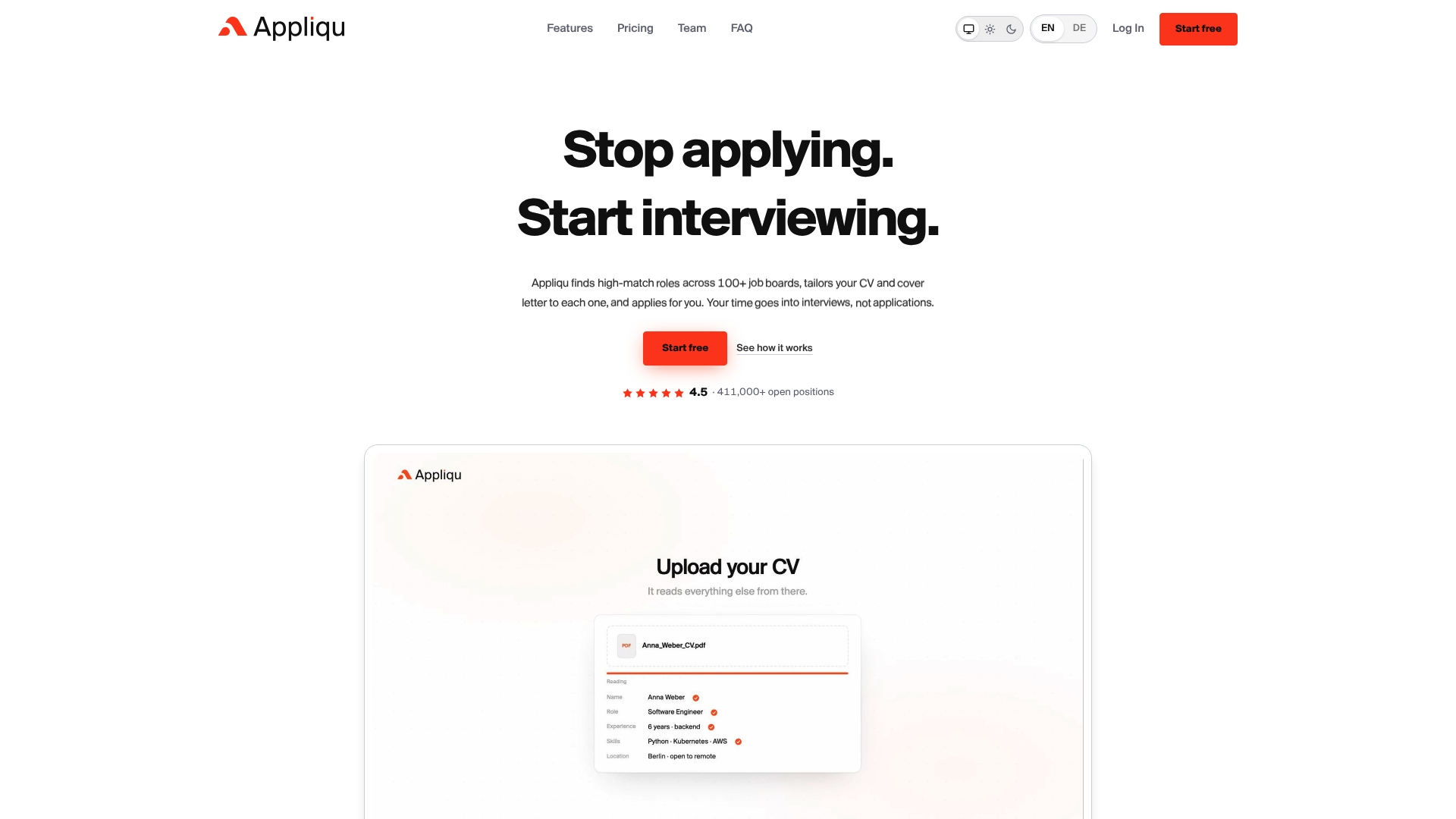
You can start on Explorer, see five applications written for roles in your target field, and move to a paid plan when you are ready to send. See the Appliqu plans.
Common mistakes when changing careers at 30
- Changing everything at once. Role, industry and city in one move leaves you with no credibility anywhere.
- Researching instead of acting. Set a date by which you will have applied to your first ten roles.
- Paying for a full qualification too early. Check first whether a short course or a project gives the same signal to employers.
- Sending the same CV everywhere. Employers in a new field look for their own vocabulary. Read how AI tailoring handles a CV for every application to see what good tailoring changes.
- Hiding the change. Say it plainly in the first lines of the cover letter, and link it to a skill the employer needs.
- Ignoring the practical limits. Without savings you may have to take a bridging job, which is a reasonable choice if it keeps the long-term direction.
Our perspective
Most people who write to us about changing careers do not lack ambition. They lack evenings. The thinking part of a career change, working out what you want and what you can offer, is yours and takes the time it takes. The applying part is repetitive: reading adverts, matching your CV, writing a letter that says why a former teacher fits a customer success role, filling in the same form again.
We built Appliqu to take over that second part. It searches the roles, scores them against your profile, writes each cover letter, adapts your CV and applies in the employer's own form. You decide the level of control: on approval, where you read and approve every application, or Autopilot.
A career change at 30 is won by the quality and the number of applications that reach the right people. Both are easier when the routine work is done for you and you spend your own time on conversations.
Niclas Fischell
FAQ
Is 30 too late to change careers?
No. At 30 you have roughly 35 working years ahead, and the skills from your first decade carry across sectors. UNSW treats this age as a course correction rather than a restart, and the UK National Careers Service says it is never too late to change.
How do I change careers at 30 with no experience in the new field?
Build small proof before you apply: a short course, a personal project, volunteering or a freelance assignment. Then rewrite your CV in the language of the job adverts and write a custom cover letter for each role. Appliqu writes a tailored cover letter for each role and adapts your CV, so each application reflects the specific advert.
How much money do I need to change careers?
EURES suggests three to six months of living expenses saved as a rule of thumb, plus a buffer for training or equipment. In the UK, the Learning & Work Institute found that people who switch sector face an average pay penalty of 14% a year, so a plan that lets you keep earning while you move is safer than a full-time course.
Can I look for a new career while I am still employed?
Yes, and it is the lower-risk route. Search and apply outside working hours, and keep the change to one variable at a time. In "on approval" mode, Appliqu applies for you only after you have approved each application, and it detects replies and interview invitations in your connected inbox.
Sources
- How to Change Careers in Your 30s, Harvard Extension School
- How to change careers at 30, UNSW
- Things to consider when making a career change, EURES
- How to Change Careers at 30, 40 or 50, SUCCESS
- All Change, Learning & Work Institute
- How to change careers, Prospects
- How to Change Careers Successfully, OU Online
- Managing your career later in life, National Careers Service
Recommended
The all-in-one career platform.
Appliqu finds matching jobs, rewrites your CV & cover letter for every single one and applies for you.
- Appliqu writes every application to an exceptional standard.
- You approve. Appliqu sends.
- Everything at a glance. Stay relaxed.
No credit card needed.
4.5 on Trustpilot · Cancel anytime


