English-Speaking Jobs Abroad: Where to Find Them and How to Apply

English-speaking jobs abroad exist in every region, but they are scattered across thousands of employer career pages, national job portals and international boards. The work is not finding one list. It is searching many sources, checking that English really is the working language, and sending each employer an application written for that role. Appliqu searches more than 1.5 million jobs from over 500 sources, including company career pages, scores every role against your profile and applies for you in the employer's own application form.
This guide covers what counts as an English-speaking job, where genuine vacancies are published, which roles and countries are open to English speakers, how to adapt your CV for another market and what to check before you say yes.
TL;DR
- An English-speaking job is one where the team works in English day to day, not only one advertised in English. Check the posting and ask the employer.
- Search several source types: official portals such as EURES and Canada's Job Bank, employer career pages and international boards. One site never covers the market.
- Entry-level routes for English speakers include teaching English, hospitality, tourism and seasonal work. Multinational, tech and finance roles in many countries run in English too.
- Each application needs its own CV emphasis and cover letter, and the CV conventions differ from country to country.
- Appliqu searches, scores, writes and applies for you. Explorer is free forever and Appliqu writes 5 applications there; sending starts with Core.
Table of Contents
- What counts as an English-speaking job abroad
- Where to find genuine vacancies
- Which roles are open to English speakers
- Choosing a country
- How to apply: one search, one application per role
- What to check before you accept
- Promo: Appliqu for an international search
- Perspective: why one application per role matters abroad
- FAQ
- Sources
What counts as an English-speaking job abroad
Three different things hide behind the phrase, and mixing them up wastes applications.
- The role is in an English-speaking country. Think Ireland, Canada, Australia, New Zealand or the UAE. English is the language of daily life and of work.
- The role is in a non-English-speaking country but the workplace runs in English. This is common in multinational companies, start-ups, tech, finance and shared-service centres in cities such as Berlin or Amsterdam.
- The posting is written in English but the team works in another language. This is the trap. An English advert does not guarantee an English workplace.
One guide to searching abroad without the local language advises looking for openings where workplace communication is in a language you understand, reading postings closely, and asking the employer which language the team uses day to day. It also notes that a posting should state its language requirements, and that searching only with English keywords can miss listings written in the local language.
In practice, read the posting for four signals:
- Stated language level. "Fluent English" with no local language mentioned is a good sign. "German is a plus" means German is probably used.
- Who you work with. International teams, global stakeholders and English-language tools suggest an English workplace.
- The company. A global employer with an English careers site is more likely to work in English than a small local firm.
- Public information. The company website, its LinkedIn page and its employee reviews usually show how international the team is.
It also helps to know that English alone carries further in some markets than others. One country comparison for 2026 suggests that in Germany and the Netherlands English is enough for many tech and multinational roles, but goes less far in healthcare, public-facing work or smaller local firms. Treat this as a direction, then confirm it in each posting.
Where to find genuine vacancies
A sound overseas search combines source types instead of relying on a single site. A 2026 guide for international job seekers lists official government portals, employer career pages, international employment services and professional networks as the four pillars.
Official portals
Government-run sources are the most reliable starting point because the vacancies come from public employment services.
- Europe. EURES, the European job mobility portal, lets you search by keyword and by country. Its own guidance on starting a career abroad notes that English is often an accepted language of communication for transnational jobs. It also says that, unless the advert specifies otherwise, you should apply in the employer's national language or the language of the advert.
- Canada. Job Bank has a dedicated section for foreign candidates from outside Canada. Employers there are recruiting internationally, and you may need a work permit to take up the role.
Employer career pages
Many vacancies appear first, or only, on the employer's own site. They are also the safest place to confirm that a job exists. This is why Appliqu includes company career pages among its more than 500 sources, and why it applies in the employer's own application form rather than through a third-party shortcut.
Hidden vacancies
Not every position is advertised. EURES advises that spontaneous applications can open doors you did not know existed, because not all vacancies are published, and recommends a targeted CV and cover letter for them. A targeted approach means one letter per company, which is exactly where manual effort adds up.
How to spot a scam
Overseas listings attract fake offers. Villanova University's career service lists warning signs: an unusually high salary for an entry-level post, little or no experience or education required, fully remote work with total schedule flexibility, and claims that anyone can do the job. It advises confirming the position on the employer's official careers page and researching the organisation on its website, LinkedIn page and review sites. Never pay a fee to be considered for a job.

Which roles are open to English speakers
Your options depend on your experience, your qualifications and the country's rules on who may work there.
Entry-level and first jobs
For graduates, students and people without sector experience, the commonly named routes are:
- Teaching English. A bachelor's degree is sometimes required and a TEFL certificate (Teaching English as a Foreign Language) is a frequent credential. Verge Magazine notes that recent graduates with a degree in any subject can often land these posts, and that positions often come with relocation support, housing and insurance.
- Hospitality and ski seasons. Go Walkabout names chalet staff, bar and hotel work, kitchen assistants and resort staff as common no-experience options, plus farm work in Australia and New Zealand.
- Cruise ships. Roles such as cabin steward, bartender and activity co-ordinator are listed by The TEFL Academy as open without prior experience.
These roles are often seasonal, so the useful pattern is to search a few months before the season starts and to check the employer's own page for the current intake.
Experienced professionals
If you already have a career, your best chances usually lie in roles that mirror your current one: the same function at a multinational, an international team or a company hiring across borders. Software, finance, marketing, operations, customer success and project management roles are frequently advertised with English as the working language. The question to ask is not "which jobs exist abroad" but "which employers in my field hire internationally".
Career changers
If you are changing field, lead with transferable skills: people management, analysis, project delivery, client communication, languages. Tie them to the language of the posting. Our guide on fixing a career change CV shows how to do this with one focused edit per application.
Choosing a country
Pick the country first only if you have a free choice. Many readers do not: your passport, your qualifications and your employer decide it. A short framework:
| Question | What to check |
|---|---|
| Is English the everyday language? | If not, confirm the team language in the posting |
| Can you legally work there? | The official government immigration page for that country |
| Is your profession regulated? | Recognition of qualifications, required for regulated professions |
| Does the employer sponsor or support relocation? | The posting and the employer's careers page |
| What does the contract state? | Gross pay, hours, probation, start date |
Work authorisation is the point where assumptions cost the most. Rules differ by country, change often and depend on your nationality. For your target country, use the official immigration or labour ministry page, and where the posting offers sponsorship, confirm what the employer will actually arrange. Canada's Job Bank, for example, explains that if you are not eligible to immigrate permanently you usually need a work permit to work temporarily.
How to apply: one search, one application per role
The steps below apply whether you work by hand or with Appliqu. At each step, the manual version is shown and what Appliqu takes over.
1. Define your search
Decide on job titles, countries, seniority and the language you will work in. Include local-language equivalents of titles where relevant, since English keywords alone can miss listings.
Appliqu works from your profile: it searches more than 1.5 million jobs from over 500 sources and scores every role against that profile with semantic matching, so a role with a different title but the same substance still appears.
2. Read the posting properly
Separate hard requirements from nice-to-haves, check your fit against the hard requirements first, and read the responsibilities section for the real scope. One posting-analysis guide suggests that candidates within roughly 60 to 70 per cent of a stated experience level can still apply. Our own walkthrough on analysing job descriptions covers the method in detail. Appliqu reads the full job posting and scores it, so you spend your time on roles that fit.
3. Adapt your CV to the market
CV conventions are not universal. Smashing Magazine points out that personal details such as marital status or date of birth may be good practice in Malaysia but unnecessary or inappropriate elsewhere. It recommends a CV of no more than two pages, a simple readable font, terminology taken from the job listing and achievements angled to the employer's market.
If you speak several languages, state your level clearly: our page on a multilingual CV shows how. Appliqu tailors your CV for each role, and you edit the CV together with Appliqu, so the version that goes out is one you have approved. For the method, see how AI can tailor your CV for every application.
4. Write a cover letter for that employer
A generic letter is the first thing a recruiter skips. Each letter should name the role, show why the company interests you and connect two or three of your achievements to what the posting asks for. Our guides on writing a cover letter from your CV and a tailored cover letter workflow give a practical routine. Appliqu writes a tailored cover letter for each role, so every application is individual, with no mass emails.
Some markets expect a specific format. If you are aiming at Germany, for instance, there is a dedicated cover letter checklist and templates for Germany and a list of common application mistakes there.

5. Submit in the employer's own form
Most employers want applications through their own form, and each one has different fields. Doing this by hand for 20 or 30 roles consumes evenings. Appliqu applies in the employer's own application form, just as you would yourself. For the reasoning behind volume with quality, read our article on scaling targeted job applications.
6. Track replies
With applications going to several countries and time zones, replies get lost. Appliqu connects to your inbox, detects replies and interview invitations and keeps all your applications in one place.
What to check before you accept
An offer abroad carries more variables than one at home. Before you say yes, confirm in writing:
- guaranteed gross base pay and what is variable
- working hours, shifts and overtime rules
- probation period and contract length (fixed term or permanent)
- the work location and any relocation, travel or accommodation support
- permission to work and the realistic start date
- recognition of your qualifications if your profession is regulated
- the team's working language
A set of questions to ask before accepting groups the rest into the work, the manager, the team, the schedule, the offer and the future. Use them in the final interview. For legal and immigration questions, use the official government page of the destination country, and a qualified immigration adviser or lawyer where your case is not straightforward.
Promo: Appliqu for an international search
An overseas search multiplies the work: more sources, more formats, more tailoring. Appliqu takes over the whole process, from search and matching to the cover letter, the CV and submission. You choose how much control you keep. In "on approval" mode you approve every application yourself. On Autopilot, Appliqu applies on its own.
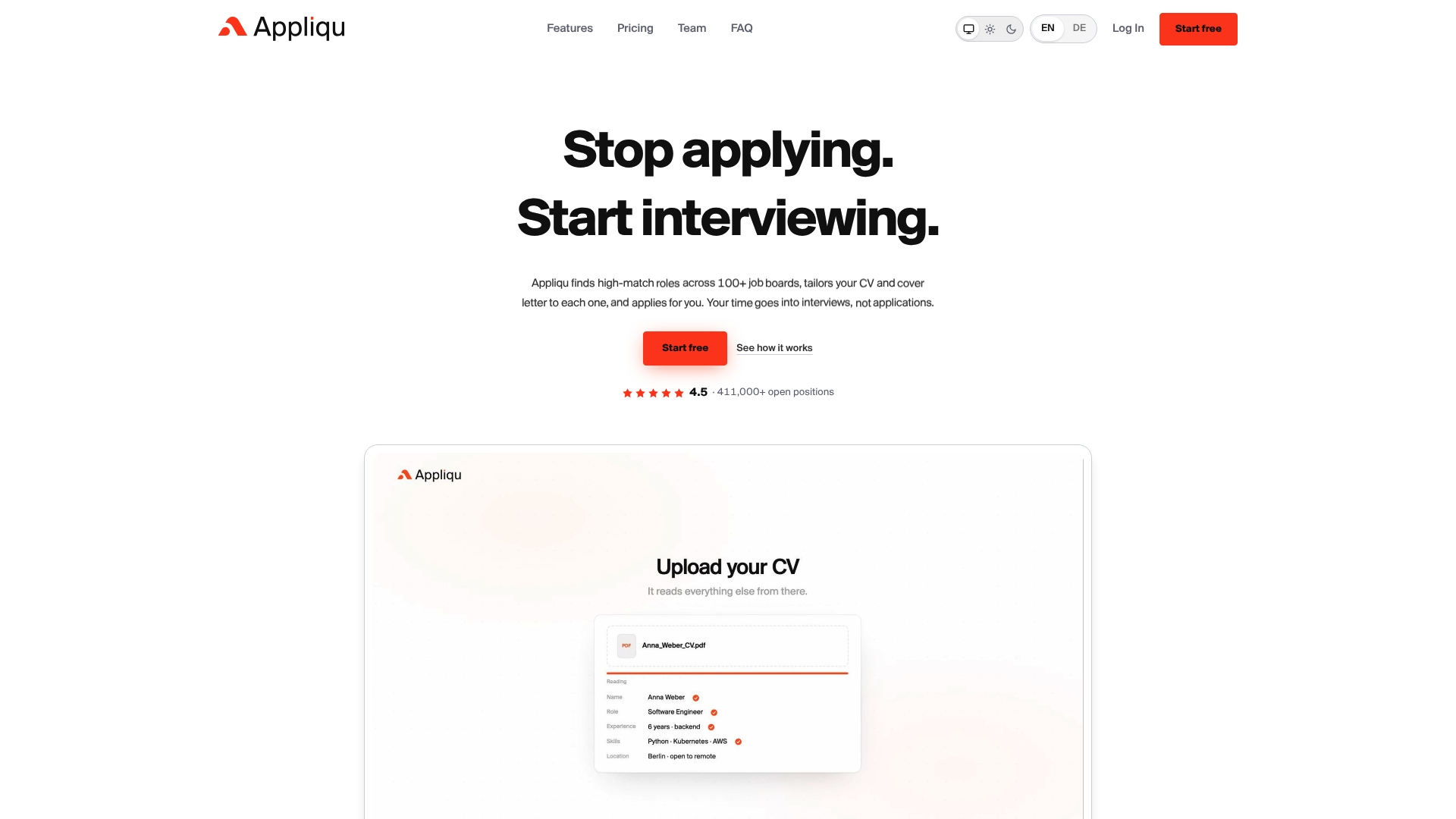
The plans, as published on the Appliqu site:
| Plan | Price | What it includes |
|---|---|---|
| Explorer | €0, free forever | Appliqu writes 5 applications |
| Core | €29.90 per month | 100 applications |
| Pro | €69.90 per month | 300 applications plus the Appliqu Job Board |
| Concierge | €199 per month | Unlimited applications plus a senior consultant session |
Sending applications starts with Core. Prices include VAT where applicable. You can start with Explorer and see what Appliqu writes for your profile.
Perspective: why one application per role matters abroad
Looking for work abroad is a volume problem and a quality problem at the same time. You need to look across many countries and sources, and every employer expects to read about its own role, in the conventions of its own market.
That is why we built Appliqu to take over the whole job application process instead of single steps. Appliqu searches, scores and writes. It tailors your CV and applies in the employer's own form. Every application is individual, and you decide the level of control: approve each one, or let Appliqu apply on Autopilot.
For a graduate looking for a first role overseas, for a professional exploring a move quietly while employed and for a career changer, the effect is the same: your evenings go to interviews and decisions, not to filling in forms.
Niclas Fischell
FAQ
Can I get a job abroad if I only speak English?
Yes, in two situations: in English-speaking countries, and in roles at international employers where the team works in English. English alone carries less far in healthcare, public-facing work and smaller local firms. Read the language requirement in each posting and ask the employer about the team's working language.
Can I find English-speaking jobs abroad without experience?
Yes. Teaching English, hospitality, tourism, seasonal and cruise roles are commonly open to people without prior experience. Some require a degree or a TEFL certificate, so check the requirements of each posting. Graduates can also apply for internships and graduate programmes at multinational employers.
Do I need a visa to work abroad?
Usually, unless you hold citizenship or a right to work in the destination country, for instance through a regional arrangement. The rules depend on your nationality and the country, so use the official immigration page of the destination. Employers who recruit internationally often explain in the posting whether they support work permits.
Should I apply in English or in the local language?
Follow the posting. EURES advises that, unless the advert says otherwise, the employer's national language or the language of the advert is the best option. If the advert is in English and states English as the working language, apply in English.
How many applications should I send?
Send as many as you can write properly. Each one should name the role and match your CV to the posting. A small number of tailored applications is stronger than a large number of identical ones. Appliqu is built so that volume does not cost individuality.
Sources
- How to search for jobs abroad without knowing the local language
- EURES: 6 steps to starting a professional career abroad, part 2
- EURES job mobility portal
- Job Bank: foreign candidates from outside Canada
- How to Find Jobs Abroad in 2026
- Villanova University: Job Scams
- Best Countries to Work Abroad in 2026
- Verge Magazine: The 7 Best Careers and Sectors for Working Abroad
- Go Walkabout: How to Work Abroad with No Experience
- The TEFL Academy: Work Abroad With No Experience
- How to Analyze a Job Posting
- Smashing Magazine: How To Search For A Developer Job Abroad
- Questions to Ask Before Accepting a Job
Recommended
The all-in-one career platform.
Appliqu finds matching jobs, rewrites your CV & cover letter for every single one and applies for you.
- Appliqu writes every application to an exceptional standard.
- You approve. Appliqu sends.
- Everything at a glance. Stay relaxed.
No credit card needed.
4.5 on Trustpilot · Cancel anytime


