How to Write a Cover Letter From Your CV

To write a cover letter from your CV, take the job posting's two or three main requirements, pick the matching achievements from your CV, and explain them in short paragraphs that show why you fit this employer. The letter does not repeat your CV. It connects your CV to one specific role. This guide shows the steps, the structure, what to copy and what to leave out, and how Appliqu can write the first draft from your CV and the posting.
TL;DR
- Your CV lists what you did. The cover letter explains why it matters for this job, so choose two or three CV points and develop them.
- Use three or four short paragraphs on one page, roughly 250 to 400 words.
- Mirror the language of the job posting, back each claim with a concrete example, and write a new letter for every application.
- If you draft with AI, check every statement against your CV and keep your own voice.
- Save the finished letter as a PDF with a professional file name.
Table of Contents
- What a cover letter does that your CV cannot
- Six steps from CV to cover letter
- What to take from your CV and what to leave out
- Structure and length
- Tailoring the letter to the job posting
- Drafting with AI from your CV and the posting
- Our perspective: the letter should start from the whole application
- Let Appliqu write the first draft for you
- Format, proofread and save
- Which goes first, the CV or the cover letter?
- Career changers and first-job applicants
- FAQ
- Sources
What a cover letter does that your CV cannot
Your CV is a record. The cover letter is an argument. The U.S. Department of Labor's Resume Essentials guide describes the split clearly: the CV lists your experience, while the letter connects your background to the job in a more personal way. Academic career adviser Karen Kelsky puts it in similar terms: a CV informs, a cover letter persuades.
This matters because the letter is often read. The same Department of Labor guide cites a LinkedIn finding that 83% of hiring managers read cover letters and consider them in hiring decisions. The NIH Office of Intramural Training & Education advises sending a cover letter with your CV unless the posting explicitly says otherwise.
In practice, this means the CV is your raw material and the job posting is your brief. Everything in the letter must answer one question: why should this employer invite you for an interview for this role?
Six steps from CV to cover letter
- Read the posting twice. Mark repeated words, required skills and the tone of the company. Resume.io's tailoring guide recommends exactly this double read before you write anything.
- Identify the three most important requirements. These are usually in the first lines of the requirements list, or repeated in the description of the role.
- Match each requirement to one CV entry. Find the job, project or result on your CV that proves it. Prefer an entry with a measurable outcome.
- Find a named recipient. The NIH guide advises finding out who to address the letter to rather than defaulting to a generic greeting. The posting, the company page or the recruiter's profile often names the person.
- Write the paragraphs using the structure in the next section.
- Cut anything that could apply to any employer. If a sentence would still make sense in a letter to a competitor, rewrite it or remove it.
If you want to see how the finished result looks next to a real advert, Appliqu has published three full cover letters with the job ad. For a manual routine, the quick tailored cover letter workflow breaks the same process into minutes.
What to take from your CV and what to leave out
The most common mistake is a letter that retells the CV in sentence form. The reader has the CV next to the letter. Give them something it does not contain.
Take from your CV:
- Two or three relevant qualifications. The NIH guide advises focusing on two to three particularly relevant qualifications, naming your skills explicitly and backing them with specific examples, while pointing to your CV rather than repeating its bullet points.
- One achievement with a result. The Department of Labor guide suggests using the letter to highlight one example from your career that shows your skills and how you can contribute.
- Transferable skills such as problem solving or organisation. The Ontario Public Service writing guide advises highlighting these, and listing any required certifications that relate to the role.
- The exact wording of the requirement. If the posting asks for stakeholder management and your CV says you coordinated client relationships, use the posting's phrase in the letter.
Leave out:
- Every job title and date that is not relevant to this role.
- Duties without outcomes. Replace them with what changed because of your work.
- Skills the posting does not ask for.
- Generic claims such as "hard-working team player" with nothing to prove them.
- Anything you cannot discuss confidently in an interview.
A worked example
Suppose your CV has this line: "Managed customer support team of eight; reduced average ticket backlog." The posting asks for "experience leading a service team through a system migration."
A weak letter says: "I managed a customer support team of eight." A stronger letter says: "In my current role I led a support team of eight through a change of ticketing system. I planned the training, set priorities for the first weeks and kept the backlog under control while the team learned the new process." The second version uses the posting's language, adds the story behind the CV line, and states a clear connection to the new job. Only include figures that are true and that you can explain.

Structure and length
The Department of Labor guide states that most cover letters run to 250 to 400 words. It describes a seven-part format: a header with contact details, a greeting, an opening paragraph stating the job and how you found it, a qualifications paragraph, a key achievement paragraph, a closing paragraph with a call to action, and your name. Cedarville University's career office uses a simpler three-paragraph model. Both work. The table maps them to the CV material you use.
| Part | What it says | Where it comes from in your CV |
|---|---|---|
| Header and greeting | Your contact details, the date, a named recipient | Contact section of your CV |
| Opening paragraph | The role, how you found it, why it interests you | Your summary or profile, plus one fact about the employer |
| Qualifications paragraph | Two or three skills matched to the posting, each with a brief example | Your most relevant roles and skills |
| Achievement paragraph | One story with a result | One bullet from your CV, expanded |
| Closing paragraph | Interest in next steps, thanks, how to reach you | Contact details |
| Sign-off | Professional closing and your name | None |
The closing paragraph can refer the reader to your CV and state that you would welcome an interview. Cornell University's HR jobs blog adds that the final paragraph should share your interest in discussing next steps and thank the reader.
Tailoring the letter to the job posting
Tailoring is what separates a cover letter from a template. The UK National Careers Service advises writing a new letter for every job, matching the keywords the employer uses in the advert, and backing up statements with facts using the STAR method (situation, task, action, result). Keep the same font and size as your CV so the two documents look like a set.
A five-minute check for each letter:
- Replace the role title and company name everywhere they appear.
- Pick two must-haves from the advert and give one line of proof for each.
- Write one "why this company" paragraph with two specifics, such as a product, a project or a value you can name.
- Remove any sentence that could apply to any employer.
This is the same logic used in the Resume.io and CV-Library guidance that the research draws on: the posting decides which parts of your CV appear. If you want to go deeper on reading the advert, see how to analyse a job description and tailor your CV with one edit.
Keywords and applicant tracking systems
Many employers screen applications electronically. Grammarly's cover letter guide advises using keywords and language from the job post, because some companies use automatic keyword scans. Use the employer's wording where it is true for you. Do not paste a list of keywords: place each one inside a sentence with evidence.
Drafting with AI from your CV and the posting
An AI draft works best when it starts from two inputs: your full CV and the full text of the job posting. Coursera's guide to ChatGPT cover letters describes the same approach: review the job description for keywords, supply both documents, ask for a letter under 400 words, then review it for accuracy and finalise it in your own voice.
That review step is the part that matters. MIT's Career Advising & Professional Development recommends keeping your own voice and checking that nothing in the text claims a qualification you do not have. A reliable method:
- Read the draft against your CV line by line. Every employer, date, tool and result must match.
- Replace any phrase you would never say aloud.
- Add one detail only you know, such as a project name or a decision you made.
- Ask a person to read it as well. MIT suggests pairing any AI feedback with feedback from mentors, peers or careers staff.
If you are unsure whether a draft reads as machine-written, Appliqu explains whether recruiters can tell if you used AI. For a wider comparison of drafting options, read AI cover letter generators versus job agents.
Our perspective: the letter should start from the whole application
We built Appliqu on one observation: a good cover letter is not a separate document. It is the same story as your CV, told for one employer, and it only works if the CV and the letter agree with each other.
That is why Appliqu writes a tailored cover letter for each role and adapts your CV for the same role. Appliqu reads the full job posting, scores it against your profile with semantic matching, and writes a letter that uses the facts in your CV. Every application is individual. There are no mass emails.
You decide how much control you want. In approval mode, you read and approve every application before it goes out. On Autopilot, Appliqu applies on its own. In both cases you edit your CV together with Appliqu, so the letter and the CV stay consistent.
Our advice for any cover letter, written by you or by Appliqu: be specific, keep it short, and make sure every claim can be backed up in the interview.
Niclas Fischell
Let Appliqu write the first draft for you
Writing a fresh letter for every role is where most job seekers lose time. Appliqu searches more than 1.5 million jobs from over 500 sources, including company career pages, and scores every role against your profile. Appliqu then writes a tailored cover letter for each role, adapts your CV and applies for you in the employer's own application form, just as you would yourself.
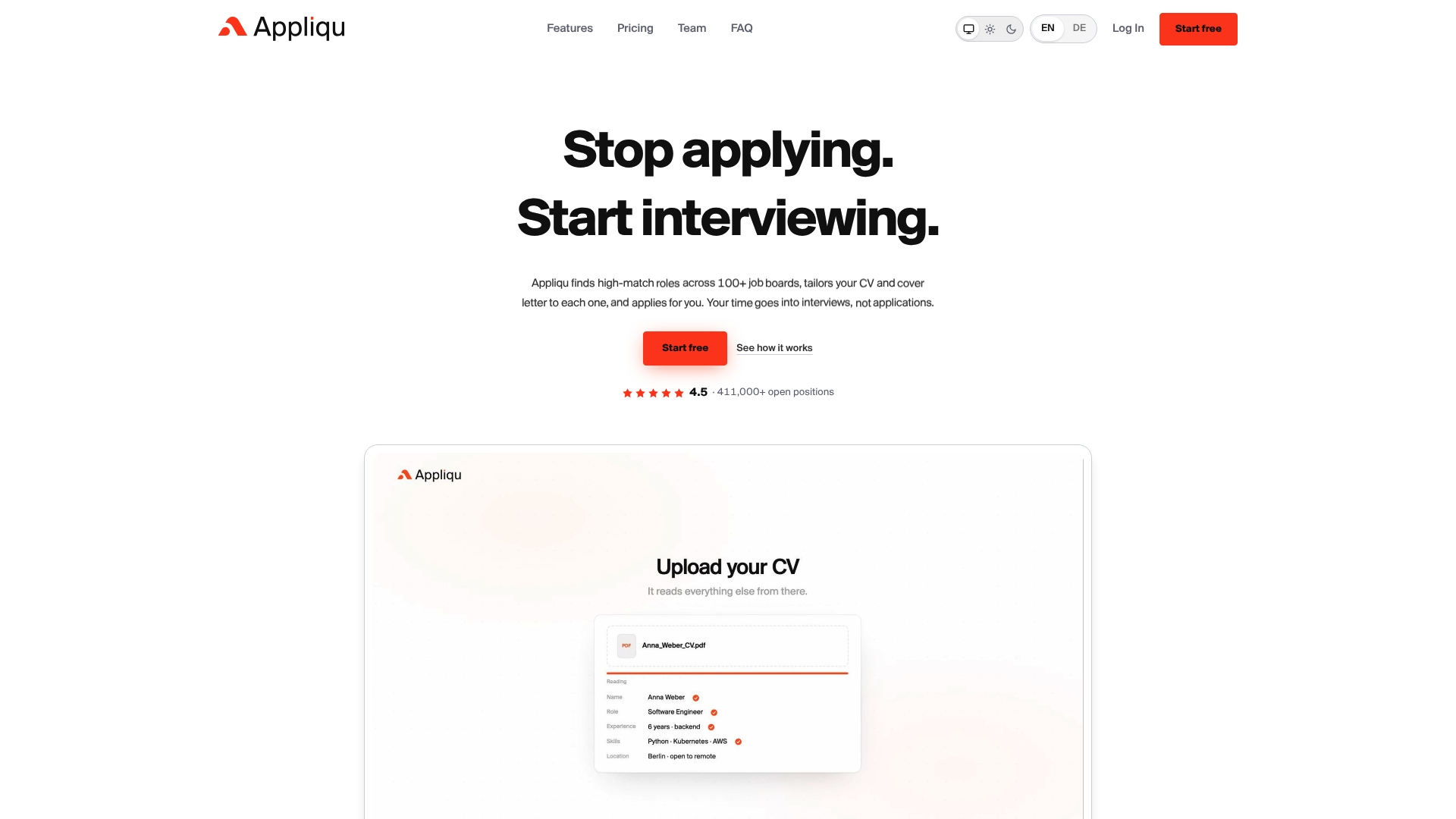
The Explorer plan is free forever, and Appliqu writes 5 applications there so you can read the letters it produces from your own CV. Sending applications starts with the Core plan at €29.90 per month for 100 applications. Pro is €69.90 per month for 300 applications, with the Appliqu Job Board. Concierge is €199.00 per month for unlimited applications, plus a senior consultant session. Prices include VAT where applicable. See the plans on the Appliqu site and choose between approval mode and Autopilot.
Format, proofread and save
A clean layout lets the content do the work. The Marquette University Law School guide recommends one page with three or four paragraphs, 11 or 12 point black font, one-inch side margins and single spacing with a blank line between paragraphs. Microsoft's cover letter format guide suggests an easy-to-read font such as Calibri or Arial, left-aligned body text, and exporting to PDF to preserve formatting.
Checklist before sending:
- One page. If it runs over, cut the weakest example.
- Spelling and grammar. The NIH guide warns that a poorly written letter will quickly get you eliminated. The University of British Columbia's cover letter toolkit notes that some employers reject applications outright for errors.
- A second reader. Maynooth University's writing tips say not to rely entirely on spell check, and to ask someone else to read the document too.
- PDF with a professional file name. Use your first and last name and a word describing the document, for example Jane-Smith-Cover-Letter.pdf, and optionally the employer's name.
- Check the PDF. Open it once to confirm the fonts and bullets are intact and it is still a single page.
Which goes first, the CV or the cover letter?
When you upload separate files, the letter is normally read first. Indeed's FAQ on the topic states that once the documents pass initial electronic screening, the employer typically reviews the cover letter before the CV. If you combine both in one document, Indeed's guide to combining them notes that many candidates put the cover letter first, because it works as an introduction to your skills and experience. When the posting gives its own instructions, follow those.
Career changers and first-job applicants
If your CV does not show a direct path to the role, the letter has to build the bridge. A peer-reviewed guide to high-quality cover letters advises against repeating the CV, and suggests that people applying for a first job or switching focus may benefit from briefly describing relevant training experiences.
In practice:
- Lead with transferable skills. Choose the three skills the posting values most and show where you used each, even if it was in a different industry, a project, a volunteer role or a degree.
- Name the reason for the change. One sentence on why you want this field is enough.
- Use coursework and projects. If you are a graduate or student, a final-year project, internship or society role is a valid example when it matches the requirements.
- Keep the claims modest and exact. Depth beats volume: the same guide notes that quality matters more than quantity, so one well-explained experience is stronger than a long list.
The same logic applies to your CV. Appliqu explains how AI can tailor your CV for every application so the letter and CV highlight the same transferable strengths.
FAQ
Can I copy sentences from my CV into the cover letter?
Use the facts, not the bullet points. Take a result from your CV and explain the situation and your role in two or three sentences in the letter. The reader has your CV, so the letter should add context and show why the result matters for this job.
How long should a cover letter based on my CV be?
Aim for one page, usually 250 to 400 words, in three or four paragraphs. The U.S. Department of Labor guide gives that range as typical. If you are over, remove CV detail that does not relate to the role.
Can I use the same cover letter for several jobs?
We advise against it. The National Careers Service recommends writing a new letter for every job. You can reuse a strong achievement paragraph, but change the opening, the matching of skills and the "why this company" section each time.
Is it acceptable to generate a cover letter from my CV with AI?
Yes, if you review the result. Supply your real CV and the full posting, check every claim against your CV, and edit until it sounds like you. In approval mode, Appliqu shows you each letter before an application goes out.
Sources
- Resume Essentials Participant Guide, U.S. Department of Labor
- Your CV Should Inform; Your Cover Letter Should Persuade, The Chronicle of Higher Education
- OITE Guide to Cover Letters, NIH
- How to Tailor a Cover Letter for a Job, Resume.io
- Writing a cover letter and resume, Ontario Public Service
- How To Write Cover Letters, Resumes, and CVs, Cedarville University
- How To Write An Effective Cover Letter, Cornell University
- How to write a cover letter, National Careers Service
- How to Write a Cover Letter and Land the Interview, Grammarly
- How to Use ChatGPT to Write a Cover Letter, Coursera
- Using AI for writing cover letters, MIT Career Advising & Professional Development
- Writing Effective Letters Guide, Marquette University Law School
- Cover letter format in Word, Microsoft
- Cover Letter Toolkit, University of British Columbia
- CV and Cover Letter Writing Tips, Maynooth University
- Do Employers Review Your Resume or Cover Letter First?, Indeed
- How To Combine a Cover Letter and Resume, Indeed
- A guide to creating a high-quality cover letter, PMC
Recommended
The all-in-one career platform.
Appliqu finds matching jobs, rewrites your CV & cover letter for every single one and applies for you.
- Appliqu writes every application to an exceptional standard.
- You approve. Appliqu sends.
- Everything at a glance. Stay relaxed.
No credit card needed.
4.5 on Trustpilot · Cancel anytime