Jobs With Work-Life Balance: How to Find Roles That Fit

No job title guarantees good work-life balance. Roles with predictable schedules, such as dental hygienist, teacher or psychologist, are often cited as strong candidates, but the employer, the team and the contract decide what your week looks like. The reliable method is to choose a few role types with a structure that suits you, then screen each individual vacancy for hours, flexibility and culture before you apply.
This guide covers the roles most often named, the pay trade-offs that come with flexibility, the wording in job adverts that signals overwork, and a step-by-step way to build a search around the life you want.
TL;DR
- Roles with structured, predictable schedules (dental hygiene, teaching, psychology) are most often linked with good balance, but each has its own demands outside paid hours.
- Flexibility can come with lower pay or slower wage growth, so decide what you are willing to trade before you search.
- The same job title can offer very different balance at different employers. Judge the vacancy, not only the profession.
- Phrases such as "comfortable with long hours" in an advert are a signal to ask questions before you apply.
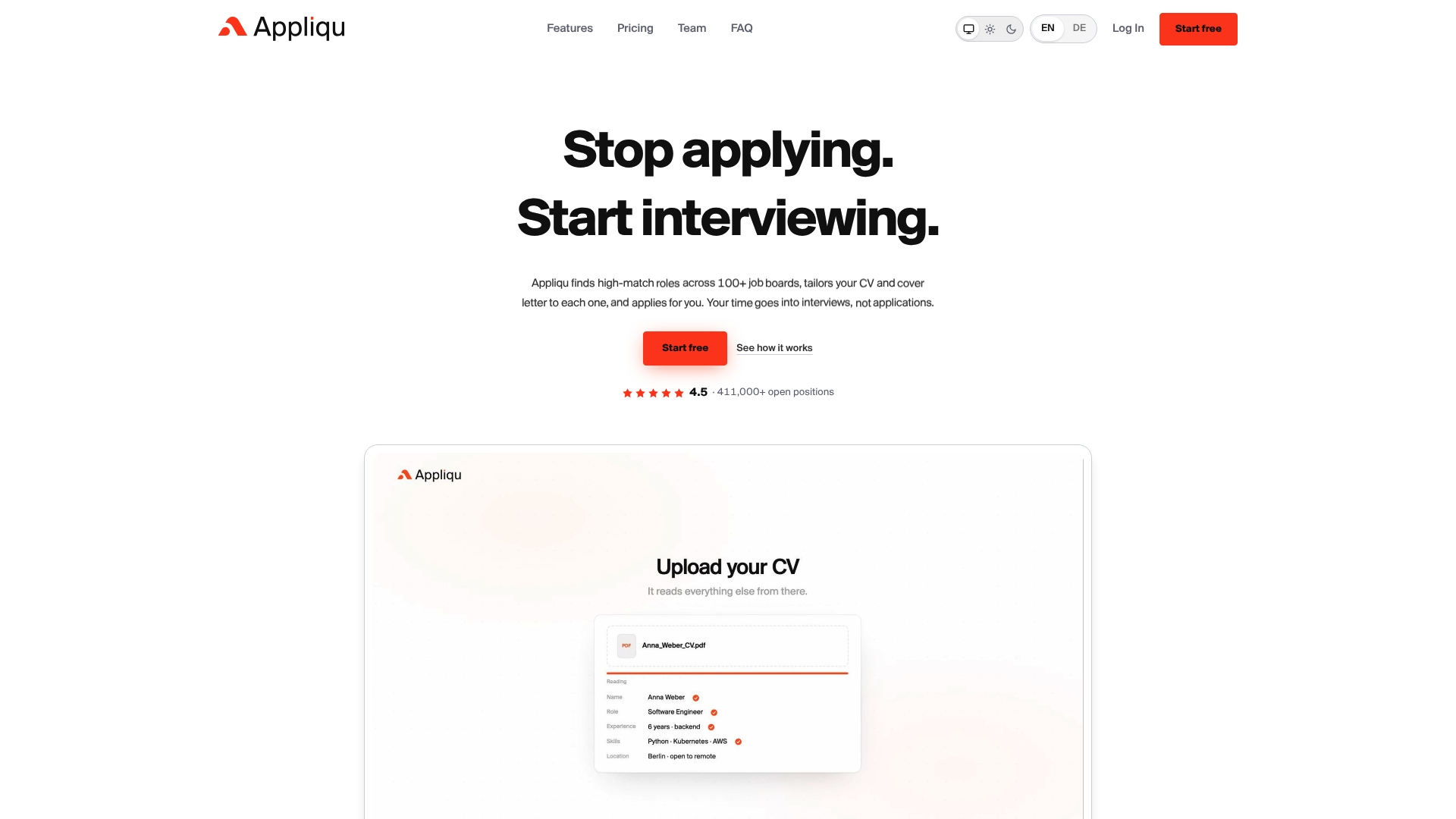
- Appliqu searches more than 1.5 million jobs from over 500 sources, scores each role against your profile and applies for you, so screening for balance takes less of your time.
Table of Contents
- What work-life balance means in a job
- Jobs often associated with good work-life balance
- Pay, flexibility and the trade-off you need to decide on
- Look at the vacancy, not only the profession
- Moving into a role with better balance
- Turning your priorities into a search
- Our perspective: balance starts with how you search
- Let Appliqu do the applying
- FAQ
- Sources
What work-life balance means in a job
Work-life balance is not one fixed state. For one person it means leaving at 5 pm every day. For another it means working from home two days a week, choosing start and finish times or taking long blocks of leave. Before you look at any list of "best jobs", write down which of these you actually need:
- Predictable hours: a fixed schedule with little overtime.
- Flexible hours: the freedom to move your working day around school runs, appointments or a long commute.
- Location flexibility: remote or hybrid work.
- Time off: generous leave, or a calendar with natural breaks.
- Low carry-home stress: work that ends when the shift ends, rather than following you into the evening.
You may have come across the "8-8-8 rule". It is a simple way of thinking about the day: roughly eight hours for work, eight for sleep and eight for everything else. Treat it as a planning aid rather than a standard. It is useful as a quick test of a vacancy: if the realistic hours of a role make the final eight impossible, the job does not fit that model, whatever its title says.
Hours also differ between countries. The World Bank's working hours data shows that paid annual leave for a worker with one year of tenure ranges from 5 working days in some places to 30 in others, and that the standard workday is 8 hours in most countries but shorter in a few, for example 7.4 hours in Denmark. If you are applying abroad, check the statutory baseline of the country as well as the employer's own offer.
Jobs often associated with good work-life balance
Lists of the best careers for balance tend to name the same professions. A US News ranking of jobs for work-life balance names roles including dental hygienists, school psychologists and teachers, usually because their schedules are structured and predictable. That ranking is based on the United States, so use it as a guide to the type of role rather than as a statement about any one country.
The table below summarises what makes each role attractive and what to check before you commit.
| Role | Why it is associated with balance | What to check |
|---|---|---|
| Dental hygienist | Defined appointments and a clinical routine. Settings range from dental offices to public health agencies, hospitals, schools and research, according to the American Dental Association. | Whether the practice offers part-time or flexible days, and the licensing route in your country. |
| Teacher | In US K-12 education, substantial time off across summer and other breaks, per US News. | Marking and preparation often happen outside the classroom and outside paid hours. |
| Psychologist | Often a structured diary of sessions, and in private practice some control over scheduling. | Independent practice typically requires a doctorate, licensing and supervised clinical hours, so the entry route is long. |
| Marketing manager | Some roles offer remote flexibility. | Balance varies with company culture. High-pressure or client-facing environments can mean long hours and tight deadlines, according to US News. |
| Corporate recruiter, content manager, data analyst | Frequently advertised with hybrid or remote options. | Volume targets, campaign cycles and release deadlines can create busy peaks. Ask how they are handled. |
Two points stand out from the table. First, almost every role that looks easy from outside has a hidden workload: marking for teachers, deadlines for marketers, training and licensing for clinicians. Second, the balance within a role depends heavily on the employer. A marketing manager at one company may log off at 5.30 pm, while a colleague with the same title elsewhere answers client calls at night.
Pay, flexibility and the trade-off you need to decide on
Flexibility has a price in some sectors, and it helps to decide your position before you start applying rather than during an offer negotiation.
The OECD notes in its report on gender gaps in paid and unpaid work (published 15 September 2025) that some occupations offer more flexibility, such as flexible hours, part-time or remote work, but these jobs may also come with lower wages. Its Employment Outlook 2022 chapter on well-being, productivity and employment adds evidence from German firms: those adopting flexible hours saw a decrease in average wage growth, which suggests a trade-off between pay rises and autonomy over hours.
Workers also put a real value on flexibility. An OECD analysis of evidence from the United Kingdom and Australia, For better not worse (published 18 January 2023), found that regularly working from home is valued at just over 20% of women's average annual salary and 7% for men. Flexible start and finish times were valued at about 48% of average annual salary for women and just under 30% for men. In other words, many people would accept a considerable pay difference for the right arrangement, which is worth remembering when you compare two offers.

Pay also varies by country far more than by sector. Data published by data.europa.eu (13 November 2025) shows that most Europeans work in mid-pay sectors such as manufacturing, trade, public administration, health and social care or education, working roughly 150 to 170 hours a month for EUR 18 to 25 an hour on average. High-pay specialist sectors such as finance and energy combine standard hours with higher hourly earnings, but employ comparatively few people. The same publication reports that average hourly pay for similar roles can differ by more than a factor of 10 across EU Member States. If you are open to relocating, the country can matter more than the job title.
A practical way to use this:
- Write down your minimum acceptable salary.
- List which flexibility features you would give up money for, and how much.
- Rank them. Predictable hours and remote work are rarely worth the same to different people.
- Search with that ranking in front of you, and discard roles that fail the top item.
Look at the vacancy, not only the profession
The single most useful habit is to treat every advert as evidence. A role with a good-balance reputation can still be badly run, and a role in a demanding field can sit inside a well-run team.
Wording in job adverts that deserves a question
Recruitment firm Morgan Philips lists job advert red flags including "dynamic role in a fast-evolving environment", "flexible multitasker needed" and "comfortable with long hours". These phrases can signal unclear structure or normalised overwork. They are not proof, but they are a cue to ask what a normal week looks like.
Also look at the other side of the advert. Good signs include stated working hours, clear remote or hybrid policies, a named team and a defined list of responsibilities. Vague duties combined with a long list of requirements often point to a role that has absorbed several jobs.
Checks to make before you apply
Morgan Philips also suggests looking at a company's hiring history on LinkedIn and asking why the position is open. A few more checks follow the same logic:
- Turnover: several people in the same job title who each stayed a short time is worth a question.
- Employer reviews: read them for patterns on hours and management rather than single comments.
- The employer's own careers page: benefits such as flexible working, leave and hybrid policies are often described there in more detail than in a job board listing.
- The interview: ask what a typical week looks like, how out-of-hours requests are handled and how holiday cover works.
If you are employed and looking quietly, the same questions apply. A move only improves your balance if the new employer's practice matches what the advert suggests.
Moving into a role with better balance
Changing field is realistic for many people, because the skills behind balanced roles overlap with what you may already do. Project coordination, client communication, analysis and writing appear in recruiter, content, data and marketing roles. Clinical and teaching routes are different: they usually require licensing or certification, which takes time and money. Check the official requirements in your country before planning a switch, and budget for the training period.
For a career change, the quality of your applications matters more than their number. Our guide to a market-driven job search explains how to focus on a small number of well-matched roles, and how many jobs to apply to per week helps you set a pace you can sustain. To see which roles are being hired for right now, use a 30-minute job demand analysis.
The job search itself affects your balance too. If it is draining your evenings, read how to stop job search burnout and build a weekly routine with limits.

Turning your priorities into a search
Once you know what balance means for you, build the search in four steps.
- Choose two or three role types from the table above or from your own background that suit your top priority.
- Set filters: hybrid or remote, part-time if relevant, and a salary floor.
- Add the language of balance to your screening. Look for stated hours, flexible working policies and named benefits. Flag the red-flag phrases listed above.
- Tailor each application. Employers hiring for structured roles read for fit. Our guide to analysing job descriptions shows how to match your CV to a posting with one focused edit, and the piece on ATS CV optimisation covers how applicant tracking systems read your document.
Searching across many boards also widens the pool of employers who advertise flexible roles. Our overview of multi job board search shows how to do it without checking every site by hand.
Our perspective: balance starts with how you search
We see the same pattern in many searches. People who want a better balance spend their evenings scrolling boards, rewriting cover letters and filling in forms, and the search itself becomes the job that has no end. That defeats the purpose.
Our view is that the application process should not cost you the balance you are looking for. Appliqu searches more than 1.5 million jobs from over 500 sources, including company career pages, and scores every role against your profile with semantic matching. Appliqu writes a tailored cover letter for each role, adapts your CV and applies in the employer's own application form, just as you would yourself. Every application is individual.
You decide how much control you keep. In approval mode, you approve each application before it goes out. On Autopilot, Appliqu applies on its own. Appliqu also connects to your inbox, detects replies and interview invitations and keeps all your applications in one place, so you do not have to track them in a spreadsheet.
That leaves your time for the part only you can do: deciding which employers and which working patterns fit your life, and asking the right questions in the interview.
Niclas Fischell
Let Appliqu do the applying
If you know the kind of role you want, Appliqu applies for you while you spend your time on the questions that matter: hours, flexibility and culture. The plans are:
- Explorer: free forever. Appliqu writes 5 applications.
- Core: €29.90 per month, 100 applications. Sending applications starts with Core.
- Pro: €69.90 per month, 300 applications, plus the Appliqu Job Board.
- Concierge: €199 per month, unlimited applications, plus a senior consultant session.
Prices include VAT where applicable. You can see the full plan details on the Appliqu plans page.
FAQ
What is the best work-life balance job?
There is no single best job, because the answer depends on whether you value fixed hours, flexibility, remote work or time off. Dental hygiene, teaching and psychology are among the roles most often cited, but the employer matters as much as the profession. Pick the feature you value most, then screen each vacancy for it.
What is the 8-8-8 rule for work-life balance?
It divides the day into roughly eight hours of work, eight of sleep and eight for everything else, including family, meals, exercise and rest. It is a simple planning guide, not a legal or professional standard. Use it to test whether a role's real hours leave you enough time for the rest of your life.
Do jobs with good work-life balance pay less?
Sometimes. The OECD reports that some occupations with greater flexibility may come with lower wages, and that firms adopting flexible hours saw slower average wage growth in German evidence. That does not apply to every role or employer, so compare each offer on pay, hours and flexibility together.
How can I tell from a job advert whether the hours will be reasonable?
Look for stated working hours, a clear remote or hybrid policy and a defined list of duties. Be cautious with phrases such as "comfortable with long hours" or "flexible multitasker needed". Then ask in the interview what a typical week looks like and why the position is open.
Can I change careers into a role with better balance?
Often yes, especially into roles such as recruiting, content, data or marketing, where communication, analysis and organisation transfer well. Clinical and teaching careers usually require licensing or certification, so check the official requirements in your country first.
Sources
- US News: Best jobs for work-life balance
- American Dental Association: Dental hygienist
- World Bank: Working hours data
- OECD: Gender gaps in paid and unpaid work persist
- OECD Employment Outlook 2022: Well-being, productivity and employment
- OECD: For better not worse, job quality and the decision to stay
- data.europa.eu: Work across the EU, jobs, pay and time off
- Morgan Philips: Job red flags