Jobs with Visa Sponsorship: How to Find and Apply in 2026

A job with visa sponsorship is a role where the employer takes a formal part in your immigration application, so you can work legally in a country where you do not yet have the right to do so. To find one, search for employers that are licensed or registered to sponsor, confirm that the specific role qualifies, and apply through the employer's own careers page. This guide explains what sponsorship means, which roles and countries offer it, what the rules require in the UK, the US and Canada, and how to apply without wasting weeks on roles that cannot sponsor you.
TL;DR
- Sponsorship means the employer supports your work permission. In the UK the employer must hold a sponsor licence, and in the US the employer files the petition.
- Sponsored roles cluster where candidates are hard to find: software and data, engineering, health care and some skilled trades.
- Eligibility depends on the role as much as on you: its skill level, its salary and the occupation code all count.
- Check the sponsor register, apply on the real careers page and never pay anyone for a "visa processing fee".
- Appliqu searches, scores and applies for you, so you can spend your time on the sponsorship checks that need your own judgement.
Table of Contents
- What visa sponsorship actually means
- Which countries and industries offer sponsored jobs
- UK Skilled Worker rules in brief
- Sponsorship in the United States and Canada
- How to find jobs that genuinely offer sponsorship
- How to apply for a sponsored job
- Avoiding fake sponsorship offers
- Our perspective on sponsored job searches
- Put Appliqu to work on your search
- FAQ
- Sources
What visa sponsorship actually means
In most countries, a work visa rests on a concrete job offer, and the employer has a defined role in the process. According to one guide to sponsored jobs, the US employer files the petition, while the UK employer must hold a sponsor licence.
Two terms are often confused. Visa sponsorship is the employer's commitment to support a new immigration permission. Work authorisation is a right to work that you already hold, for example through citizenship, settled status or a spouse visa. The Oyster glossary draws the same distinction. If you already have the right to work, you do not need a sponsored job. If you do not, the sponsorship has to be possible for that employer, for that role and for your profile at the same time.
That three-part test explains why a job advert saying "visa sponsorship available" is a starting point and not a guarantee. The outcome depends on the role, your profile and the immigration rules, so confirm the details before you invest time in an application.
Which countries and industries offer sponsored jobs
Sponsorship costs employers time and money. For that reason it is mostly offered where candidates are scarce: software and data, engineering, health care and some skilled trades, as the same guide notes.
Current job-board data points the same way:
- A study of European job boards on 30 October 2026 found that engineering had the most visa sponsorship mentions, with 159 ads.
- The same study found that only 0.3% of all open jobs it monitored in Europe explicitly mentioned sponsorship. Explicit mentions are rare, so you should not rely on them alone.
- On the same date, the aggregator Jaabz listed 3,051 active sponsored jobs across 91 countries, with the United States, the United Kingdom, Germany and the Netherlands among its leading countries and programming as its largest category.
The low share of explicit mentions has a practical consequence. Workcamino's research indicates that job feeds often underreport sponsorship, because many adverts are written for a domestic audience. Tukki.ai makes a related point: smaller employers often decide case by case, so a posting that says nothing about sponsorship is neither a yes nor a no.
Your search should therefore cover two groups of roles: those that state sponsorship openly, and those at licensed employers that do not mention it but may still be willing.
UK Skilled Worker rules in brief
The UK is the market most searches for this keyword come from, so it is worth knowing the Skilled Worker route in detail. You need a job offer in an eligible skilled occupation from a Home Office-approved sponsor, and you must meet the route's skill, salary and other requirements, as the official sponsor guidance sets out.
| Requirement | What it means for you |
|---|---|
| Approved sponsor | The employer must hold a sponsor licence before it can offer you a certificate of sponsorship. |
| Skill level | Since 22 July 2025, jobs must normally be at RQF level 6 (degree level) or equivalent, or appear on the Immigration Salary List or Temporary Shortage List. |
| Salary | The higher of £41,700 a year or the going rate for the occupation, according to GOV.UK. |
Two practical points follow. First, the salary threshold is a floor and many occupations have a higher going rate, so read the salary in the advert against the occupation, not just against £41,700. Second, rules change. Read the GOV.UK page for the current figures before you accept any offer.
Checking whether an employer can sponsor
The Home Office publishes a register of licensed sponsors. On 26 October 2026 it contained 121,985 employers, according to RebornJob's count. A licence does not mean every role at that employer can be sponsored, but an employer that is not on the register cannot sponsor you at all. Check the register before you spend time on a tailored application.
New licences are not instant. Applications from organisations typically take around eight weeks to process, per the same official guidance. A small company that says it "will apply for a licence" is therefore a slower route than one that already holds one.
A concrete example of a sponsored UK role: a veterinary surgeon vacancy in Lancashire from a recruiter, Vetted Recruitment, states a salary up to £70,000, a CPD budget of at least £2,000 a year and visa sponsorship available. It also requires a surgeon eligible for RCVS registration. Notice the pattern: the advert names the sponsorship and the professional registration in the same listing, which is exactly the level of detail you want to see.

Sponsorship in the United States and Canada
United States: H-1B
For the H-1B route, the position must require at least a US bachelor's degree or higher in a directly related specific specialty, or its equivalent, as a minimum for entry, according to USCIS. The employer must also obtain a certified Labor Condition Application from the Department of Labor, attesting that it will pay no less than similarly qualified workers or, if higher, the prevailing wage for the position and area. Your degree and the job's requirements therefore need to line up.
Canada: two employer routes
Canadian employers can hire through the Temporary Foreign Worker Program or the International Mobility Program. Under the first, the employer pays a $1,000 fee per position to process a Labour Market Impact Assessment, and positions must be full-time, at least 30 hours a week. Under the second, the employer generally pays an employer compliance fee of $230 and submits an offer of employment through the Employer Portal. These are employer fees. You should not be asked to pay them.

Even with a positive opinion from an International Mobility Workers Unit, a border services officer makes the final decision on admissibility, as IRCC states. A job offer is necessary, but it is not the last step.
How to find jobs that genuinely offer sponsorship
Use several signals together, because no single one is reliable.
- Start from the registers. Build a list of employers on the official sponsor register of your target country, then look at the vacancies on their own careers pages.
- Use filters as a signal, not proof. A visa-sponsor filter on a job board gives a positive signal. One provider says it checks the UK Home Office and Dutch IND registers, per its own page. The Dutch register held 13,017 recognised sponsors on 26 October 2026, per RebornJob.
- Search by role family. Prioritise software, data, engineering, health care and skilled trades, where sponsorship is most common.
- Search the full market. The most suitable roles may sit on company career pages and smaller boards rather than the biggest job boards. Our guide to the best job boards in 2026 compares the main options.
- Do not rule out silent adverts. If a licensed employer does not mention sponsorship, ask the question at the right time (see below) instead of skipping the role.
How to apply for a sponsored job
The strongest applications deal with the sponsorship question early and clearly, without making it the whole story.
- Confirm the basics before you tailor anything. Check that the posting explicitly offers sponsorship or that the employer holds a licence, that the role is at the skill level the route requires, and that the salary fits the country's visa conditions.
- Apply through the company's real careers page. This confirms that the vacancy exists and that you are dealing with the employer itself.
- State your status honestly. Say in your cover letter or application form that you will need sponsorship. Many forms ask directly, and an honest answer saves everyone time.
- Match the wording of the posting. Sponsored roles are competitive because the employer must justify the cost. Our article on analysing job descriptions shows how to tailor your CV with a single targeted edit.
- Ask about the process before you accept. Ask who pays the visa costs, how long the employer expects the process to take, and whether the offer is conditional on the visa being granted. Recruiters that handle overseas candidates normally describe their process openly. Vetted Recruitment, for instance, lists a discovery call, candidate qualification, interview management, offer management and after-sales reviews, and says it checks qualifications, identity and right to work.
If your applications go out in volume, quality still matters. Our guide to targeted job applications explains how to scale without sending generic documents.
Avoiding fake sponsorship offers
Sponsorship attracts fraudsters because the stakes for applicants are high. Warning signs include offers you did not ask for, a promise of a visa without an interview, and requests for a "visa processing fee" paid to a private account. Official fees are paid directly to government authorities, as the GetGlobalJob guide explains.
Protect yourself with three habits:
- Apply only through official company career pages.
- Verify that the employer is a registered entity and, where relevant, on the sponsor register.
- Treat any request for money before a signed offer as a reason to stop.
Legitimate recruiters do not charge candidates. Vet Seekers, for example, states that its services are completely free to job seekers.
Our perspective on sponsored job searches
Searching for a sponsored job is a volume problem and a precision problem at the same time. You need to look at many employers, because explicit sponsorship adverts are rare. You also need each application to be individual, because employers who sponsor can afford to be selective.
This is why we built Appliqu to take over the whole application process instead of single steps. Appliqu searches more than 1.5 million jobs from over 500 sources, including company career pages, and scores every role against your profile with semantic matching. Appliqu writes a tailored cover letter for each role, adapts your CV and applies in the employer's own application form.
You decide how much control you keep. In approval mode you approve every application yourself, which suits a sponsored search: you can check each role's sponsorship wording and salary before anything is sent. On Autopilot, Appliqu applies on its own once you are confident in your settings.
Every application is individual, with no mass emails. That is the standard a sponsoring employer expects.
Niclas Fischell
Put Appliqu to work on your search
Appliqu applies for you in the employer's own application form, and it connects to your inbox to detect replies and interview invitations, so every application stays in one place. You keep the decisions that matter: which roles to pursue and whether the sponsorship terms are acceptable.
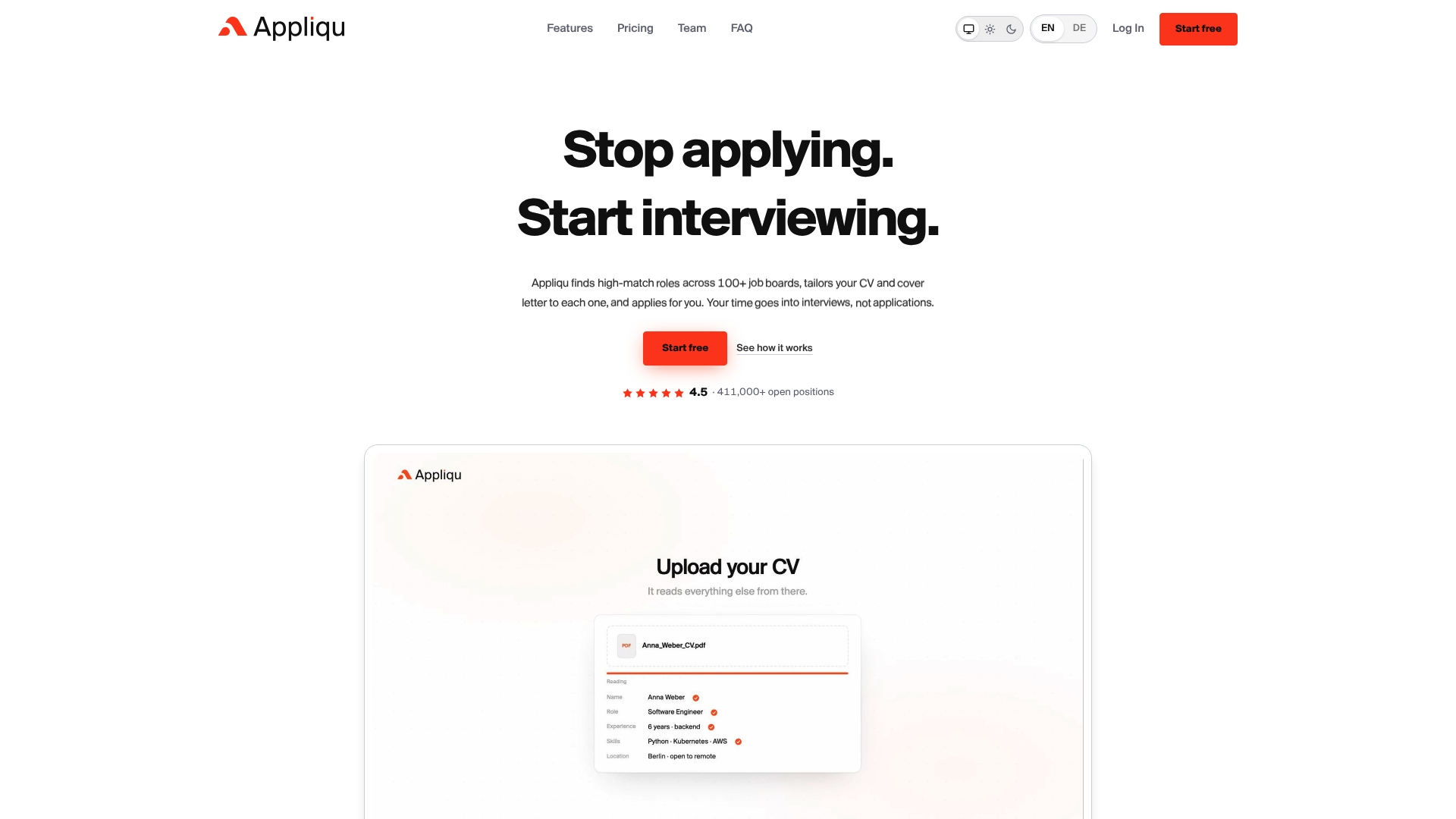
The Explorer plan is free forever, and Appliqu writes 5 applications there. Sending applications starts with Core at €29.90 per month for 100 applications. Pro is €69.90 per month for 300 applications, plus the Appliqu Job Board. Concierge is €199 per month with unlimited applications and a senior consultant session. Prices include VAT where applicable. See the plans on Appliqu and start with Explorer.
If you are unsure whether automation is appropriate, read is auto-apply legal first.
FAQ
Can I get a sponsored job without experience?
Yes, but the options are narrower. Some employers offer sponsorship for graduate schemes. Deloitte UK, for example, says it can apply for sponsorship on behalf of some graduates who meet the Skilled Worker new entrant criteria. Check each employer's graduate page for the current terms.
Does "visa sponsorship available" guarantee I will get a visa?
No. The employer's commitment is one part of the process. The outcome depends on the role, your profile and the immigration rules, and a government decision-maker still makes the final call. Confirm the details before you apply and again before you accept an offer.
Should I mention that I need sponsorship in my application?
Yes, when the form asks, and in most cases in your cover letter too. A clear, factual sentence about your status lets a licensed employer decide quickly. It also avoids a late rejection after several interview rounds.
Can I apply to many sponsored jobs at once?
Yes, as long as each application is tailored and you have checked that the employer can sponsor the role. Approval mode in Appliqu lets you review each application before it is sent, which keeps volume and accuracy together.
Sources
- Visa sponsorship jobs: how they work and how to find them
- What is visa sponsorship? Oyster glossary
- Visa sponsorship jobs in Europe: live ads by country
- Top Companies Sponsoring Visas, Jaabz
- Visa sponsorship jobs 2026 guide, Tukki.ai
- Workers and Temporary Workers: guidance for sponsors
- Skilled Worker visa: Your job, GOV.UK
- Visa sponsors hiring now, by country, RebornJob
- Veterinary Surgeon vacancy, Vetted Recruitment
- International Hiring, Vetted Recruitment
- H-1B Specialty Occupations, USCIS
- Program requirements for low-wage positions, Canada.ca
- How to hire under the International Mobility Program, Canada.ca
- International Mobility Workers Unit, Canada.ca
- International Jobs with Visa Sponsorship, CVJet
- Locums, Vet Seekers