In-Demand Careers: Which Jobs Are Growing in 2026

The careers in highest demand sit in health and social care, digital technology (software, data, cybersecurity), engineering and construction, and professional services such as finance, consulting and business analysis. Official forecasts from the UK, the EU, the OECD and the US point the same way: shortages are most pronounced in high-skilled occupations, and demand for care and digital roles is rising fastest. This guide shows which careers are growing, what they involve, what some of them pay, and how to check whether a role is in demand in the country where you want to work.
TL;DR
- Health, social care, ICT, engineering and teaching are the occupation groups where the OECD finds shortages most pronounced.
- In the UK, Skills England expects demand for key occupations in priority sectors to grow by almost a quarter over the next decade, with care workers and digital occupations among the largest increases.
- Demand differs by country. Check national forecasts and live job postings before you retrain or relocate.
- Career changers can often enter in-demand fields through short courses and micro-credentials rather than a second degree.
- A career being in demand does not mean every opening is easy to win. A tailored application for each role still decides who gets an interview.
Table of Contents
- What "in demand" actually means
- The careers with the strongest demand
- Quick comparison by sector
- Demand changes from country to country
- Options for career changers and graduates
- Applying once you have chosen a direction
- Promo: let Appliqu apply for you
- Our perspective
- FAQ
- Sources
What "in demand" actually means
A career is in demand when employers struggle to fill vacancies relative to the number of qualified people available, or when the number of jobs is projected to grow faster than average. These are two different signals, and good research separates them.
Shortage means vacancies are hard to fill today. The OECD's mapping of skill shortages finds that shortages are particularly pronounced in high-skilled occupations such as ICT, science and engineering, health and teaching, while surpluses are more common in lower-skilled occupations (OECD, Mapping Skill Shortages in OECD Countries).
Growth means the total number of jobs will rise. A role can be growing without being short of people, and a role can be short of people in a shrinking field. Both matter when you choose a direction, but they carry different risks. A shortage usually means you can find work quickly if you hold the right qualification. Growth means the field offers a longer runway.
The World Economic Forum gives the global picture. Its Future of Jobs Report 2025 estimates that macrotrends will create 170 million new jobs by 2030, equal to 14% of current employment, while 92 million jobs (8%) will be displaced. The net effect is growth, but the new roles are not the same as the old ones. That is why reading the direction of travel matters more than a single ranked list.

The careers with the strongest demand
No single list fits every country. The groups below appear repeatedly in the official forecasts and are a sound starting point.
Health and social care
Health is the most consistent theme across sources. In the UK, Skills England projects that care workers are among the occupations seeing the largest increases (Skills England annual skills report 2026). The CIPD's winter 2025/26 Labour Market Outlook found the most positive hiring intentions among employers in care, social work and other healthcare activities, with a net employment balance of +30 (CIPD Labour Market Outlook).

In the United States, the Bureau of Labor Statistics (BLS) projects that private healthcare and social assistance will add the most jobs of any major industry between 2025 and 2035, more than 2.2 million (BLS). Among individual occupations, the BLS expects registered nurses to add 194,700 jobs, with a 2025 median annual pay of $97,550 (BLS Occupational Outlook Handbook). Those are US figures and should not be read as UK pay.
Routes in range from nursing and allied health professions to care coordination and health administration. Many require a regulated qualification, so check the registration body in your country before you plan a move.
Digital technology and data
Software, data, AI and cybersecurity roles appear on almost every list. The World Economic Forum names big data specialists, FinTech engineers, AI and machine learning specialists and software and applications developers among the fastest-growing roles to 2030 (Future of Jobs Report 2025).
In Europe, the EU's skills agency CEDEFOP projects that professional occupations in digital technologies, business, health and specialised knowledge will see the strongest growth, with ICT professionals expected to grow by 2.7% in 2027 (CEDEFOP short-term skills anticipation). In the US, the BLS expects software developers to add 174,700 jobs by 2035, with a 2025 median pay of $135,980, and computer and information systems managers to add 108,100 jobs at a median of $175,140 (BLS Occupational Outlook Handbook).
For UK freelancers, the IPSE 2024 day-rate data gives a sense of earnings: programmers and software developers averaged £546 per day, electronics engineers £606, mechanical engineers £581 and management consultants and business analysts £763 (IPSE average day rates). IPSE also notes that freelancers with fewer than five years in self-employment charge 28% less on average, so these averages describe established contractors, not first-year earnings.
Engineering, construction and utilities
Skills England says digital, engineering and construction occupations appear most commonly among the jobs that are already in high demand and crucial to the Industrial Strategy (Skills England). In the US, utilities are projected to be the fastest-growing major industry between 2025 and 2035, at 9.8% (BLS). Energy-transition work, grid upgrades and infrastructure projects are the common thread.
Professional services and business roles
The same BLS release projects growth of 8.6% for professional, scientific and technical services, driven by demand for AI-based systems, research and development and associated consulting. In the UK, the CIPD survey found positive hiring intentions in legal, accounting, consultancy and head office activities (+27), and in information and communication (+23) (CIPD). Business analysts, operations managers and project managers sit in this group.
Teaching
The OECD lists teaching professionals among the high-skilled groups with pronounced shortages. Subjects and regions differ widely, so look at the shortage lists published by your national education department rather than assuming every teaching post is easy to fill.
Quick comparison by sector
| Sector | Typical roles | Demand signal | Entry route |
|---|---|---|---|
| Health and social care | Nurses, care workers, allied health | OECD shortages; Skills England growth; CIPD +30 | Regulated qualification or vocational course |
| Digital and data | Software developers, data, cybersecurity | WEF fastest-growing roles; CEDEFOP ICT growth | Degree, bootcamp or micro-credentials |
| Engineering and construction | Civil, electrical, mechanical | Skills England priority occupations | Degree or apprenticeship |
| Professional services | Business analysts, consultants, operations | BLS +8.6%; CIPD +27 | Degree, professional certification |
| Utilities and energy | Technicians, engineers | BLS +9.8% (US) | Apprenticeship or technical training |
Treat this as a map, not a promise. The demand signals come from different countries and years, which is why the next section matters.
Demand changes from country to country
A career that is scarce in one labour market can be crowded in another. Job-posting data from September 2025 to August 2026 shows that computer and mathematical roles were the largest occupational group in India (19%) and Poland (18.1%), while office and administrative support led in Brazil, Italy, the Philippines, Peru and Colombia (Decanaria Global Hiring Trends 2026). The same data puts Canada, the UK and Brazil among the largest job markets outside the US, with 2.68 million, 2.18 million and 1.81 million unique postings.
CEDEFOP stresses that cross-country comparisons need harmonised methods (CEDEFOP Skills Forecast). In practice, do not compare one country's growth percentage with another's. Read each against its own method and base year.
How to check demand in your own market
- Find the official forecast. Look for your country's labour market agency or skills body: Skills England and the National Careers Service in the UK, CEDEFOP in the EU, the BLS in the US.
- Check live postings. Search your target job title on three or four job boards and count how many fresh listings appear in a week. A role with many new postings and few applicants per post is in real demand.
- Read the requirements. If most postings ask for a licence, degree or local certification you do not hold, the shortage may not apply to you yet.
- Compare pay with cost of living. A high salary in a high-cost city can leave less than a moderate salary elsewhere.
- Test with applications. Send a small batch of tailored applications and see what comes back before you commit to retraining.
For a structured version of step two, our guide to a 30 minute job demand analysis walks through finding three roles that are hiring now. Our overview of the best job boards in 2026 shows where to look.
Options for career changers and graduates
The OECD notes that workers in routine roles facing displacement from automation can use their transferable skills to move into healthcare or professional services through reskilling. It also finds that career changers often benefit from micro-credentials and flexible learning pathways to enter ICT or health associate positions (OECD). The OECD adds that expanding entry pathways into healthcare and broadening ICT talent supply through flexible learning can help address shortages.
Three practical moves follow from this:
- List transferable skills by task, not job title. Customer service, scheduling, reporting, budgeting and stakeholder communication appear in operations, project management, business analysis and care coordination.
- Choose a short credential tied to a named job. A credential is worth more when postings for your target role ask for it.
- Aim for the associate level first. Health associate, junior analyst and support engineer roles often accept career changers sooner than senior titles.
Graduates should treat the degree as an entry ticket, not a guarantee. Look at the postings for internships and graduate schemes in your chosen sector, and read the requirements line by line.
Applying once you have chosen a direction
Picking an in-demand career solves half the problem. The other half is the application itself. Each posting needs a CV adjusted to its wording and a cover letter that speaks to that employer. Done by hand, ten good applications can take a full week.
For reference, our page of cover letter examples shows three full letters next to the job advert they answer. If you want to understand how tailoring works at scale, read our 5 stage workflow to automate job applications without losing tailoring.
Promo: let Appliqu apply for you
Appliqu searches more than 1.5 million jobs from over 500 sources, including company career pages, and scores every role against your profile with semantic matching. For each role Appliqu writes a tailored cover letter, adapts your CV and applies in the employer's own application form, just as you would yourself.
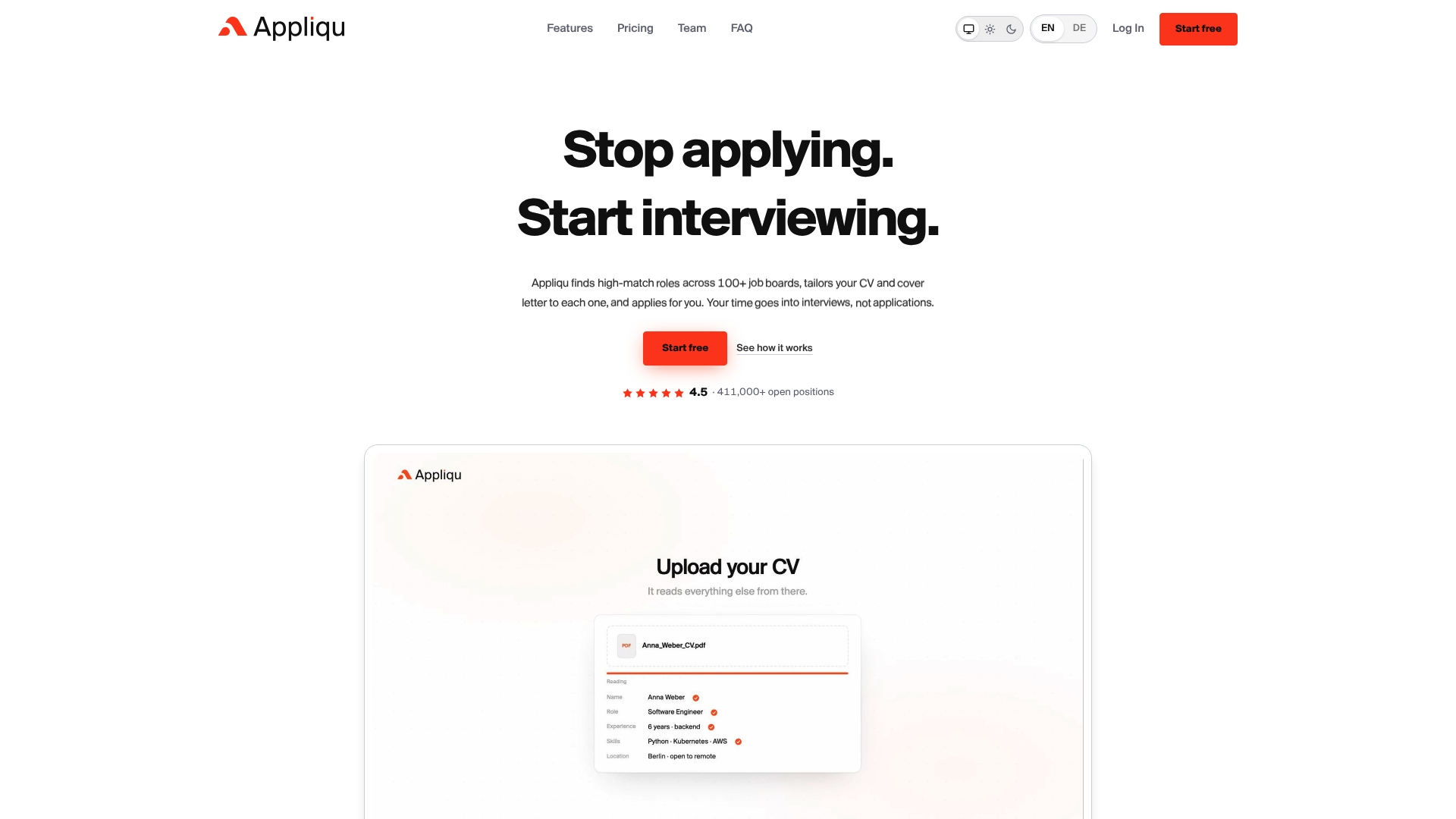
You choose how much control you keep. In the "on approval" mode you approve every application yourself. On Autopilot, Appliqu applies on its own. Appliqu also connects to your inbox, detects replies and interview invitations and keeps all your applications in one place.
The Explorer plan is free forever, and Appliqu writes 5 applications there. Sending applications starts with Core at €29.90 per month for 100 applications. Pro is €69.90 per month for 300 applications plus the Appliqu Job Board. Concierge is €199.00 per month with unlimited applications and a senior consultant session. Prices include VAT where applicable. See all plans on the Appliqu homepage.
Our perspective
Choosing an in-demand career is a sound first decision. It does not replace the work of applying well. In a field with many openings, the candidates who get interviews are the ones whose CV and cover letter answer the specific posting.
We built Appliqu around that point. Appliqu takes over the whole application process instead of single steps: it searches, scores the match, writes the cover letter, tailors the CV, applies in the employer's own form and detects interview invitations. Every application is individual, with no mass emails.
Demand research also tells you where to look. Because Appliqu searches over 500 sources, including company career pages, you see roles in your chosen field that a single job board does not list. You stay in control through the "on approval" mode or Autopilot, and you edit your CV together with Appliqu.
Our advice is simple: pick a direction using the official forecasts, confirm it against live postings, and let Appliqu apply for you while you prepare for interviews.
Niclas Fischell
FAQ
Which careers are most in demand right now?
Health and social care, digital technology, engineering and construction, and professional services appear most often in official forecasts. The OECD finds shortages most pronounced in ICT, science and engineering, health and teaching. Exact rankings depend on your country, so check your national skills body.
Are in-demand careers always well paid?
Not always. Software and management roles pay well in the BLS and IPSE data cited above, but care work and teaching often pay less relative to the demand for them. Pay also varies by country, experience and sector, so compare current postings in your own market.
Can I switch to an in-demand career without a new degree?
Often, yes. The OECD points to micro-credentials and flexible learning pathways as routes into ICT and health associate roles. Regulated professions such as nursing still require a recognised qualification and registration.
How do I know if a career is in demand in another country?
Read that country's official labour forecast, then check live job postings for your target title. Do not compare growth percentages across countries, because methods and base years differ. Also check whether your qualifications are recognised and whether you need a work visa.
Does demand mean I do not need a tailored application?
No. Even in fields with shortages, employers screen applications against the posting. A CV and cover letter adjusted to each role give you the strongest starting position.
Sources
- OECD: Mapping Skill Shortages in OECD Countries
- Skills England annual skills report 2026
- CIPD Labour Market Outlook, winter 2025/26
- World Economic Forum: Future of Jobs Report 2025, jobs outlook
- CEDEFOP: short-term anticipation of skills and VET demand
- CEDEFOP: Skills Forecast
- BLS: utilities fastest job growth, 2025 to 2035
- BLS Occupational Outlook Handbook: most new jobs
- IPSE: average day rates
- Decanaria: Global Hiring Trends 2026