Job Search Anxiety: How to Cope and Keep Applying

Job search anxiety is the tension, worry and loss of control many people feel while looking for work. It is common, it has identifiable causes, and it responds to structure: a fixed routine, a clear way of handling rejection, support from other people and, where symptoms persist, professional help. This guide covers each of these in the order you are likely to need them.
TL;DR
- Job search anxiety comes mostly from uncertainty, competition and the habit of linking personal worth to work. None of these says anything about your ability.
- A routine with limited hours helps. One university career centre suggests 1 to 2 hours a day, or 3 to 4 focused sessions a week, and the 3:3:1 method.
- After a rejection, treat the result as information about one role, not a verdict on you. A short self-compassion writing exercise has research support.
- Persistent hopelessness, poor sleep or appetite, or panic are reasons to speak to a GP, therapist or counsellor. Do not wait for the search to end.
- Appliqu can take the repetitive work off your plate, so your energy goes to interviews and recovery.
Table of Contents
- What job search anxiety is
- Why the search makes you anxious
- Signs that the search is affecting your wellbeing
- Build a routine that contains the search
- Map your habit loops
- What to do after a job rejection
- Stay motivated over weeks and months
- Our perspective
- How Appliqu fits into a calmer routine
- When to seek professional support
- A short checklist for this week
- FAQ
- Sources
What job search anxiety is
Job search anxiety is an emotional response to the stress of finding a new role. It shows up as nervousness, excessive worry and a sense that you cannot control the outcome. It is not a diagnosis in itself. It is a description of what a long, uncertain process does to many people, whether they are unemployed, employed and looking quietly, changing career or applying for a first job.
The pressure is widespread. NPR reported in 2024 that more than 28% of Americans were looking for a new job, the highest rate in a decade. That figure describes the United States, but the experience of being one of many applicants will be familiar wherever you live.
The same NPR coverage points to a cultural cause: society tends to tie individual worth to professional output, which can deepen shame during unemployment. The advice is to reject that link consciously. Your CV is a document about your skills. It is not a measure of your value.
Why the search makes you anxious
Most causes fall into four groups. Naming yours is the first practical step, because each one has a different remedy.

1. Uncertainty. You send an application and hear nothing for days or weeks. The mind fills the silence with worst-case readings. A 2022 study of college students in the PMC database links job-seeking anxiety to job competition and to the lengthening period of job preparation. The longer the wait, the louder the worry.
2. Overload. Each role asks for a tailored cover letter, an adapted CV, a separate account on a separate form and a set of screening questions. The volume of small tasks produces a feeling of falling behind before you have started.
3. Comparison. Reading about other people's offers and promotions makes your own timeline feel slow.
4. Identity. When work is central to how you see yourself, every unanswered application feels personal.
Signs that the search is affecting your wellbeing
Stress about a job hunt is normal. It becomes worth acting on when it spreads into the rest of your life. Healthline lists common symptoms such as persistent sadness, anxiety and worry, fatigue and sleep disturbances, appetite changes, irritability, difficulty concentrating, negative thought patterns and feelings of helplessness or loss of control.
Check yourself against three groups of signs:
- Thinking: harsh self-talk, trouble making decisions, difficulty focusing on a cover letter you could once write in an hour.
- Feeling: irritability, dread on opening your inbox, a sense of isolation.
- Body: poor sleep, headaches, tiredness that rest does not fix, changes in appetite.
If several of these appear most days for more than a couple of weeks, move to the section on when to seek support below.
Build a routine that contains the search
An open-ended search has no natural end to the day, so worry fills the whole day. A routine gives it edges.
The WKU Career Development Center recommends limiting job-search time to 1 to 2 hours per day, or 3 to 4 focused sessions per week, and using the 3:3:1 method: 3 applications, 3 networking touches and 1 learning activity. The guide also describes the search as a process rather than a race and suggests celebrating small steps, such as updating your CV.
A weekly structure you can copy
| Day | Focus | Time |
|---|---|---|
| Monday | Review new roles, shortlist the best fits | 1 hour |
| Tuesday | Applications | 1 to 2 hours |
| Wednesday | Networking: three messages or replies | 1 hour |
| Thursday | Applications and CV adjustments | 1 to 2 hours |
| Friday | Learning activity, then review the week | 1 hour |
Keep the weekend free of searching. Rest is part of the plan, not a reward for finishing it.
Apply to fewer, better-matched roles
Volume without fit increases both the workload and the number of rejections you have to absorb. If you want a method for choosing roles before you write anything, our guide to a market-driven job search explains why three focused applications can serve you better than thirty scattered ones. For the practical side of keeping quality high as your volume grows, see how to scale targeted job applications without losing your evenings.
Track everything in one place
Part of the uncertainty is not knowing what you have already sent. A short weekly review removes that. We describe a 15 minute weekly tracking routine that keeps every application, reply and follow-up visible, so you stop holding the list in your head.
Map your habit loops
Psychiatrist Judson Brewer, speaking to CNBC, suggests that job seekers map out their habit loops: identify the trigger for the anxiety, the behaviour that follows (procrastination, for example) and the outcome. Once you can see the loop, you can interrupt it.
A simple version in three lines:
- Trigger: I open a job listing that asks for a tailored cover letter.
- Behaviour: I close the tab and check my email instead.
- Outcome: brief relief, then guilt, then more dread at the next listing.
The fix is rarely willpower. It is usually making the trigger smaller: a ready draft instead of a blank page, a ten-minute timer instead of an open-ended task, or handing the repetitive step to something else.
What to do after a job rejection
Rejection is the most frequent event in a job search, so it deserves a plan made before it happens. Healthline notes that constant rejection can erode self-esteem over time and advises remembering that setbacks are common and do not define your worth or abilities.
A practical sequence for the first 48 hours:
- Pause before you reply. Give yourself a day before responding to a rejection email. Your first reaction is rarely your most useful one.
- Separate the facts from the story. The fact: this employer chose another candidate for this role. The story: you are not good enough. Write down only the fact.
- Ask for feedback once. A short, polite message asking whether there is anything you could improve is reasonable. Accept that many employers will not answer.
- Update one thing. Adjust a line on your CV or a paragraph of your letter. Small action restores a sense of control.
- Apply to the next role the same week. Momentum is easier to keep than to rebuild.
When you look back over several rejections, look for patterns in the roles, not in your worth. If most rejections come from roles that ask for more experience than you have, your shortlist needs adjusting. If they come after interviews, practise interview answers.
A self-compassion exercise with research behind it
A 2020 study in Frontiers in Psychology tested a self-compassion writing exercise with job seekers. It reduced self-criticism, which in turn increased calmness and reduced negative responses such as sadness to job-search difficulties.
You can try a version in ten minutes. Write a short note to yourself about the rejection, as you would to a friend in the same position. Acknowledge that it hurts, remind yourself that other capable people face the same setbacks, and name one thing you did well in the application.

Stay motivated over weeks and months
Motivation falls when effort and reward are far apart. Research on job-search behaviour points to a few reliable supports.
- Clear, manageable goals. A University of Minnesota quantitative review of job search research describes setting daily goals and planning for setbacks in advance as ways to shield motivation when challenges arise.
- Social support. The same review reports that support, including counselling, training and emotional encouragement, relates positively to job-search intensity and to employment outcomes. Tell one or two people what you are doing and ask them to check in weekly.
- Skills and motivation together. A meta-analysis of job search interventions found that participants had 2.67 times higher odds of obtaining employment than control groups. The interventions worked when they combined skill development with motivation enhancement.
The last point matters in practice. Working only on morale without improving your CV, your targeting or your interviewing is incomplete, and so is the reverse. Do both each week.
If exhaustion is the main problem rather than worry, read our guide on how to stop job search burnout and build a weekly system.
Our perspective
Anxiety in a job search rarely comes from one big event. It comes from hundreds of small, repetitive tasks that never seem to end: reading listings, rewriting the same CV, drafting another cover letter, filling in another form, checking another inbox.
This is why we built Appliqu to take over the whole application process instead of one step. Appliqu searches more than 1.5 million jobs from over 500 sources, including company career pages, and scores every role against your profile. It writes a tailored cover letter for each role, tailors your CV and applies in the employer's own application form, just as you would yourself. It also connects to your inbox, detects replies and interview invitations and keeps all your applications in one place.
Control matters as much as speed. In approval mode you approve every application yourself. On Autopilot, Appliqu applies on its own. You choose how much to hand over, and you can change that choice as your confidence changes.
The point is not to apply to more roles for the sake of it. Every application is individual, with no mass emails. The point is that your hours and attention go to what only you can do: preparing for interviews, talking to people and resting.
Niclas Fischell
How Appliqu fits into a calmer routine
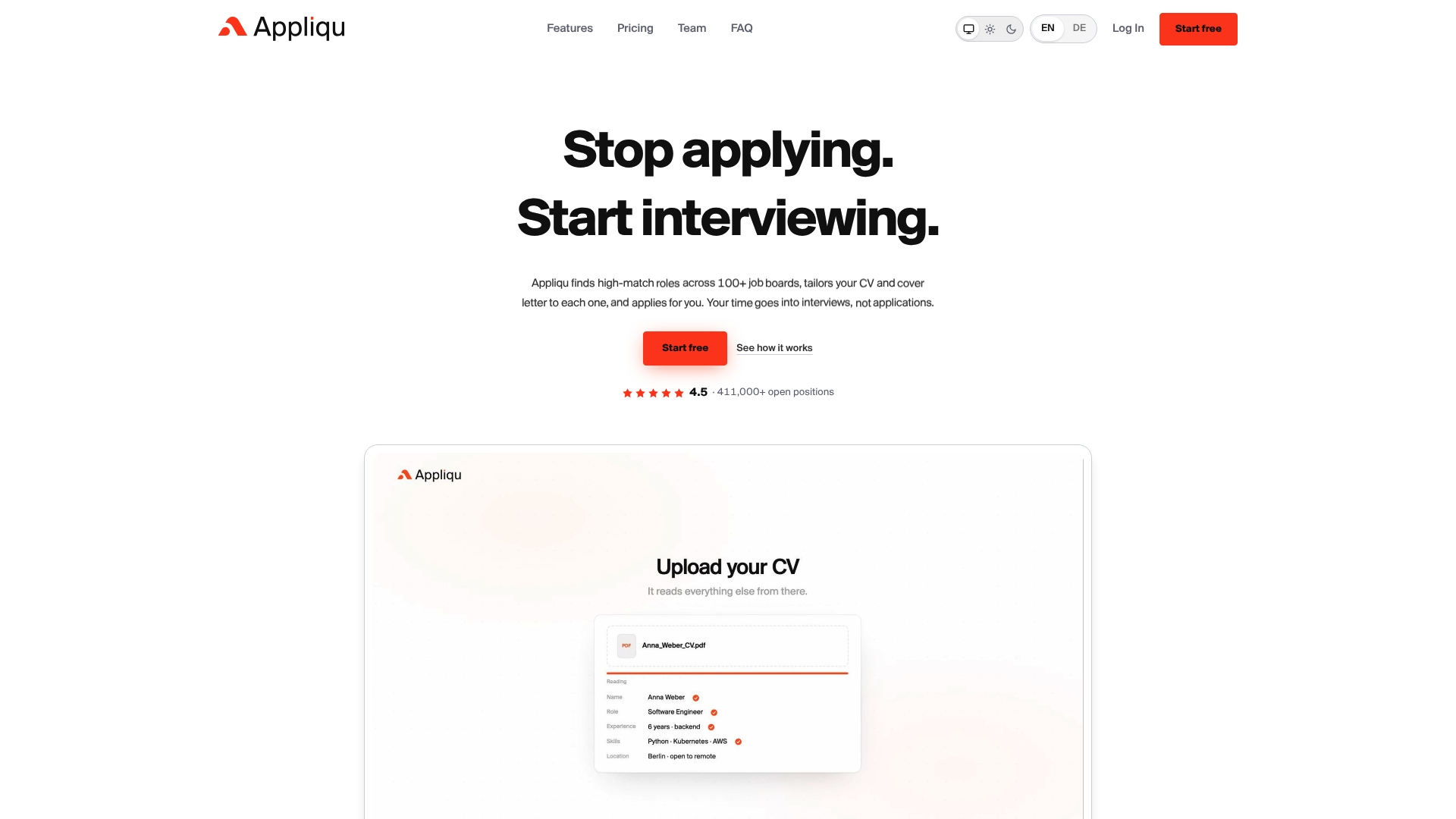
If the repetitive work is what drains you, Appliqu applies for you while you keep your hours for the parts of the search that need you. The Explorer plan is free forever, and Appliqu writes 5 applications there so you can see the quality of the letters and CV tailoring before you decide anything. Sending applications starts with the Core plan.
The paid plans, as published on our site:
| Plan | Price | What it includes |
|---|---|---|
| Explorer | €0 per month | 5 written applications, free forever |
| Core | €29.90 per month | 100 applications |
| Pro | €69.90 per month | 300 applications, plus the Appliqu Job Board |
| Concierge | €199.00 per month | Unlimited applications, plus a senior consultant session |
Prices include VAT where applicable. You can compare the plans and start on the Appliqu plans page. If you work full time and search quietly, our guide to passive job search automation shows how to keep looking while you work.
When to seek professional support
A routine and a few good habits are not a replacement for treatment. The WKU guide lists signs that call for professional help: persistent hopelessness, feeling constantly overwhelmed, trouble sleeping or eating, losing interest in all daily activities, or persistent panic. If your ability to function day to day is impaired, reaching out to a therapist or counsellor is essential.
A 2023 systematic review of mental health and unemployment found that both prevention and treatment interventions have merit for reducing anxiety and depression symptoms among unemployed people, and that cognitive behavioural therapy (CBT) and work-related interventions have the most robust evidence.
If you live in England and are 18 or over, you can refer yourself to NHS Talking Therapies for anxiety and depression without a GP referral, and the NHS advises seeing a GP if you want help with your mental health but are unsure whether that service is right for you. Readers elsewhere should ask their local doctor or health service about equivalent options. If you ever feel you may harm yourself, contact your local emergency number straight away.
A short checklist for this week
- Set your search hours and write them in your calendar.
- Choose your three applications for the week and a shortlist of roles by fit, not by volume.
- Write down one habit loop and shrink its trigger.
- Decide in advance what you will do within 48 hours of a rejection.
- Tell one person your plan and ask them to check in.
- Keep one full day free of job-search tasks.
FAQ
Is job search anxiety normal?
Yes. Uncertainty, competition and long waits for replies make worry a usual part of looking for work. It becomes a concern when it affects your sleep, appetite, concentration or daily functioning for an extended period. At that point, speak to a GP, therapist or counsellor.
How long should I spend on my job search each day?
One university career guide suggests 1 to 2 hours a day, or 3 to 4 focused sessions a week. Shorter, scheduled sessions tend to be easier to sustain than open-ended ones. Choose a pattern you can keep for months, and stop when the session ends.
What should I do straight after a rejection?
Wait a day before replying, then ask once for feedback and note only the facts. Adjust one part of your CV or letter, and apply to the next suitable role within the week. Remember that rejection is common and does not define your worth or abilities.
How do I stay motivated when nothing is working?
Set small daily goals, celebrate steps such as updating your CV, and plan for setbacks before they happen. Involve a friend, mentor or counsellor, because social support is linked to stronger job-search effort. Combine this with real improvements to your targeting and documents.
Can automating applications reduce stress?
It can remove the repetitive work that triggers procrastination. With Appliqu, you choose between on approval, where you approve every application, and Autopilot, where Appliqu applies on its own. Either way, it does not replace rest, support or professional care when you need them.
Sources
- How to manage and overcome job search anxiety, NPR Illinois
- Job Search Depression: Cause, Symptoms, Tips, Healthline
- Job Search Mental Health, WKU Career Development Center
- How to handle job search anxiety, CNBC Make It
- Testing a Self-Compassion Intervention Among Job Seekers, Frontiers in Psychology
- Job Search and Employment Success: A Quantitative Review, University of Minnesota
- Effectiveness of job search interventions: a meta-analytic review, PubMed
- Mental health and unemployment: a systematic review, PubMed
- Find NHS talking therapies for anxiety and depression, NHS
- Job-Seeking Anxiety and Job Preparation Behavior, PMC