250-400 Words: Recruiter's Guide to Cover Letter Length for Germany
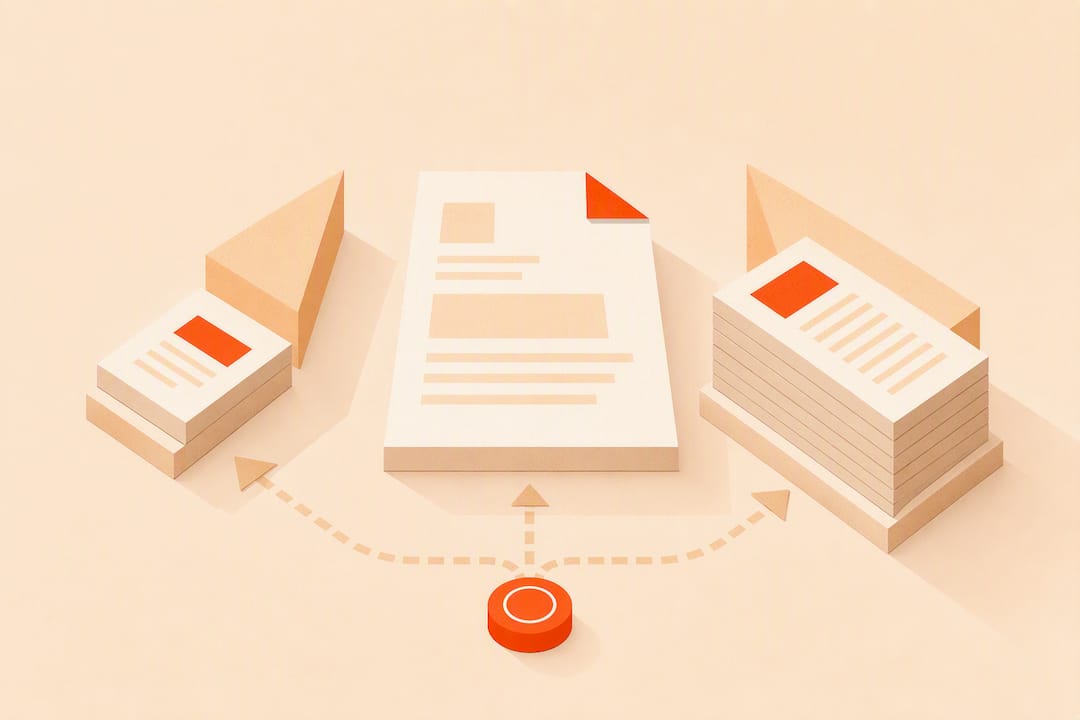
One page is the target: roughly 250 to 400 words, with 300 as a dependable middle ground. Check the job ad first, since some employers specify a limit. Email-body letters should run shorter, around 150 to 200 words, while senior or academic applications can justifiably run longer.
TL;DR:
- Most cover letters should stay within 250 to 400 words, with 300 words being a reliable target for a standard one-page letter.
- Entry-level applicants and interns should aim for closer to 200 to 250 words, focusing on concise, relevant examples.
- Longer letters beyond 500 words usually indicate repetition or unnecessary details and risk losing the reader's interest.
- A three-paragraph structure-opening, body with one or two examples, and closing-helps keep the letter within the ideal length and purpose.
- Formatting with clear spacing, professional fonts, and a logical layout enhances readability and suggests professionalism, especially when kept to one page.
Table of Contents
- Cover letter length guidelines: how many words is right?
- The three-paragraph structure that fits the word count
- Formatting rules that make a one-page letter easy to read
- When a longer cover letter is genuinely justified
- How to trim a cover letter that has run too long
- Does the format change the ideal length? Email, attachment and portal letters
- Why tailored brevity beats a long, unfocused letter
- Appliqu: tailored cover letters without the hours per application
- Where to read more on cover letter length
- Sources
- FAQ
Cover letter length guidelines: how many words is right?
The 250 to 400 word range covers most professional applications, and Resume treats 300 words as a reliable target for a standard one-page letter. That is enough space to name the role, offer one sharp example, and close with a clear call to action, without drifting into padding.
Career stage changes where you sit inside that range. Entry-level candidates and those applying for internships often do better nearer 200 to 250 words, since they typically have fewer achievements to unpack and a short, confident letter reads as focused rather than thin. Mid-level professionals tend to sit at 300 to 400 words, using the extra space for one quantified result that entry-level applicants usually cannot offer, a pattern Resume.io's breakdown by experience level backs up directly.
Letters significantly longer than the typical range risk losing the reader's attention and weakening impact. Recruiters and career coaches consistently say a cover letter should be readable in under a minute, and The Muse's guidance on ideal length makes the point that quality examples mapped to the job beat a long recap of your whole career. A 500-plus word letter almost always signals one of two problems:
- You are repeating the CV instead of adding new context.
- You are trying to cover every accomplishment instead of the two or three that matter for this specific role.
Both are fixable, and both start with picking a target length before you write, not after.
The three-paragraph structure that fits the word count
Most one-page letters organize content into three or four concise paragraphs, each serving a clear purpose. Trying to write freely and then cut down afterwards almost always produces something baggy. Build to the structure instead.
- Opening (30 to 60 words). Name the role, mention where you found it or who referred you, and offer a one-line hook that signals fit. No throat-clearing, no "I am writing to apply for" filler.
- Body (120 to 200 words total). Pick one or two examples that map directly to the job's stated requirements, not your favourite achievements in general. Each example should include a concrete result, not just a description of a task.
- Closing (30 to 50 words). State your availability, restate interest in the role, and invite the next step, such as an interview or a call.
That structure alone accounts for roughly 180 to 310 words before formatting, which sits comfortably inside the recommended range. It also forces discipline: if a paragraph is not doing one of these three jobs, it probably does not belong. Cornell University's cover letter guidance makes the same point about tying every example directly to what the employer is asking for, rather than listing achievements for their own sake. Appliqu's cover letter examples with the matching job ad show how this plays out against a real posting, line by line.
Formatting rules that make a one-page letter easy to read
Layout matters as much as word count. A cover letter formatted for A4 with tight, DIN 5008-style conventions reads faster and looks more deliberate, and German Bewerbungsanschreiben guidance recommends exactly this approach: one A4 page, a professional font at 11 to 12 point, and 1.15 to 1.5 line spacing.
A few formatting choices consistently separate a scannable letter from a dense one:
- Use Arial or Times New Roman at 11 to 12 point, never smaller to squeeze in extra text.
- Use appropriate line spacing and margins to ensure readability without overcrowding the page.
- Include a subject line stating the role and reference number if one was given.
- Use the correct salutation, addressed to a named contact wherever possible rather than a generic greeting.
- Break the letter into short paragraphs of three to five sentences, never one dense block of text.
Welcome Center guidance on structuring a cover letter flags that missing structural elements, such as a subject line or correct sender and recipient addresses, can lead to a letter being set aside early, regardless of how strong the content is. White space is not wasted space here. A recruiter skimming a stack of applications reads the shape of a letter before the words, and a cleanly spaced page signals competence before a single sentence is read.
Pro Tip: Print your letter (or preview it as a PDF) before sending it. If it spills two or three lines onto a second page, trim rather than shrink the font, since a font below 11 point undoes the readability gains from good spacing.
When a longer cover letter is genuinely justified
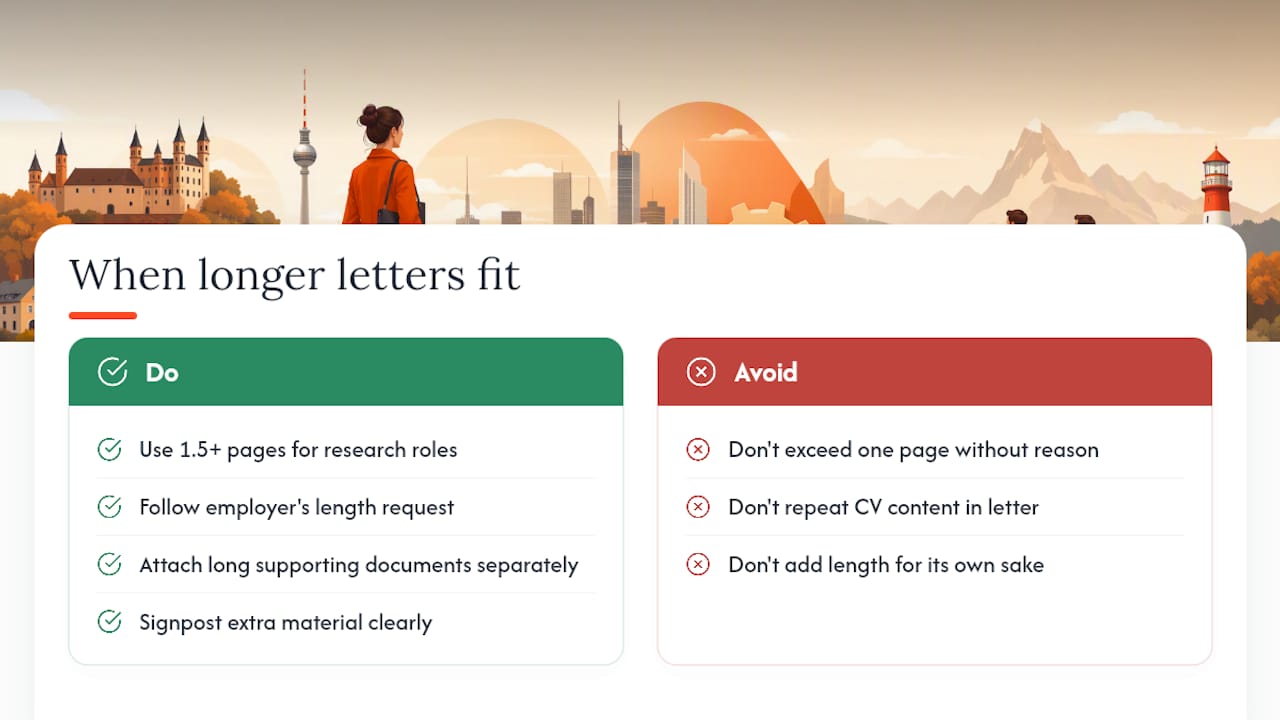
The one-page rule has real exceptions, but they are narrower than most applicants assume. Academic and research roles, where a cover letter doubles as a statement of research interests, often run to a page and a half or more. Senior executive applications sometimes need the extra space to address a specific mandate, such as turning around a division or leading an acquisition. And if an employer explicitly asks for a longer motivation letter, follow that instruction over any general guideline.
Outside those cases, resist the urge to add length just because you have more to say. If you genuinely need to include supporting material, such as a publication list or a detailed project summary, attach it separately or add a short executive summary rather than stretching the main letter. Germany's cultural expectations reinforce this: sticking to one A4 page is read as a sign of professional prioritisation, and Germany Handbook's guidance on the Anschreiben notes that exceeding it without a clear, job-related reason can count against you rather than for you. If you do go longer, signpost the extra material clearly and never repeat what is already on your CV.
How to trim a cover letter that has run too long
Most over-length letters are not badly written. They are just unedited. Working through a short checklist gets most letters back under 400 words without losing the substance that makes them persuasive.
- Cut filler and cliché phrases first. Delete lines like "I am a hardworking team player" or "I believe I would be a great fit." They cost words and tell the recruiter nothing that a concrete example would not show better.
- Pick one or two examples that map directly to the job requirements, and quantify them. If the ad asks for budget management experience, one sentence with a real figure beats three sentences describing your general responsibilities.
- Convert background context into a single results line. Instead of two sentences explaining how a project came about, write one sentence stating what happened and what it achieved.
Once you have trimmed, read the letter aloud and time it. The Muse's advice on cover letter length puts the benchmark at under a minute to read, and if your letter runs longer than that out loud, it is very likely too long on the page as well.
Pro Tip: Read your closing paragraph last. It is the section most likely to carry leftover filler from an earlier draft, since applicants often forget to re-edit it after trimming the body.
Does the format change the ideal length? Email, attachment and portal letters
Where the letter lives changes how long it should be, even when the content is otherwise the same.
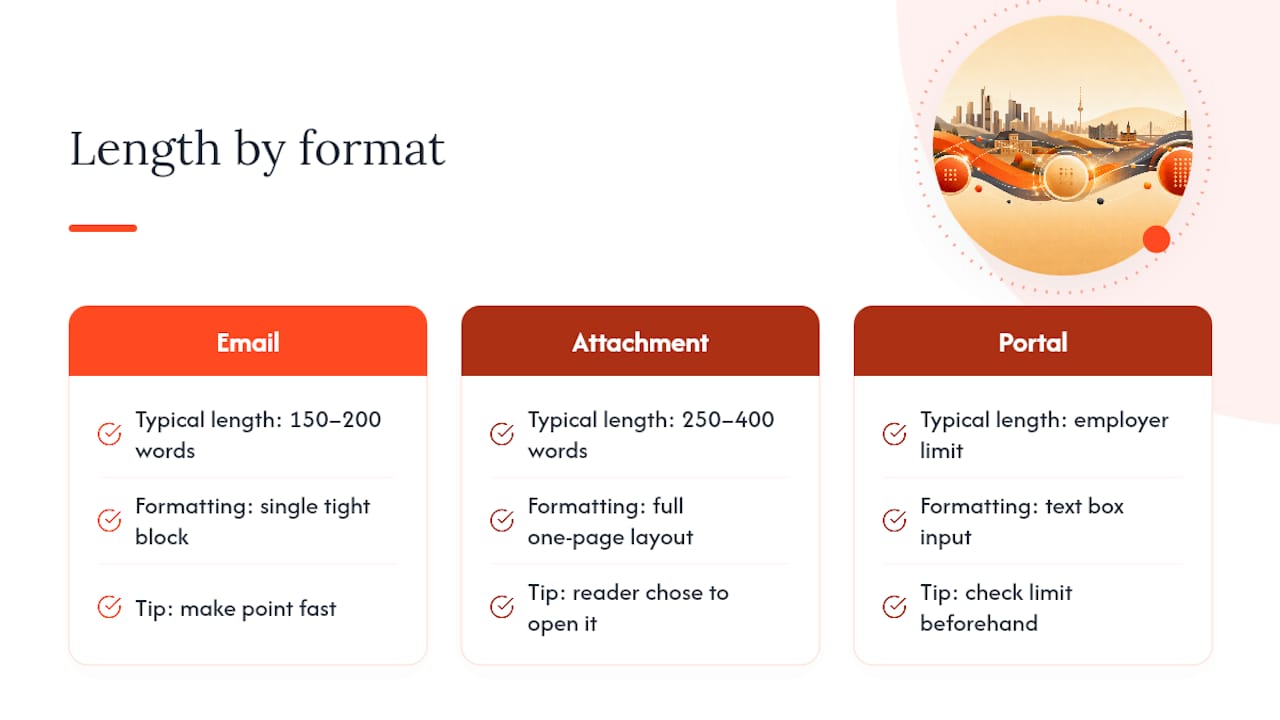
An email-body cover letter, pasted directly into the message rather than attached, should run shorter: around 150 to 200 words in a single tight block, since Resume.io notes that email letters compete with a crowded inbox and need to make their point fast. An attached PDF or Word document can carry the full one-page treatment, 250 to 400 words with proper formatting, because the reader has already chosen to open it. A portal text box, common with larger employers' application systems, often comes with its own word or character limit. Check that limit before you paste anything, and keep a shorter, stripped-down version of your letter ready so you are not cutting content under pressure at the last step of an application.
Why tailored brevity beats a long, unfocused letter
Recruiters skim. That is not a criticism of the process, it is simply how a stack of forty applications gets read in one afternoon, and a letter that respects that reality gets more attention than one that ignores it. A tight letter with one well-chosen, evidence-backed sentence tends to outperform a longer one trying to summarise an entire career, because the recruiter's eye lands on specifics, not volume.
When trimming a letter, focus on removing generic phrases first, preserving specific evidence of qualifications. A line about being "passionate about this opportunity" adds nothing a recruiter has not read fifty times already; a single figure tied to a real result is what actually moves a letter from the "maybe" pile. This is also where consistent tailoring across many applications becomes a genuine advantage rather than a nice-to-have. Appliqu approaches this by reading the full job posting for each application rather than matching on keywords alone, which keeps letters short and specific instead of long and generic, without needing to rewrite each one from scratch by hand.
Alex
Appliqu: tailored cover letters without the hours per application
Writing a tight, role-specific letter for one job is manageable. Doing it for the twenty or thirty applications that a serious job search usually needs is where most people run out of time, and that is exactly the gap Appliqu is built to close.
Appliqu writes tailored applications automatically, reading each job posting in full so the cover letter reflects the actual requirements rather than a generic template, and matches you to roles across more than 100 job boards before sending applications on your behalf. That makes it a strong fit for anyone applying at volume, whether that is a career changer testing several directions at once or a professional running a focused, high-intensity search, since consistent tailoring across dozens of letters is difficult to sustain by hand.
Every plan starts with Explorer, a permanent free tier where Appliqu writes five applications so you can see the tailoring quality before committing to anything. You choose between on approval mode, reviewing each letter before it goes out, or Autopilot for full automation. Visit Appliqu to see which tier matches how many applications you are realistically sending each month.
Where to read more on cover letter length
For readers who want the guidance straight from career professionals rather than a summary, these sources are worth bookmarking directly.
- Cornell University's cover letter guidance: useful for how a university career service frames role-specific examples over general achievement lists.
- Welcome Center guidance on cover letter structure: practical, Germany-focused detail on the structural elements a letter needs to avoid early rejection.
- Lifetimes Deutschland's Bewerbungsanschreiben guide: a clear walkthrough of DIN 5008-style formatting conventions for German applications.
Sources
- Resume
- How to write a cover letter (Welcome Center guidance)
- How to Write a German Bewerbungsanschreiben (Cover Letter) | Lifetimes Deutschland
- What’s the ideal length for a cover letter?. The Muse
FAQ
Is 500 words too long for a cover letter?
Yes, in most cases. 500 words usually pushes a letter past one page and past the one-minute read time recruiters expect, so trim it back towards the 300 to 400 word range unless the employer has asked for more.
What is a good length for a cover letter?
Around 250 to 400 words is standard for most professional applications, with 300 words a dependable target; entry-level letters can sit nearer 200 to 250 words.
Is 2 pages too long for a cover letter?
Yes, for almost every standard application. Two pages is reserved for genuine exceptions such as academic or research roles, senior executive applications, or cases where the employer specifically requests a longer motivation letter.
Is a cover letter one page or two pages?
One page is the norm and the safe default. A second page only makes sense when the role or the employer's own instructions call for more detail than a single A4 page can hold.
How does cover letter length change for internships?
Internship applications generally sit at the shorter end, around 200 to 250 words, since candidates typically have less professional experience to draw on and a concise letter reads as confident rather than incomplete.