How to Follow Up on Job Applications: Timing and Wording

Send one short, polite email to the hiring manager or recruiter, roughly one to two weeks after you applied, or one to two days after the posted closing date. Name the role, restate your interest in one sentence and ask about the next step. If the posting says not to contact the employer, do not follow up. This guide explains the timing in detail, the channel to choose, the wording of the message and the point at which you stop.
TL;DR
- Wait about 7 to 14 days after applying, or 1 to 2 days after a stated closing date. Where a posting gives its own timeline, that timeline wins.
- Use email, put your name and the job title in the subject line and keep the message to a few lines.
- Send one follow-up, perhaps two in a slow process, then move on and keep applying.
- Obey any instruction such as "no calls" or "only shortlisted candidates will be contacted".
- Track every application with its date, contact and status, so you know exactly when a follow-up is due.
Table of Contents
- When to follow up on a job application
- Check the posting before you send anything
- Email, phone or the application portal
- What to put in a follow-up email
- Following up after an interview
- If you hear nothing back
- Our perspective: follow-ups work when the application was individual
- Keeping the process manageable at volume
- Let Appliqu handle the applications and keep the record
- FAQ
- Sources
When to follow up on a job application
The published advice is consistent in direction and differs only in the number of days. Taken together, it gives you a working range rather than a single rule.
| Source | Suggested wait |
|---|---|
| Indeed | 7 to 14 days after applying, or 1 to 2 days after a posted closing date |
| Larimer County CareerRise | About 5 to 7 days, unless the position has a specific close date |
| UNLV Career Services | About 7 to 10 days, unless the posting specifies a timeline |
| Northwestern CareerSpace | At least two weeks after the deadline, or about four weeks after submission for rolling reviews |
| jobs.ac.uk | About three weeks if no deadline is given, then a second attempt about two weeks later |
Most of these pages come from the United States. The one written for UK readers, which covers academic and research roles, is the most patient of the group. Public-sector, university and large-company recruitment in the UK often runs to a fixed closing date, followed by sifting and a shortlist, so weeks of silence are normal and do not signal rejection.
A practical rule of thumb
Use the employer's own information first, then fall back on a default:
- The posting or the confirmation email states a timeline. Follow up only after that date has passed.
- The posting has a closing date. Wait one to two days after it closes, as Indeed suggests, and allow longer if the employer is large or the process is formal.
- There is no date at all. Wait around two weeks. For rolling recruitment, Northwestern's guidance points to about four weeks after you submitted.
Following up too early can work against you. JobStreet notes that a message within three days of submitting can be counterproductive. A hiring team that has not yet looked at the pile has nothing to tell you.
Check the posting before you send anything
Some employers ask candidates not to make contact. Larimer County's guidance says to respect instructions such as "no calls or emails". Goucher College likewise advises against following up when the job description says "no phone calls" or that only candidates of interest will be contacted.
Before you write, go through this short checklist:
- Does the posting name a decision date, an interview week or a start date?
- Does it say how to contact the team, or that you should not?
- Did your "application received" email include a named contact or a contact address? If so, that is where your first follow-up goes. Robert Half makes this point.
- Did you check your spam and junk folders for a reply you may have missed?
This is also where a record of your applications pays off. If you have 30 applications open, you need to know which ones are past their stated date and which ones are not. A spreadsheet works, and so does a defined set of tracking metrics if you want to see your whole search at once.
Email, phone or the application portal
Email is the default. Indeed advises aiming for the hiring manager or recruiter and says email is generally preferred over phone calls. Northwestern recommends email rather than phone for follow-ups made after applying but before interviewing, with a concise, polite message and your name and the position in the subject line.
How to choose in practice:
- Email: the right channel for almost every first follow-up. It is easy for the recipient to forward, answer when convenient or ignore without friction.
- Phone: only when the posting invites calls or the role is one where phoning is normal. Robert Half's guidance allows a call as well as an email, with the same conditions: not too soon, respectful and focused.
- Application portal: check the status page first. A status such as "under review" or "closed" answers your question and saves you an email. If the portal has a messaging function, use it, but keep the same short format.
- LinkedIn message: acceptable when you have no email address, but it carries less weight than an email sent to a named person. Keep it to two or three sentences.
If you cannot find a named contact, address the team by its function, for example "Dear Hiring Team", and mention the job title and reference number so the right person can find your application.
What to put in a follow-up email
A follow-up has one job: to remind a busy reader who you are and make the next step easy. Indeed describes a structure that works well:
- A subject line with the job title and your name.
- A polite salutation.
- A sentence saying you applied, with the date or reference.
- A line of enthusiasm for the role.
- A note that your CV is attached, if the message may be forwarded.
- A clear question about timing or next steps, and your contact details.
Keep any question count low. Indeed suggests one to three at most. Goucher's template asks for an update on the status or next steps and includes the job title and submission date.
If you want to add value, mention one relevant fact. Indeed suggests briefly restating your value with one or two quantified achievements, and Northwestern notes that an accomplishment since you applied is a legitimate reason to draw attention back to your application. A new certificate, a published project or a relevant piece of work qualifies. Only include figures you can stand behind.
If you have not been given any information about the hiring process, Northwestern says it is appropriate to ask about it.
Template: after applying
Subject: Marketing Manager application (ref. 4821), Jordan Ellis
Dear Ms Patel,
I applied for the Marketing Manager position on 12 March and wanted to confirm that my application reached you. The role matches my experience in managing B2B campaigns, and I would welcome the chance to discuss it.
Could you tell me where the process currently stands, and when you expect to invite candidates for interview? My CV is attached for convenience.
Thank you for your time.
Kind regards, Jordan Ellis 07700 900123
Template: after a deadline has passed
Subject: Data Analyst vacancy, closing date follow-up, Sam Okafor
Dear Hiring Team,
The closing date for the Data Analyst role has now passed, and I wanted to restate my interest. Since submitting my application I have completed a SQL certification that applies directly to the reporting work described in the posting.
I would be glad to hear about the next stage when you have an update.
Kind regards, Sam Okafor
Both messages are short, specific and free of pressure. Neither asks the reader to justify a delay.
Following up after an interview
The same patience applies, with a different anchor. Northwestern advises that if the date by which you expected a reply has passed, you may follow up between one and two weeks after that date. Use the timeline the interviewer gave you, not the date of the interview itself.
Robert Half recommends allowing the hiring manager or recruiter at least one full business day to respond after you contact them. A thank-you email on the day of the interview is a separate message and is appropriate in most cases. Keep it brief and refer to something specific that was discussed.

If you hear nothing back
Silence is the most common outcome, and it is rarely personal. UC Santa Barbara Career Services points out that employers may receive more applications than they can closely evaluate. For more context on this, see our article on recruiter response and what to do when nobody answers.
A sensible limit is one follow-up, or two for slow processes:
- WayUp recommends one follow-up email and then moving on.
- ApplyArc suggests stopping when the employer gives a final decision, the portal shows a closed or unsuccessful status, the employer asks not to be contacted, or a reasonable follow-up goes unanswered.
- The Indeed Help Center says that after three to four weeks without hearing back it is acceptable to move on while continuing to apply elsewhere.
Moving on does not mean closing the file. If the employer is slow, a reply can arrive months later. Mark the application as "no response", keep the date and put your attention on the next role.
Mistakes that cost goodwill
- Following up daily, or on several channels at once.
- Writing a long message that repeats your whole cover letter. If you need a reference point for a strong first letter, see these full cover letter examples.
- Sounding irritated, or asking why you were not chosen.
- Sending the same generic text to every employer. Name the role, the company and one real reason you want the job.
- Contacting several people at the same company about the same application.
Our perspective: follow-ups work when the application was individual
We see follow-ups as the second half of a good application, not a rescue attempt. A message is easy to write when the first application was specific, because you already know what you offered and why this employer was a fit.
That is why Appliqu is built around individual applications. Appliqu searches more than 1.5 million jobs from over 500 sources, including company career pages, and scores every role against your profile. It writes a tailored cover letter for each role, adapts your CV and applies in the employer's own application form, just as you would yourself. There are no mass emails.
The follow-up then has something concrete to refer to: the role, the date and the points your letter made. Appliqu connects to your inbox, detects replies and interview invitations and keeps all your applications in one place. You see which applications are waiting, which have been answered and which are due for a message.
You decide how much control you want. In approval mode you approve every application yourself. On Autopilot, Appliqu applies on its own. In both modes the decision about when to write to an employer remains yours.
Niclas Fischell
Keeping the process manageable at volume
The hard part of following up is rarely the wording. It is knowing which of many open applications is due. Anyone applying to several roles a week soon loses track of dates, contacts and statuses.
A simple system helps:
- Record the date, the role, the source of the posting and any named contact the moment you apply.
- Add the employer's stated timeline, or your default follow-up date.
- Review the list on one fixed day each week and send the messages that are due.
- Mark each application with its current status, including the ones you have closed.
If you work through a structured pipeline, the same logic applies to the full process: search, match, tailor, apply, track. Our guides on a job application pipeline and on automating applications without losing tailoring describe how the steps fit together. If you are employed and searching quietly, passive job search automation shows how to keep the search running alongside your current job.
Let Appliqu handle the applications and keep the record
Appliqu applies for you, so your attention goes to the replies and the follow-ups that matter. Appliqu writes a tailored cover letter for each role, adapts your CV, applies in the employer's form and keeps every application in one place with the replies it detects in your inbox.
The Explorer plan is free forever, and Appliqu writes 5 applications there. Sending applications starts with the Core plan at €29.90 per month for 100 applications. Pro costs €69.90 per month for 300 applications and includes the Appliqu Job Board. Concierge costs €199 per month for unlimited applications and a senior consultant session. Prices include VAT where applicable.
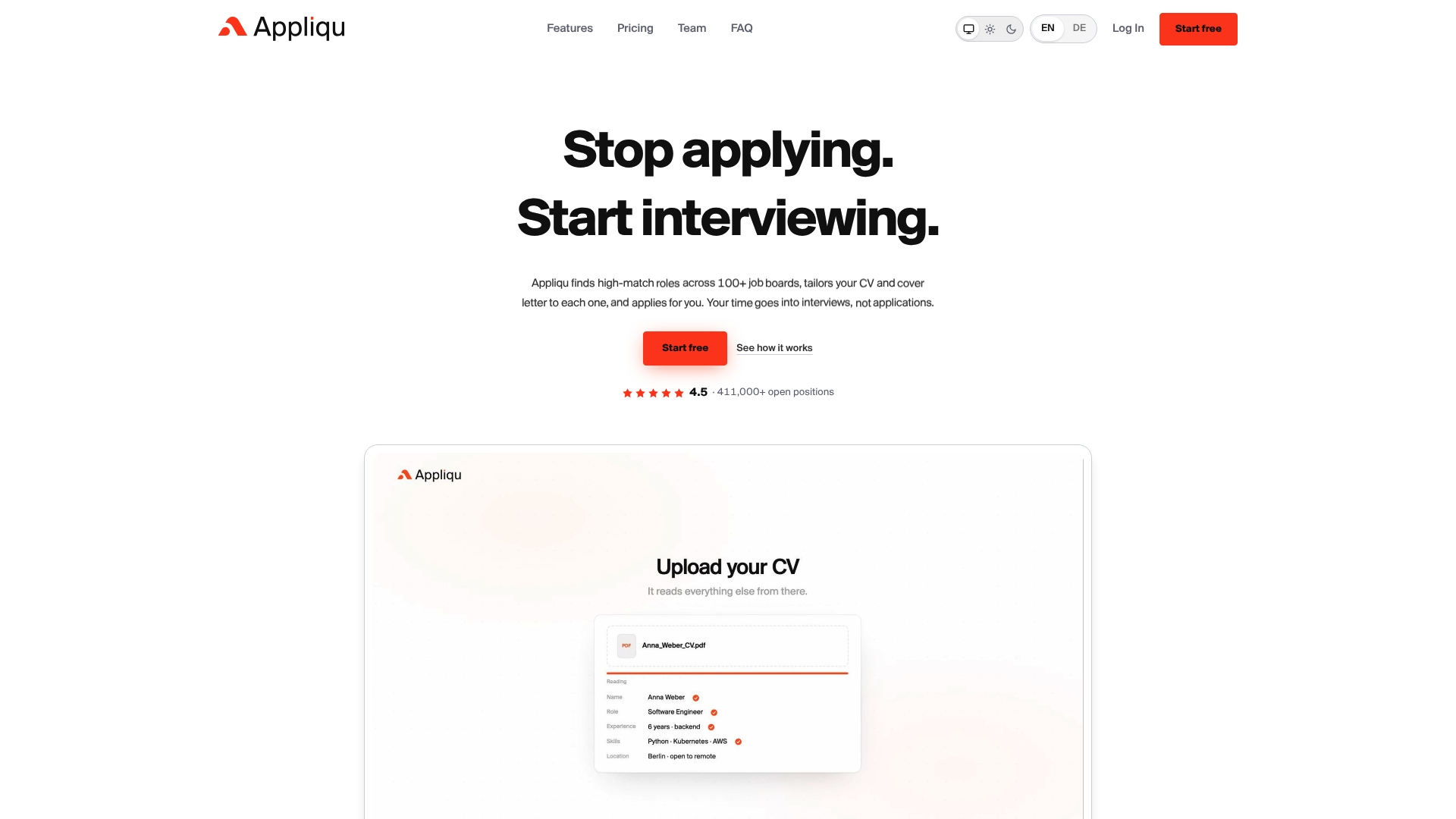
You can compare the plans on the Appliqu website and start with Explorer.
FAQ
How soon is too soon to follow up?
Anything within the first few days is generally too early. Robert Half suggests no sooner than a few days, and JobStreet warns that a message within three days can be counterproductive. A week is the earliest comfortable point, and two weeks is safer when no timeline is given.
How do I professionally say I am following up?
State it plainly in the opening line: you applied for a named role on a given date and you are writing to ask about the next step. Keep the tone polite and direct, and avoid apologising for writing. The templates above show the wording in full.
Should I follow up if the posting says not to contact the employer?
No. Instructions such as "no calls or emails" or "only successful candidates will be contacted" should be respected, as both Larimer County and Goucher College advise. Use the waiting time to apply for other roles, and watch your inbox and spam folder for any reply.
How many times can I follow up?
One follow-up is the standard, according to WayUp and ApplyArc. In slow processes with a published timeline, such as academic recruitment, jobs.ac.uk suggests a second attempt about two weeks after the first. After that, move on to other applications.
Can I follow up on the phone?
Yes, if the posting allows it and you have a number for the right person. Email is still the safer first choice because it is easier for the employer to answer on their own schedule. If you do call, keep it short and ask only about timing and next steps.
Sources
- How To Follow Up on a Job Application, Indeed
- Follow Up and Communication With Employers, Larimer County CareerRise
- Following Up, UNLV Career Services
- Following Up With Employers, Northwestern CareerSpace
- How to follow up on job applications, jobs.ac.uk
- The right way to follow up on a job application, JobStreet
- Correspondence Templates, Goucher College
- How to Follow Up on a Job Application, Robert Half
- Always Follow Up, UC Santa Barbara Career Services
- Silence in the Inbox, WayUp
- When to Follow Up on a Job Application, ApplyArc
- Applying for a Job on Indeed, Indeed Help Center