Start With 5 Free Drafts: Job Application Bot for German Jobseekers

Yes, a job application bot can genuinely automate and personalise your job search, but only when you feed it accurate information and check what it produces before it lands in an inbox. Appliqu is built for exactly this: semantic matching across job boards, tailored CVs and cover letters, and a review step you control. The caveat matters as much as the promise. Automation without a fact check is how good applications go wrong at scale.
TL;DR:
- Automation saves time by generating tailored applications quickly, but unchecked outputs can produce flat, generic language that employers may detect.
- Using a detailed fact sheet and reviewing initial applications in on-approval mode helps prevent profile contamination and fosters authenticity.
- Privacy concerns are minimized by sharing only necessary data and choosing services with strong GDPR compliance, especially if applying from Europe.
- The most cost-effective plan depends on volume, with the Core plan suitable for most job seekers and the Pro or Concierge plans for high-volume or strategic applications.
- Automation is best suited for volume-driven job searches and should still involve personal oversight to maintain a genuine voice.
Table of Contents
- How does a job application bot actually work?
- What does automation save you, and where does it fail?
- How do you protect your data when a service applies for you?
- How do you set up Autopilot or on-approval mode safely?
- What does each Appliqu plan actually unlock?
- Alex's view: when automation earns its place
- Try Appliqu without committing to anything upfront
- Where this guidance comes from
- Sources
- FAQ
How does a job application bot actually work?
Most confusion about this technology comes down to one distinction: semantic matching versus keyword matching. A keyword system scans a job advert for terms like "project management" or "SAP" and scores your CV against them. Semantic matching reads the whole job description, the tone, the seniority signals, the implied culture, and compares that against your full profile rather than a handful of terms. Appliqu uses this whole-description approach, which is why it can surface roles a keyword scanner would miss entirely, such as a position titled "Growth Lead" that is functionally a marketing manager job.
The pipeline behind this generally runs in four steps:
- Import your profile. Your CV, work history, qualifications and preferences become the source data.
- Discover roles. Appliqu searches across more than 100 job portals, continuously rather than on a fixed schedule.
- Generate tailored documents. A CV and cover letter are drafted for each specific role, not recycled from a template.
- Preview or send. You choose "on approval" mode, where nothing goes out until you say so, or Autopilot, where the process runs unattended once you trust it.
What gets automated is the drafting, matching and form filling. What doesn't change is the underlying truth of your CV. A job application tracker works differently again, since it organises applications you've already written rather than generating new ones, so the two tools solve different problems.
What does automation save you, and where does it fail?
The upside is straightforward: volume without burnout. Writing a genuinely tailored cover letter for each of 40 applications by hand takes most people an entire week of evenings. Automation compresses that into minutes of generation time plus a review pass, which is the whole appeal of a job application automation tool in the first place.
The risks sit on the other side of that same coin.
- Generic tone. Unreviewed AI text can sound flat, and employers increasingly notice this pattern.
- Detection and policy breaches. Official recruitment guidance from the Civil Service is explicit that employers expect applications to be accurate and authentic, and may reject ones that misuse AI.
- Profile contamination. One wrong detail in your master profile (a mistaken job title, an old salary figure) gets copied into every application the automation generates afterwards.
JobHelp's official guidance makes the same point from a different angle: AI is genuinely useful for finding vacancies and tailoring letters, but it can introduce inaccuracies, so checking outputs and keeping your own voice matters more as volume increases.
Pro Tip: Before you scale up sending, generate five applications and read them aloud. If a sentence sounds like nobody, that's the sentence to rewrite.
How do you protect your data when a service applies for you?
Handing your CV, contact details and work history to any automated service means thinking about what you're sharing and where it goes.
- Know what's being collected. A job application bot typically needs your CV, contact information, work history and preferences, not your bank details or national insurance number, so treat any request for the latter as a red flag.
- Use a dedicated email address. Separating job-search correspondence from your personal inbox limits exposure if an account is ever compromised.
- Avoid handing over full account credentials where a service offers a limited-access alternative. The fewer passwords you share, the smaller the blast radius of any single mistake.
- Read the privacy policy before you commit, specifically the data-retention section. How long is your CV stored after you cancel? Is it shared with third parties?
- Favour services built with EU data protection in mind. Since GDPR sets stricter rules than many other jurisdictions on consent and storage, a reputable European service is answerable to that standard by default, which is worth checking if you're applying from Germany, Austria or Switzerland.
How do you set up Autopilot or on-approval mode safely?
Treat the first week as calibration, not a launch.
- Build a fact sheet first. List your verified dates of employment, job titles, qualifications, languages, locations and salary expectations in one place. This becomes the single source of truth the automation reads, which is the single best defence against profile contamination.
- Start in on-approval mode. Nothing sends until you approve it, so this is where mistakes get caught for free.
- Read the first five generated applications line by line. Check the five spots that most often carry copy-forward errors: dates and tenures, employer names, qualification titles, location or eligibility fields, and salary figures.
- Edit for voice, not just accuracy. A tailored cover letter should still sound like you wrote it. Adjust phrasing that feels too smooth or too generic.
- Verify form fields before sending, particularly free-text boxes that ask unusual questions, since these are where automation is most likely to guess wrong.
- Move to Autopilot only once five to ten reviewed applications have come back clean. Keep monitoring afterwards. Pause it the moment you spot an error pattern rather than waiting for it to self-correct.
Pro Tip: Re-check your fact sheet every time your circumstances change, a new qualification, a changed salary expectation, a different notice period. An outdated fact sheet is the most common source of contamination, and it's entirely avoidable.
National guidance on writing a CV reinforces the same principle from the manual side: tailor each application to the specific role rather than sending one CV everywhere, whether a person or an automation does the tailoring.
What does each Appliqu plan actually unlock?
Appliqu runs on four tiers, and the difference between them is mostly about volume and support, not core functionality.
- Explorer is a permanent free tier. Appliqu writes 5 applications, so you can test the tailoring quality before spending anything.
- Core, at 29.90 EUR per month, is where sending starts, unlocking 100 applications.
- Pro, at 69.90 EUR per month, raises that to 300 applications and adds the Appliqu Job Board.
- Concierge, at 199 EUR per month, offers unlimited applications plus a session with a senior consultant.
All prices include 19% VAT. If you're applying to a handful of roles a month, Core covers most job-changers comfortably. If you're running a wide, high-volume search, whether that's a career change, a return from parental leave, or an international relocation, Pro's 300 applications and job board access earn their cost. Concierge suits anyone who wants a second, human, pair of eyes on strategy alongside the automation itself.
Alex's view: when automation earns its place
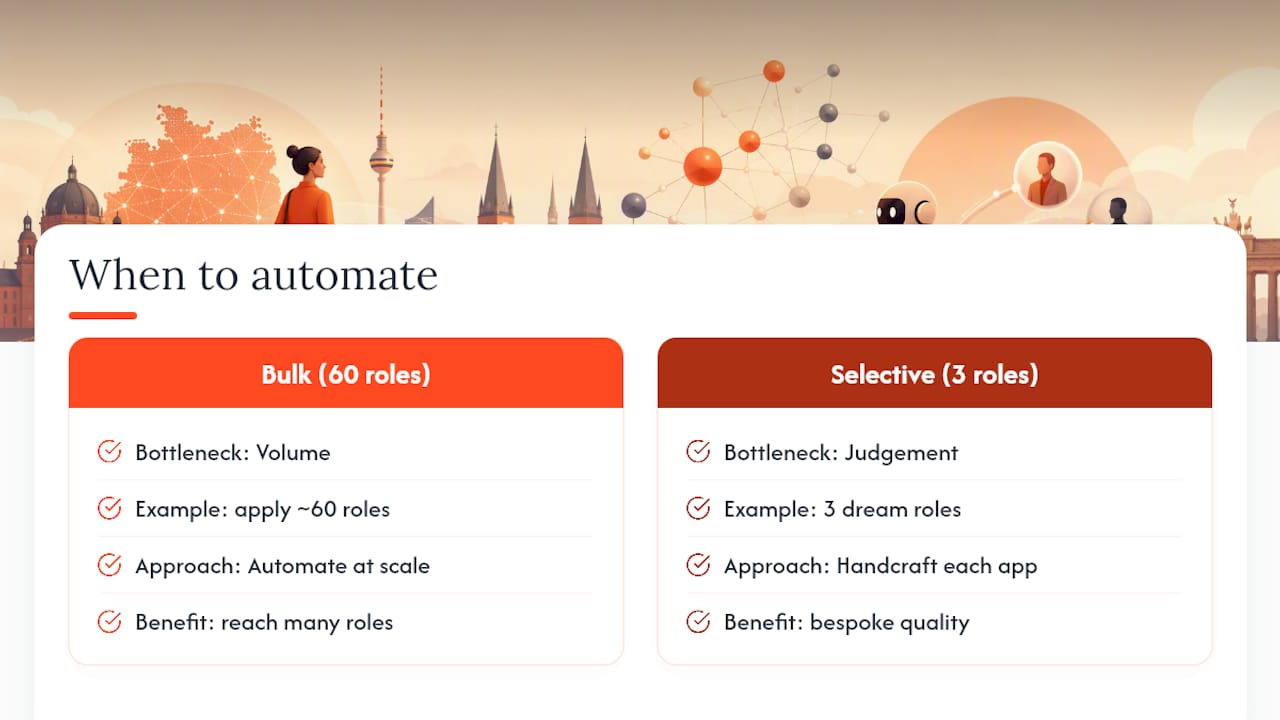
Automation is the right call when the bottleneck is volume, not judgement. Applying to 60 roles by hand, most of them a reasonable fit, is where a job application bot genuinely changes what's possible for someone with a full-time job and a Sunday evening to spare. It's the wrong call when you have three dream roles and one shot at each; that situation rewards a slow, handcrafted application over speed.
The thread running through every recommendation here is authenticity under control. Automation should sound like you, on your worst Tuesday, not like a system pretending to be you. Get that balance right and scale stops being a risk.
Alex
Try Appliqu without committing to anything upfront
Everything covered here, semantic matching against full job descriptions, round-the-clock searching across more than 100 portals, tailored CVs and cover letters, and a choice between on-approval review and Autopilot, is what Appliqu was built to do. The difference between Appliqu and a manual spreadsheet-and-template approach isn't just speed; it's that every application still gets your input before anything ships, not after something goes wrong.

Start with Explorer and let Appliqu write 5 applications at no cost, enough to judge the tailoring quality for yourself. When you're ready to actually send, Core unlocks that at 29.90 EUR per month for 100 applications. If your search grows from there, Pro and Concierge are waiting with more volume and more support. There's no trial to sign up for and no expiry date on Explorer, so the only real decision is when you want sending to start.
Where this guidance comes from
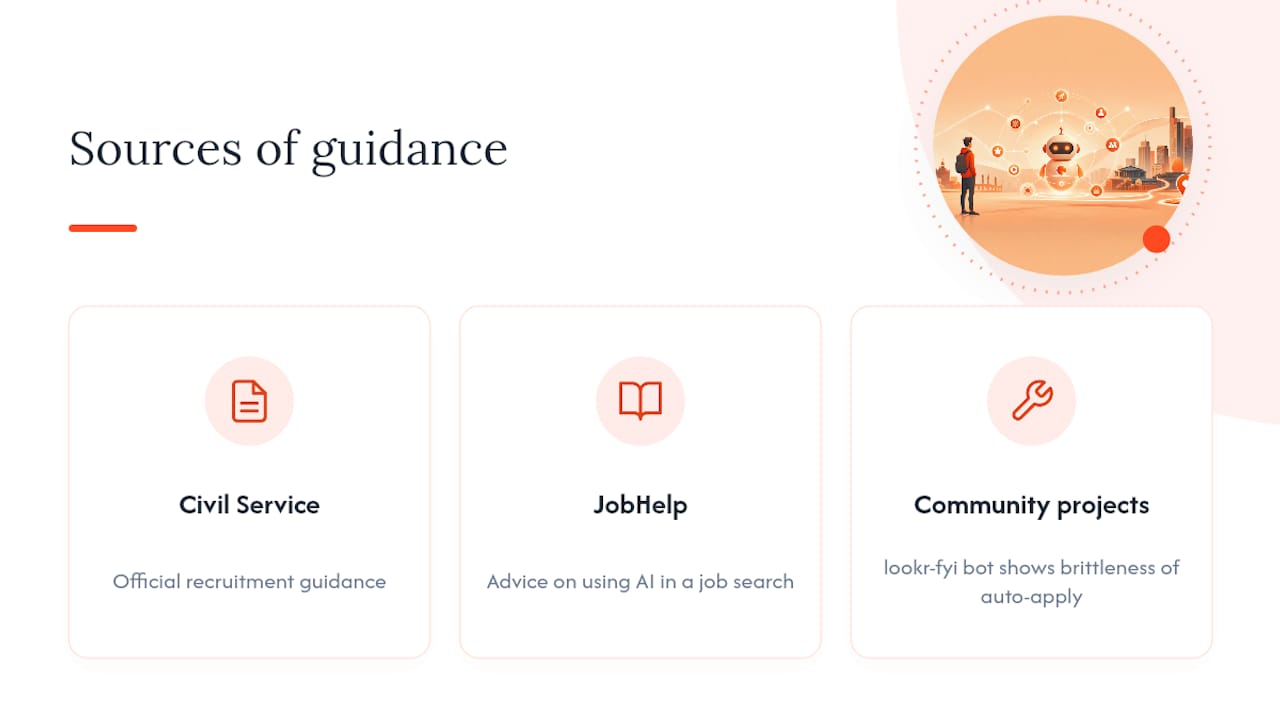
This guide draws on the Civil Service's official recruitment guidance, JobHelp's advice on using AI in a job search, and community experiments like the lookr-fyi job-application-bot project, which illustrates just how technically brittle universal auto-apply attempts can be outside a dedicated service.
Sources
- Artificial intelligence and recruitment | Civil Service Careers
- Using Artificial Intelligence (AI) in your Job Search - JobHelp
- lookr-fyi/job-application-bot-by-ollama-ai
FAQ
Is there an AI that can apply for jobs on your behalf?
Yes. Appliqu searches across more than 100 job portals and generates tailored CVs and cover letters for each match, sending them either on approval or through Autopilot once you trust the output. Explorer, its free tier, lets Appliqu write 5 applications before you decide whether to unlock sending with Core.
Can employers tell if you used AI on your CV?
Employers can often spot generic, unedited AI text, which is why official recruitment guidance stresses that applications must stay accurate and authentic. Reviewing and personalising every AI-drafted application before sending is the reliable way to avoid that impression.
Can you use ChatGPT to write a job application?
You can, and many people do use general AI chat tools to draft a cover letter or polish a CV. The JobHelp guidance recommends checking every output carefully, since general tools don't verify facts against your actual work history the way a dedicated fact sheet does.
What is a job application bot, exactly?
It's a service that finds job openings matching your profile, drafts a tailored CV and cover letter for each one, and either submits them for you or waits for your approval first. The term covers everything from simple form fillers to fuller services like Appliqu that combine semantic matching, document generation, and tracking.
How much does Appliqu cost?
Explorer is free permanently and includes 5 written applications. Sending starts with Core at 29.90 EUR per month for 100 applications, Pro is 69.90 EUR per month for 300 applications plus the Appliqu Job Board, and Concierge is 199 EUR per month for unlimited applications plus a senior consultant session, all prices inclusive of 19% VAT.