Application Organiser: Every Job, CV Version and Follow-Up

A good application organiser holds four things in one place: every role you applied for with its status, the exact CV and cover letter you sent, the date to follow up, and a final check before anything is submitted. Appliqu covers all four. It searches, scores and applies for you, tailors each CV and cover letter, and keeps every application in one place, connected to your inbox so replies and interview invitations appear next to the right role.
This guide explains what an organiser has to record, how to manage several CV versions without losing track, when to follow up, and what to check before you send. It is written for people applying while employed, for graduates and career changers, and for anyone applying in English across borders.
TL;DR
- An application organiser needs one record per application: company, role, date, status, the CV version sent, contact, follow-up date and notes.
- Keep one master CV and tailor a version for each role. The organiser must show which version went where.
- Follow up about 7 to 10 days after applying if there is no reply, and review the whole list on a fixed day each week.
- Check the CV, cover letter, file format and contact details before submission. In Appliqu's on approval mode, you approve each application yourself.
- Appliqu applies for you in the employer's own form and keeps every application in one place. Explorer is free and Appliqu writes 5 applications there.
Table of Contents
- Why an organiser matters more than it used to
- What a job application organiser must record
- Managing different CVs for different jobs
- Reminders and follow-ups
- Review before you submit
- From organising to applying: what Appliqu takes over
- Appliqu plans
- Our perspective
- FAQ
- Sources
Why an organiser matters more than it used to
Applying has become a volume problem. CNBC reported in April 2026 that LinkedIn sees roughly 8,200 applications submitted every minute, and that 38% of US job seekers told the platform they were applying to more jobs than ever while hearing back less often. The figures describe the United States, but the pattern is familiar to job seekers in most markets: more applications, more versions of your documents, more loose ends.
Without a record, the loose ends cost you. You forget which CV went to which employer. You cannot remember whether you already applied to a role you saw again on another job board. A recruiter calls and you cannot recall what the advert asked for.
There is also a psychological side. In the same CNBC article, Mindy Shoss, an organisational psychology professor at the University of Central Florida, said tracking helps applicants maintain a sense of control and structure in a difficult market, and helps them start seeing patterns in their search. A search that is visible on one screen is easier to steer than one scattered across tabs, emails and notes.

What a job application organiser must record
Whatever form it takes, an organiser is only as useful as the fields it keeps. Each application should carry:
- Company and job title. Include the link to the original posting, because adverts are often removed once the role closes.
- Date applied. Every follow-up date is calculated from this.
- Status. For example: saved, applied, replied, interview, offer, rejected, no response.
- CV and cover letter version. The exact documents sent, not the master copy.
- Contact details. The recruiter or hiring manager, if known.
- Follow-up date. The day you plan to act if nothing has arrived.
- Notes. Salary range, interview questions, impressions of the process.
This matches the structure recommended by Danaher's jobs blog: one tracker with a record per application containing company, title, date, status, contact, follow-up date and notes.
The difficulty is not the design. It is the upkeep. Each field needs updating by hand after every application, every reply and every rejection, and the habit usually collapses in the second or third week, when you are busiest. Appliqu removes that upkeep: it applies for you, so the application is recorded as it is sent, and because it connects to your inbox it detects replies and interview invitations and shows them in the same list.
If you want a weekly routine around your list, our guide to application tracking you will actually use sets out a 15 minute review. For the measures worth watching, see job application tracking metrics.
Managing different CVs for different jobs
The question behind "different resumes for different jobs" is simple: how do you tailor without creating chaos? The approach recommended by the University of Colorado Boulder's graduate career guide is to keep a comprehensive master CV and create tailored versions from it, choosing the responsibilities most relevant to each opportunity and quantifying achievements where you can.
That gives you a clear structure:
- Master CV. Everything: every role, project, skill, certificate and achievement. You never send it as it is.
- Role versions. A shorter document built from the master for each type of role, with the summary, skills and achievements reordered to match the advert.
- Version label. A short name that goes in your organiser, such as "Operations Manager, logistics, Nov".
What to change in each version
Tailoring does not mean rewriting the whole CV. Robert Half's guidance on tailoring a CV suggests studying the advert for required skills, experience, systems and repeated wording, then personalising the summary, placing the most relevant skills near the top, leading each role with its strongest achievements and giving less space to older or less relevant work.
The emphasis also depends on the type of role. A Harvard Graduate School of Arts and Sciences guide notes, for example, that applicants should stress practical research and internships for industry roles, quantitative analysis for investment banking, and leadership or teamwork for consulting. Career changers and graduates can use the same logic: pick the evidence your target employer values, even if it came from a different field or from study.
Where version management goes wrong
- Overwriting the master. You edit for one role and lose the original wording.
- Unlabelled files. Six files called "CV final" and "CV final 2".
- No link between version and employer. At interview you cannot recall what you claimed.
- Stale versions. A new qualification or job is added to one version and not the others.
Appliqu works from your profile. It scores every role against it with semantic matching, adapts your CV for the role and writes a tailored cover letter for each application, so each employer receives an individual application rather than a mass mailing. You edit your CV together with Appliqu, and the version sent stays attached to the application in your list. For a closer look, read how AI can tailor your CV for every application and how to analyse a job description in 15 to 18 minutes.
Reminders and follow-ups
Most organisers fail at reminders. Recording an application is easy. Remembering to act on it eight days later is not.
The Danaher jobs blog recommends a structured schedule: follow up 7 to 10 days after applying if there is no response, send a thank-you within 24 hours of an interview, and contact networking connections within 3 to 5 days. These are one employer's recommendations rather than rules, but they give you a reasonable default.
A workable reminder routine looks like this:
- Set a follow-up date when you apply, not later.
- Choose one fixed day each week to review every application with a status of "applied" and no reply.
- Write a short follow-up that names the role, the date you applied and one reason you fit.
- Record each follow-up in the notes so you do not send two in the same week.
- After a set period with no answer, mark the application as closed and move on.
Because Appliqu connects to your inbox and detects replies and interview invitations, you see at a glance which applications have an answer and which are still waiting, without searching your email. That makes the weekly review a matter of minutes.
Review before you submit
The phrase "application review mode" describes a simple principle: nothing leaves your hands until it has been checked. Official guidance is consistent on what to check. The US Department of Labor's Resume Essentials guide (February 2026) says a CV should include keywords from the job posting, a clear targeted summary and achievement statements, be proofread, be saved in the required format and carry a professional filename.
Use this checklist before every submission:
- The CV and cover letter are tailored to this role and this employer.
- Keywords and achievements from the advert appear where they are true.
- Dates, names and contact details are correct.
- Spelling and grammar are correct. The University of Queensland's employability guide recommends plain business English, no unexplained abbreviations and one main idea per paragraph.
- The file format and the submission instructions match what the employer asked for.
- Attachments are complete and no text from another application remains.
That last point matters. CPA Alberta's 2022 handbook lists using the same cover letter for every job, being generic, and failing to correct grammar and spelling among common mistakes.
In Appliqu you choose how much control you want. In on approval mode, you approve every application yourself before it is sent. On Autopilot, Appliqu applies on its own. Many people begin with on approval mode to see how their applications read, then move to Autopilot for the roles that clearly fit.
From organising to applying: what Appliqu takes over
A tracker records what you have done. It does not search, write or submit. Appliqu takes over the whole process instead of single steps:
- It searches more than 1.5 million jobs from over 500 sources, including company career pages.
- It scores every role against your profile with semantic matching.
- It writes a tailored cover letter for each role and adapts your CV.
- It applies in the employer's own application form, just as you would yourself.
- It connects to your inbox, detects replies and interview invitations, and keeps all your applications in one place.
If you wonder how this differs from a simple list, a comparison of a job application tracker and an AI agent explains it in detail. To see how wide the search reaches, read about multi job board search.
Quantity is not the goal. A market driven job search with three focused applications rather than thirty is often the better plan, and with on approval mode you decide which applications go out.
Appliqu plans
Explorer is free permanently, and Appliqu writes 5 applications there. Sending applications starts with Core. Prices include VAT where applicable.
| Plan | Price | Applications | Also included |
|---|---|---|---|
| Explorer | €0 per month | 5 written | Permanent free plan |
| Core | €29.90 per month | 100 | Sending applications |
| Pro | €69.90 per month | 300 | Appliqu Job Board |
| Concierge | €199 per month | Unlimited | Senior consultant session |
If you are applying while employed and have only evenings free, Core covers the routine. If you are changing field and want a wider search, Pro adds the Appliqu Job Board. Graduates and students can start on Explorer and see five applications written for their profile before choosing a plan.
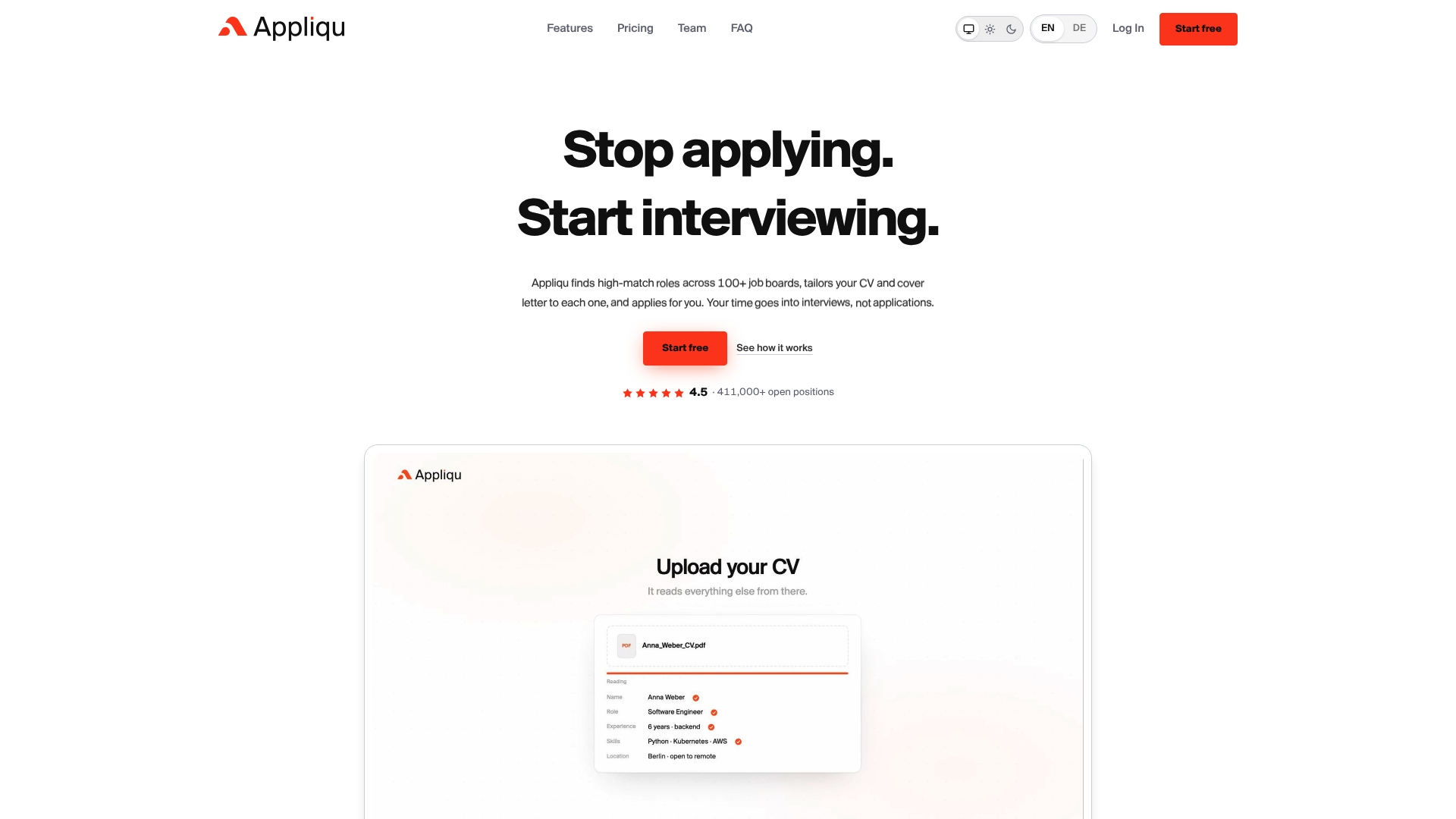
Start with Appliqu's plans and set up your profile once. Appliqu then searches, writes and applies for you.
Our perspective
Most job seekers do not struggle with a lack of effort. They struggle with scattered effort: a CV copied six times, a cover letter edited at midnight, a reply buried in an inbox.
We built Appliqu on the view that organising is part of applying, not a separate chore. When the same system that finds the role also writes the cover letter, adapts the CV, applies in the employer's own form and watches your inbox, the record is never out of date, because it is created by the work itself.
Control matters as much as speed. That is why you choose between on approval mode, where you approve every application, and Autopilot, where Appliqu applies on its own. Every application is individual, with no mass emails, and you edit your CV together with Appliqu.
Your time is better spent on interviews, networking and deciding which roles you want, and Appliqu is designed to take the rest off your hands.
Niclas Fischell
FAQ
What is a job application organiser?
It is a single record of every role you have applied for, with its status, the documents you sent, contact details and follow-up dates. Appliqu keeps all your applications in one place and detects replies and interview invitations in your inbox, so the record updates as the search moves.
How many CV versions should I keep?
Keep one master CV containing everything, and create one tailored version per type of role, as the Colorado guide suggests. Label each version and record it against the application. Appliqu adapts your CV for each role and keeps the version sent with the application.
When should I follow up on an application?
A common recommendation is 7 to 10 days after applying if there has been no reply, as Danaher's jobs blog advises. Set the date when you apply, and check your list on a fixed day each week.
Can I approve each application before it is sent?
Yes. In on approval mode you approve every application yourself. On Autopilot, Appliqu applies on its own. Sending applications starts with the Core plan.
Can I use Appliqu for free?
Yes. Explorer is a permanent free plan on which Appliqu writes 5 applications. Core, Pro and Concierge add sending applications, a higher volume and extra services.
Sources
- CNBC: For some job seekers in a tough market, spreadsheets bring a sense of control (9 April 2026)
- Danaher jobs blog: How to keep track of job applications
- University of Colorado Boulder: Grad student and postdoc career guide
- Harvard Graduate School of Arts and Sciences: resume guide
- Robert Half: How to tailor your resume
- US Department of Labor: Resume Essentials Participant Guide (February 2026)
- University of Queensland: Employability and career preparation guide
- CPA Alberta: Cover letter and resume handbook (2022)
Recommended
The all-in-one career platform.
Appliqu finds matching jobs, rewrites your CV & cover letter for every single one and applies for you.
- Appliqu writes every application to an exceptional standard.
- You approve. Appliqu sends.
- Everything at a glance. Stay relaxed.
No credit card needed.
4.5 on Trustpilot · Cancel anytime


