Why You Want to Leave Your Current Job: Reasons and Answers

People leave jobs for a small number of recurring reasons: pay, lack of progression, feeling undervalued, poor management, burnout, and a wish for flexibility or a different career. Knowing which of these applies to you does two things. It tells you whether leaving is the right decision, and it gives you an honest, forward-looking answer for the interviewer who will ask, "Why are you leaving your current job?" This guide covers both: the reasons, the test for whether it is time to go, and the wording that works in an interview.
TL;DR
- The most cited reasons for leaving are pay, no route to advancement, feeling disrespected or undervalued, and poor work-life balance. In the UK, higher salary comes first in CIPHR's February 2026 survey at 36%.
- Before you resign, decide whether the problem is individual, interpersonal or structural. Structural problems rarely change on their own.
- Employers ask the question to check consistency, culture fit and how you talk about conflict. They are not looking for a confession.
- A good answer is honest, takes two or three sentences, and spends more time on what you are moving towards than on what you are leaving.
- Appliqu searches, scores and applies for roles while you are still employed, so your search does not cost you evenings.
Table of Contents
- The most common reasons for leaving a job
- How to tell whether it is time to leave
- Why employers ask why you are leaving
- How to answer "Why are you leaving your current job?"
- How to resign properly once you have an offer
- Searching while you are still employed
- Perspective
- Applying while you decide: what Appliqu does
- FAQ
- Sources
The most common reasons for leaving a job
Research from several countries lists the same themes in a slightly different order. The figures below come from different surveys with different samples, so read them as indications of what is common, not as one ranking.
In the UK. CIPHR's February 2026 infographic reports these reasons for seeking a change:
| Reason | Share of respondents |
|---|---|
| Higher salary | 36% |
| Lack of recognition | 24% |
| Wanting a more rewarding job | 23% |
| Lack of growth | 22% |
| Better work-life balance | 17% |
| Greater job security | 13% |
In the United States. Pew Research Center's survey of workers who quit a job in 2021 found that low pay and no opportunities for advancement were each cited by 63%, and feeling disrespected by 57%. Among parents with children under 18, 48% cited childcare issues. Insufficient flexibility, inadequate benefits, too many or too few hours and relocation also appeared.
In employer exit data. The Work Institute's 2026 Retention Report found that career-related reasons have been the number one reason for leaving since 2011, cited by 19.2% of exited employees. It also classifies nearly three-quarters (74.69%) of all reasons for leaving as preventable.
Across these sources, the reasons group into five areas.
1. Pay and benefits
Salary is the most direct reason and the one people most often feel awkward about. It is legitimate. The question is how you word it, which is covered below.
2. Progression and learning
If you have stopped learning, or the next step is blocked because nobody above you is moving, the role has a ceiling. Indeed's guide to reasons for leaving lists needing more challenge, seeking growth and wanting a clearer structure among the common voluntary reasons.
3. Recognition and management
Feeling undervalued, receiving little feedback or working under a manager you cannot work with are among the most common reasons people give. These are interpersonal problems, and they are the hardest to describe in an interview without sounding critical.
4. Wellbeing, flexibility and work-life balance
Burnout, long hours, a commute that no longer fits your life, or a lack of remote flexibility all belong here. In a Robert Half survey of U.S. workers planning to look for a new job, 28% cited a wish for more remote flexibility. If this is your reason, our guide to jobs with work-life balance explains how to find roles that fit.
5. Direction and circumstances
A career change, a restructure, a redundancy, relocation or a change in family circumstances are reasons that do not point at your employer at all. They are also the easiest to explain.
How to tell whether it is time to leave
Wanting to leave on a bad Monday is different from needing to leave. Three questions help you separate the two.
Is the problem individual, interpersonal or structural?
Harvard's Division of Continuing Education advises examining which of these three it is before deciding. Individual problems, such as a skills gap or a mismatch in how you work, can often be addressed in your current role. Interpersonal problems depend on the people involved. Structural problems include low pay, limited benefits, poor communication and few project opportunities, and they sit outside your control. The same source suggests that if you remain unhappy after considering how to address the issue, or if your wellbeing or personal life is suffering, it may be time to move on.

Is this a rut or a pattern?
G2's guide to when to quit distinguishes a temporary rut from a likely need to leave. Time off may briefly restore someone in a rut. Persistent dread, loss of trust, problems that stay the same despite your requests, and emotional disengagement make a stronger case for moving on.
Are you at the right organisation, in the right role, heading where you want to go?
The Harvard Business Review podcast on quitting recommends assessing exactly these three points. It also names reasons to consider staying: learning, development, reputation, respect and a useful network. If you can answer yes to all three, the better move may be a conversation with your manager. If you answer no to two or more, you have a case for a search.
A short decision check
- Write down the single biggest reason you want to leave.
- Classify it as individual, interpersonal or structural.
- List what you have already tried to change it, and the result.
- Name what the next role must have that this one does not.
- Check whether your shortlist of target roles actually contains that feature.
Step 5 matters more than it looks. If a new role contains the same feature you say you are escaping, Ask a Manager notes that the explanation may undermine your application. It will also undermine your next year.
Why employers ask why you are leaving
The question is standard because the answer reveals more than the stated reason. Sources agree on what interviewers are assessing.
- Career goals and motivation. Robert Half says employers want to understand your career goals, what creates satisfaction and engagement for you, whether you are leaving on good terms and what you want from the new role.
- Consistency, fit and red flags. Glassdoor describes three checks: whether your answer matches your CV and references, whether your reason hints at what you value, and whether you show blame or bitterness that signals how you handle conflict.
- Judgment. Ask a Manager adds that candidates who overshare or attack a former employer reveal poor judgment, and that interviewers test whether the new role actually addresses your stated concern.
The practical reading is simple. The interviewer is not trying to find out whether your employer is flawed. They are trying to find out whether you will be a good colleague and whether this job will keep you.
How to answer "Why are you leaving your current job?"
The consistent advice from Glassdoor and Indeed is to be honest, keep the answer to two or three sentences, and focus on what you are moving towards rather than what you are running from. Hays UK suggests starting with what you learned in your current role, then explaining the development you want, then connecting it to the opportunity in front of you.
A three-part structure
Revarta's Push-Pull-Bridge framework gives a usable proportion:
- Push (about 25%). Acknowledge briefly what you are moving away from, without criticising your employer.
- Pull (about 50%). Name what you are moving towards.
- Bridge (about 25%). Connect the two with a sentence that shows the move is deliberate.
Worked examples
The wording below is an illustration of the structure, not a script to read out. Replace the specifics with your own.
Limited progression. "I have learned a great deal in my current role, particularly in managing client accounts. The team structure means there is no step up available in the near term, and I am ready for more responsibility. This role includes leading a small team, which is the direction I want to take."
Pay. "I am looking for compensation that reflects my experience and current market levels. What interests me about your company is the way you pair a clear package with defined routes to advancement." This follows the approach in Robert Half UK's guidance, which links your pay expectation to your research on the target employer. Monster adds that money should not be your sole stated motivation.
Stress and workload. "I want to work somewhere with balanced deadlines and well-planned projects. I do my best work when expectations are reasonable and problem-solving is collaborative, and that is what I have seen of your team."
Career change. Describe a concrete development plan and a long-term goal, so that the move reads as deliberate and not impulsive, as Robert Half's guidance puts it. Name the transferable skills explicitly. Our guide to a career change CV shows how to present them.
Redundancy. Glassdoor suggests a plain statement of fact, such as: due to a company restructuring in [month, year], your role was eliminated. Then move on to what you want next. Do not apologise for something that was not your decision.
Dismissal. Say that you were let go or that you and the employer decided to part ways, and briefly explain what you have changed since. Hays France advises explaining the circumstances, accepting responsibility where appropriate, showing what you learned and describing any training or productive activity afterwards. Keep the explanation consistent with your references.

What to avoid saying
Glassdoor's guidance is to avoid insulting a former employer, boss or client. Phrases such as "my boss was crazy", "it was a toxic work environment" or "the pay was terrible" read as blame and can raise doubts about your loyalty. Management writer Suzy Welch explains in her CNBC advice that interviewers are trying to assess whether you are the problem and not the job, so the aim is to sound mature and positive and to turn the conversation to why you want to join the new company.
Also avoid:
- Vague answers that you cannot support with a detail.
- Reasons that contradict your CV or what a referee will say.
- Describing your current employer's confidential matters.
- Naming a reason that the target role shares.
How to resign properly once you have an offer
The interview answer and the resignation letter should agree. Your notice period is set out in your written statement of employment particulars, and Acas explains how to resign, including how to handle your notice. Check your contract before you hand in anything, and do not resign before you hold a written offer.
Searching while you are still employed
Most people who are leaving a job are still doing it. That limits a search to evenings and lunch breaks, and it is the point at which many people either stall or apply to anything. Two practices keep a search steady:
- Decide what the next role must contain. Use the decision check above to write three non-negotiables, and score every role against them.
- Apply selectively but consistently. Each application should name the role and the employer. Our guide to score roles in 30 minutes a week shows a routine for this, and our piece on job search burnout covers how to keep it sustainable. If the process itself is weighing on you, read our guide to job search anxiety.
If you are unsure which direction to move in, our overview of in-demand careers is a starting point, and career coaching for job seekers explains what a coach covers. When an invitation arrives, follow our job interview preparation plan so that your answer to this question is rehearsed and short.
Perspective
Most advice about leaving a job concentrates on the answer you give in the interview. We think the larger problem comes earlier: the search itself is the part that makes people give up, settle or send the same generic letter to fifty employers.
Appliqu was built around that problem. Appliqu searches more than 1.5 million jobs from over 500 sources, including company career pages, and scores every role against your profile with semantic matching. Appliqu writes a tailored cover letter for each role, adapts your CV and applies for you in the employer's own application form, just as you would do yourself. Every application is individual, and there are no mass emails.
You decide how much control you keep. In approval mode you approve every application yourself. On Autopilot, Appliqu applies on its own. Appliqu also connects to your inbox, detects replies and interview invitations, and keeps all your applications in one place. For someone who is employed and leaving quietly, that means the search continues while your attention stays on your current job and on deciding what you actually want next.
Niclas Fischell
Applying while you decide: what Appliqu does
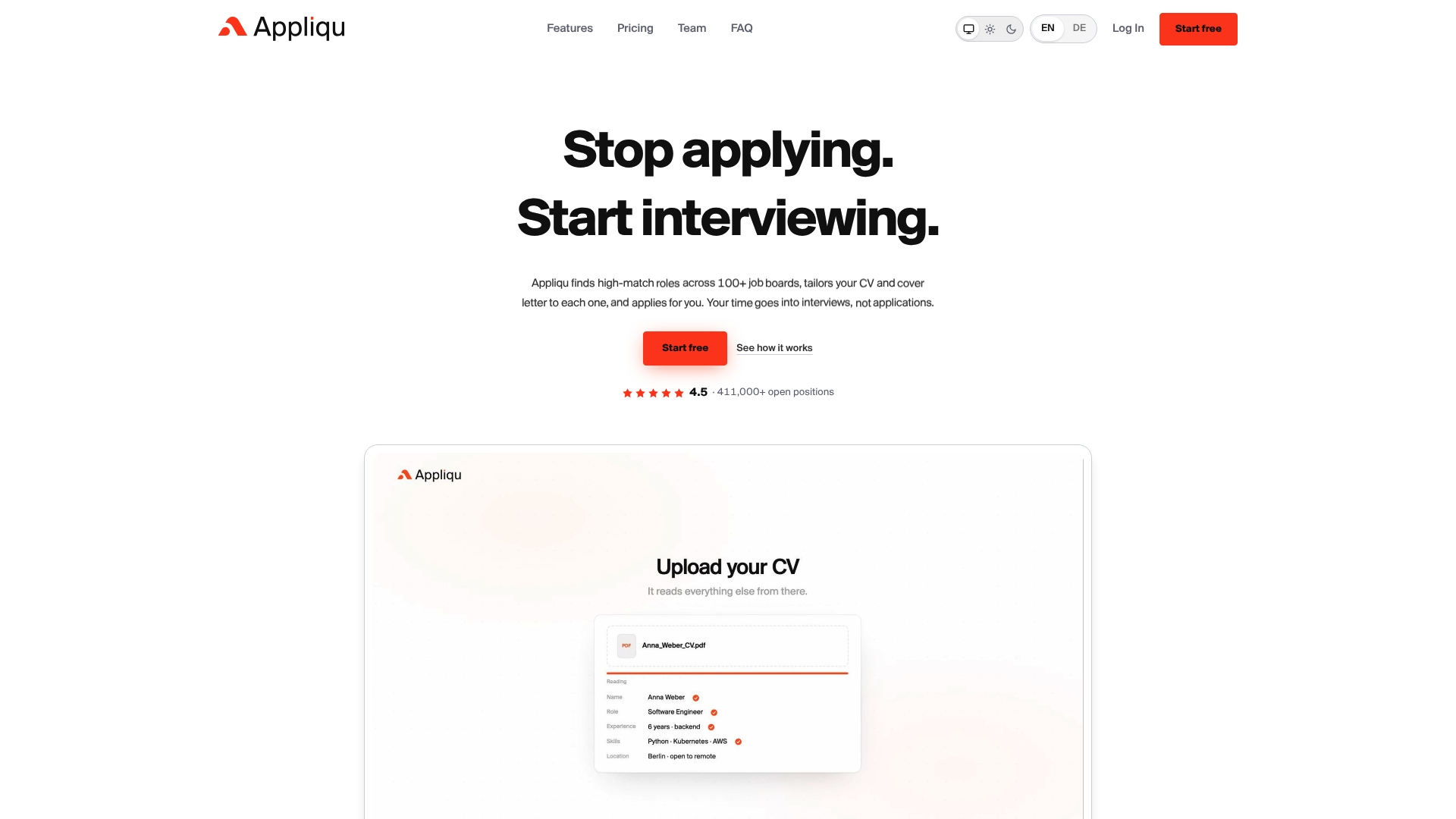
Once you know what you want from the next role, the work is finding it and applying well. Appliqu applies for you: it searches, scores each role against your profile, writes the cover letter, tailors your CV and submits in the employer's own form. You choose between approval mode and Autopilot.
The plans are:
| Plan | Price | What it includes |
|---|---|---|
| Explorer | €0 per month, free forever | Appliqu writes 5 applications. Sending starts with Core |
| Core | €29.90 per month | 100 applications |
| Pro | €69.90 per month | 300 applications, plus the Appliqu Job Board |
| Concierge | €199.00 per month | Unlimited applications, plus a senior consultant session |
Prices include VAT where applicable. See the Appliqu plans to choose one. If you want to see what a tailored letter looks like first, read our cover letter examples, which show three full letters with the job ad.
FAQ
What is a good reason for leaving a job?
A good reason is honest, forward-looking and free of blame. Wanting more responsibility, a clearer route to progression, pay that reflects your experience, a sustainable schedule or a change of direction are all accepted. State the reason in one sentence, then explain what you want from the next role.
How long should my answer be?
Two or three sentences. Glassdoor and Indeed both recommend this length. Give the reason briefly, name what you are moving towards and stop, so the interviewer can ask a follow-up if they want more.
Can I say I am leaving because of the pay?
Yes, if you pair it with other professional motivations and frame it around your experience and market levels. Do not make money the only reason, and do not suggest that your employer underpays. Link your expectation to what you know of the new employer's package and progression.
When is it time to leave without another job lined up?
That depends on your finances, your contract and your health, so it is a decision for you, not a rule. If your wellbeing is suffering, speak to your GP, and if you have a dispute with your employer, Acas offers free guidance on resigning and your rights. Check your notice terms before you act.
How do I explain being made redundant?
State it as a fact, with the month and year and the reason, such as a restructure that eliminated your role. Then move on to what you are looking for. Keep it consistent with your references, and do not apologise.
Sources
- CIPHR: Why employees quit, top 20 reasons
- Pew Research Center: Why workers say they quit jobs in 2021
- Work Institute: 2026 Retention Report
- Indeed: 16 reasons why employees choose to leave their jobs
- Indeed: How to explain why you are leaving your job
- Robert Half: What are your reasons for leaving a job
- Robert Half UK: Why did you leave your last job
- Harvard Division of Continuing Education: Should I leave my job
- G2: When to quit your job
- Harvard Business Review: So you are thinking about quitting your job
- Ask a Manager: What interviewers hope to learn
- Glassdoor: Reasons for leaving a job
- CNBC: Suzy Welch on why you are leaving your current job
- Hays UK: Why are you leaving your current job
- Hays France: Parler de son licenciement en entretien
- Revarta: Why are you leaving your current job
- Monster: Why are you looking for a new job
- Acas: How to resign
Recommended
The all-in-one career platform.
Appliqu finds matching jobs, rewrites your CV & cover letter for every single one and applies for you.
- Appliqu writes every application to an exceptional standard.
- You approve. Appliqu sends.
- Everything at a glance. Stay relaxed.
No credit card needed.
4.5 on Trustpilot · Cancel anytime


